Phillip Patrick of Birch Gold Group recently joined IncomeInsider TV for a deep conversation about gold, inflation, debt, de-dollarization, and the pressures facing retirement savers in today’s economy.
The discussion went far beyond the daily price of gold. Instead, Phillip focused on the bigger picture: what happens when money loses purchasing power, government debt keeps rising, central banks begin shifting reserves, and savers start questioning whether traditional paper assets are enough on their own.
You can watch the full interview here or continue reading the text below:
For readers who prefer to skim the main points, here are the biggest takeaways from the conversation.
Gold Is Not Just About Price, It Is About Trust and Security
When many people think about gold, they think about spot prices, market charts, or headlines about whether gold is up or down. Phillip Patrick encouraged viewers to look at the issue differently.
In his view, gold is not simply a trade or a short-term market story. It is connected to deeper questions about money, trust, purchasing power, and whether the financial system is still working the way savers expect it to work.
He explained that Americans do not experience inflation through charts or government data releases. They feel it when they buy groceries, renew an insurance policy, pay medical bills, or cover monthly utilities. Those real-world expenses are where the loss of purchasing power becomes obvious.
That is why Phillip Patrick believes retirement savers need to think beyond the account balance on a statement. The more important question is whether those dollars will still buy what retirees expect them to buy years from now.
The Dollar Is Not a Fixed Measure of Value
A major point Phillip Patrick made during the interview is that the dollar should not be viewed as a permanent, fixed measure of value.
People often talk about dollars as if they are like inches, pounds, or gallons. But the dollar itself changes in purchasing power over time. A dollar today does not buy what a dollar bought 10, 20, or 40 years ago.
That matters greatly for retirement savers. Many Americans spend decades building up savings in dollar-denominated assets. But if the cost of living rises faster than those savings grow, the saver may still be falling behind in real terms.
Phillip argued that this is one of the reasons gold continues to attract attention. Gold is often viewed as a way to hold value outside the paper currency system, especially during periods when confidence in money, debt, and government policy is being questioned.
Cash Is Useful, But It Has Limits
 The conversation also covered the role of cash. Phillip did not dismiss cash. In fact, he said cash remains important because it provides liquidity, flexibility, and a financial cushion.
Retirees and savers need cash to pay bills, handle emergencies, and avoid being forced to sell investments during periods of market stress. But Phillip drew a distinction between cash as a short-term tool and cash as a long-term store of value.
Cash feels safe because the number does not appear to move. If someone has $100,000 in the bank, they still see $100,000 on the statement. But if prices rise sharply over time, that same $100,000 may buy less than it did before.
That is the hidden risk of holding too much cash for too long. The balance may stay the same, but the purchasing power may quietly decline.
Phillip’s view was not that people should abandon cash. Instead, he suggested that retirement savers should understand what cash is good for and what it is not designed to do. Cash may help with short-term certainty, but it may not protect long-term buying power in an inflationary environment.
Debt Is Not Just a Washington Problem
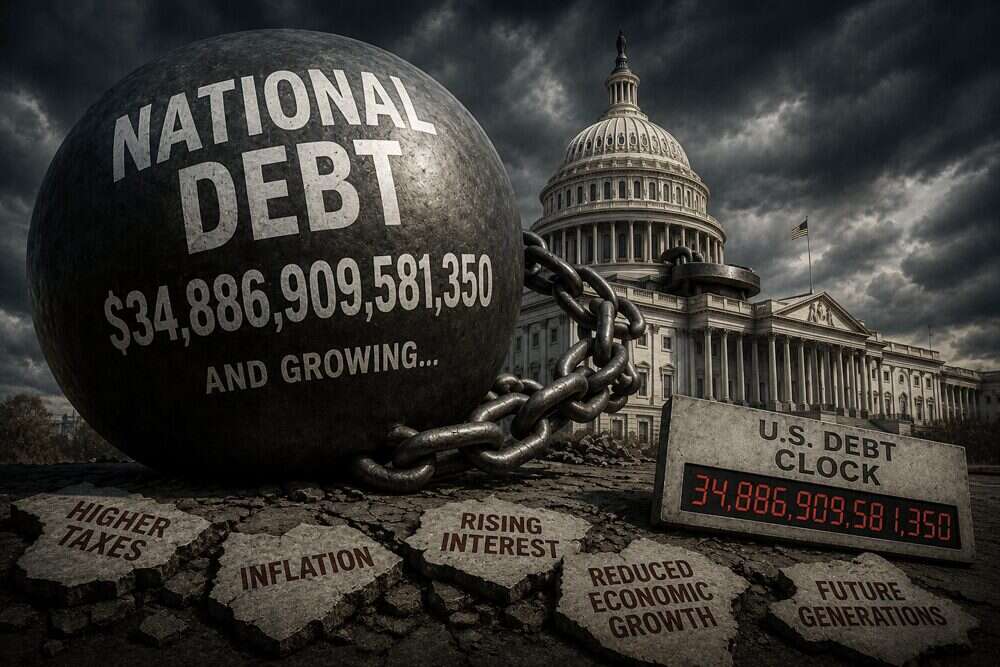
Another major theme of the interview was the national debt. Phillip explained that large government debt can seem abstract. Many people hear numbers like $30 trillion or $40 trillion and tune out because the figures are too large to feel personal.
But according to Phillip, debt eventually shows up in ways that affect ordinary households and retirement portfolios. Rising debt can place pressure on inflation, interest rates, government spending, bond markets, and the Federal Reserve. It can also affect global confidence in the United States as a borrower.
Phillip compared debt to rust. It does not necessarily destroy the structure overnight. Instead, it corrodes slowly. By the time the damage is obvious, the cost of fixing it may already be enormous.
For retirement savers, the concern is that debt can weaken confidence in paper promises. If governments continue borrowing heavily, and if investors begin demanding higher rates to hold that debt, the ripple effects can reach stocks, bonds, cash, and retirement accounts.
Can America Grow Its Way Out of the Debt Problem?
Phillip was careful to acknowledge America’s strengths. He noted that the United States still has deep capital markets, innovative companies, energy resources, and a culture that rewards entrepreneurship. He said he would not bet against America or the American people.
But he also warned that growth alone may not solve the debt problem if the debt continues to grow faster than the economy. That is the key challenge.
A strong economy can help manage debt. But if deficits remain high and interest costs continue rising, even a growing economy may struggle to keep up. Phillip suggested this is one of the most important issues for savers to understand, as it affects the long-term stability of the financial system.
De-Dollarization Is Gradual, Not Instant
Phillip also broke down the meaning of de-dollarization. He made it clear that de-dollarization does not mean the U.S. dollar disappears tomorrow. The dollar is still deeply embedded in global trade, commodities, banking, finance, and debt markets.
But he also said it would be wrong to ignore the gradual shifts taking place. Some countries are trying to reduce their reliance on the dollar. Some are settling more trade in local currencies. BRICS nations have explored alternatives to the dollar-based system. Central banks have also been increasing their gold reserves.
Phillip described de-dollarization as a slow diversification away from dollar dependency, rather than an immediate collapse of the dollar.
That distinction matters. The risk is not necessarily that the global dollar system ends overnight. The risk is that confidence erodes slowly, and the world gradually builds alternatives.
Central Banks Are Sending a Signal
One of the strongest points from the interview was Phillip’s discussion of central bank gold buying. Central banks are not buying gold because of a television ad or a short-term trend. They manage national reserves, which means they must think about safety, liquidity, currency risk, and long-term stability.
Phillip argued that when central banks buy gold year after year, retirement savers should at least ask why. Gold has certain qualities that make it attractive to central banks. It is not issued by another country. It does not depend on a borrower’s promise to repay. It cannot be printed by a central bank. It is widely recognized and traded around the world.
For Phillip, central bank gold buying reflects a broader shift. Large institutions are looking for ways to diversify away from overreliance on paper reserves, especially in a world of inflation, debt, sanctions, and geopolitical tension.
How Gold Can Fit Into a Retirement Savings Strategy

Phillip did not present gold as a replacement for everything else. Instead, he framed it as a diversification tool.
Many retirement savers hold most of their wealth in traditional assets such as stocks, bonds, mutual funds, ETFs, 401(k)s, and IRAs. Phillip’s argument is that physical gold may offer a different kind of exposure because it tends to respond to different forces than paper assets.
He described gold as a potential hedge against currency weakness, inflation, and loss of confidence in the financial system.
But he also made clear that gold should not be treated like a short-term trade. People considering physical precious metals should generally think in terms of years, not days or weeks.
The core idea is not to chase a quick profit. It is necessary to consider whether gold belongs as one piece of a broader retirement strategy.
Education Should Come Before Action
 Birch Gold’s Phillip Patrick repeatedly emphasized education. He said people should not make decisions based on panic, pressure, or fear. In fact, when asked what people should look for in a precious metals company, he said high-pressure sales tactics are a major red flag.
His advice was to learn first. That means reading educational materials, understanding the role of precious metals, researching the risks, and asking questions before moving any money.
Phillip said fear can be dangerous because it pushes people into rushed decisions. The better approach is to become informed, think clearly, and decide whether precious metals make sense based on a person’s own financial picture.
Request a👉 FREE Info Kit and learn how to buy gold the right way!

The Biggest Mistake Is Waiting for a Perfect Signal
Near the end of the interview, Phillip said one of the most common mistakes people make is waiting for certainty. Many people want someone to announce the exact moment when inflation is permanent, the debt is too high, the dollar is in trouble, or the financial system has reached a breaking point.
But markets do not usually work that way. By the time everyone agrees that a problem is obvious, it may already be expensive to protect against it.
Phillip’s message was not to panic. It was to be preemptive. If savers are concerned about debt, inflation, currency weakness, or market risk, they should begin educating themselves before they feel forced to act.
Preparation, Not Panic!
One of the most important themes from Phillip Patrick’s interview was the difference between preparation and panic. He was not arguing that people should abandon traditional investments, move everything into gold, or make fear-based financial decisions. Instead, he encouraged viewers to think more seriously about the risks facing their money.
Inflation, debt, de-dollarization, and central bank gold buying are not isolated topics. They are all connected to the bigger question of how retirement savers can protect purchasing power in a changing financial system.
For Phillip, gold may play a role in that conversation because it sits outside the traditional paper system and has a long history as a store of value.
The main takeaway: retirement savers do not need to panic, but they should pay attention. They should understand the risks, get educated, and consider whether physical precious metals belong as part of a diversified long-term plan.
Request a👉 FREE Info Kit on Gold and learn how to safeguard your retirement!