·
+1-855-222-6993
·
[email protected]We are reader-supported. If you buy through links on our site, we may earn a commission. Learn more.

Thank you for visiting our complete 2026 guide on the best ways to invest in gold and other precious metals. In this guide, we will help you learn how to buy gold like a pro!
We will explain why gold and other precious metals are one of the best investments available to help investors protect their wealth in this volatile economic climate and whether you should consider investing in physical gold, Exchange Traded Funds (ETFs), gold mining stocks, or a Precious Metals IRA.
Our goal is to provide you with the most accurate and reliable information to help you identify the best option to grow and protect your wealth today.
With careful and extensive research, we have reviewed and rated the 8 best precious metals IRA companies of 2026 to help make your decision easier!
👉 See our list of the top 8 precious metals IRA companies (cash sales also available).
With that said, since this is a comprehensive guide, you can use the quick links in the TOC list to jump straight to any section:
Now, let us jump straight to the topic of why you are here: to learn the best way to invest in gold.

Some investors choose to gain exposure to gold through ETFs, mining stocks, mutual funds, futures contracts, or even gold-backed bonds. While each investment option has its own advantages and risks, our extensive research and market analysis have led us to believe that owning physical gold remains one of the most effective and reliable ways to preserve wealth over the long term.
Physical gold offers a level of tangible security that paper-based investments often cannot provide. Unlike ETFs or mining stocks, physical bullion is a real asset with no direct counterparty risk, making it especially attractive during periods of economic uncertainty, inflation, market volatility, or currency devaluation. For many investors, physical gold serves as a long-term store of value and a strategic hedge against financial instability.
That said, every investor has different financial goals, risk tolerances, and investment strategies. That is why this guide explores all the major ways to invest in gold—including physical bullion, Gold IRAs, ETFs, mining stocks, and other alternatives—so you can make a well-informed decision based on your personal objectives.
If you would like to skip ahead and learn why many experienced investors prioritize physical gold and other precious metals for wealth preservation and retirement protection, you can jump directly to that section here. With that in mind, let us begin by exploring why gold has remained one of the world’s most trusted investment assets for centuries.
Despite hope for a bright future with the new Trump administration, remaining inflation, geopolitical tension, and interest rate hikes are all hitting the wallets of everyday Americans, and millions are watching their retirement savings disappear as the stock market continues to be volatile.
Commodity experts mean we may even move toward stagflation, which is causing many Americans to move their money out of the stock market and into safe-haven assets, like physical gold and silver.
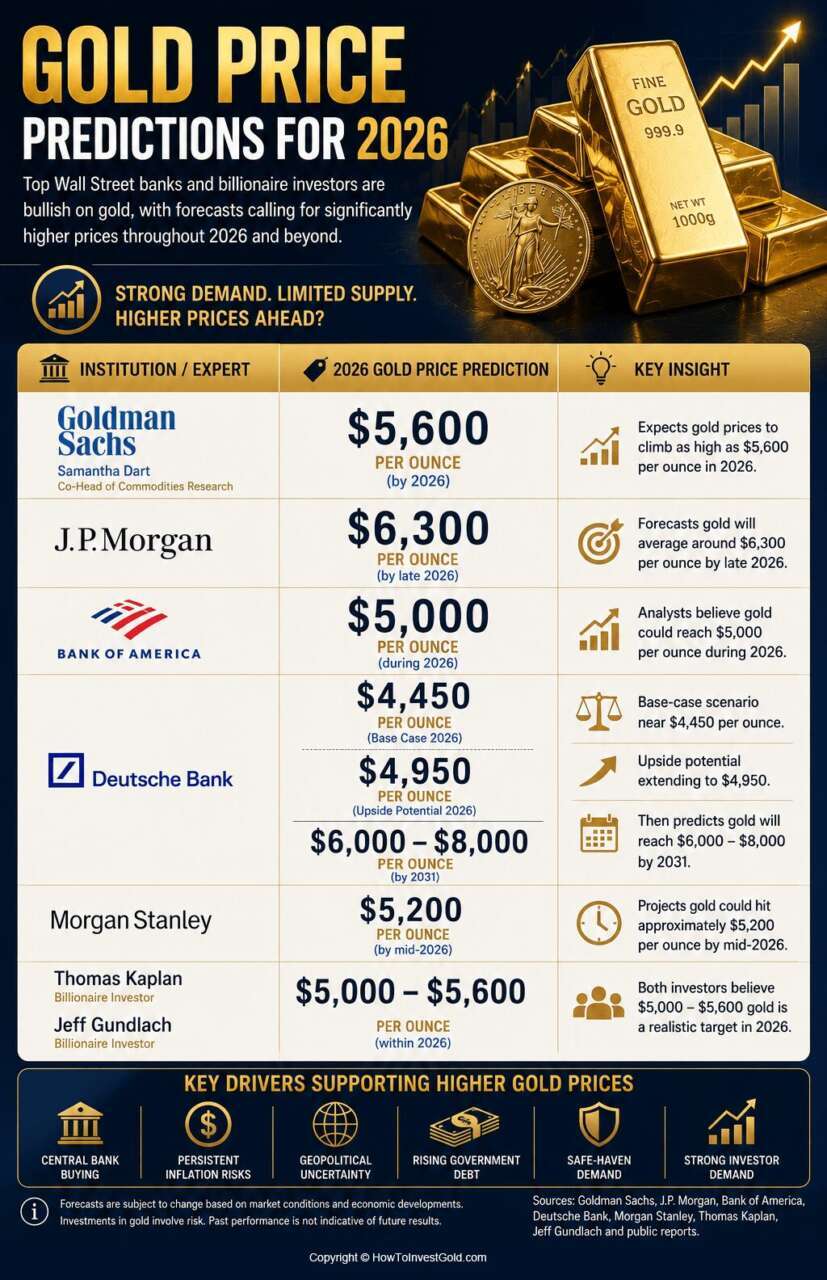
The global spot price of gold has risen significantly over the last year, and prices have already hit the $5,300 level this year, which shows it’s an asset class investors rely on in uncertain times. In fact, J.P. Morgan predicts that gold will reach $6,300 by the end of 2026. This chart shows the gold price history for the last 30 years:

The precious metals market is also projected to hit $403.08 billion in 2025-2028 and shows a CAGR of 5.6%. And central banks keep stocking up on gold as North America is currently storing 813,962.69 US$m worth of gold according to World Gold Council’s data, which is a sign they fear what’s coming next.
According to Goldman Sachs, 2026 will be a continuation of the bull market we saw in 2025 for precious metals, with gold possibly reaching $6,300 by the end of the year. They recommend investors turn to gold as a hedge against a continued unstable market.
Additionally, silver prices are also expected to skyrocket this year because of increased demand while mines struggle to keep up. Check out this silver price prediction by some of Wall Street’s biggest financial institutions and precious metals specialists:
This positive trend for gold and silver prices is projected to continue with current geopolitical tensions and de-dollarization as a result of BRICS dropping the dollar and replacing it with a gold-backed currency. On top of that, a new financial system, NESARA GESARA (QFS), is also emerging, which will be backed by physical assets and commodities.
In uncertain times like these, it is more important than ever to turn to assets that will help you create a currency and inflation hedge and other economic stresses to help strengthen your savings.
Precious metals will help you:
In summary, gold is a great investment because it not only protects your portfolio from market volatility but may also set it up for significant future growth.
As J.P Morgan once said:
|
What he means is that in times of economic uncertainty and instability, buying gold makes more sense than other assets. Gold is no one’s liability and carries no counterparty risk. It is a tangible asset that will stand the test of time. In other words, it is a store of value that offers financial insurance, which is why physical gold and other metals should be an essential part of any investor’s portfolio who wants to protect their savings.
Trevor Gerszt, founder and CEO of Goldco means:
“Precious metals should not be seen as an investment, but as financial insurance.”
 Historically, gold has moved in the opposite direction of traditional securities like stocks, bonds, and mutual funds. When the stock market goes down, the price of gold and silver tends to rise. For this reason, gold has proved to be a successful preserver of wealth throughout time. Also, high gold prices and record demand have ensured that it has outperformed most other forms of investment.
As a highly valuable metal, gold is recognized internationally and considered a valuable luxury no matter where you are in the world. A gold investment should be viewed primarily as a low-risk security asset. So if you are looking to minimize risk, diversify your portfolio, and safeguard your wealth during times of heightened volatility, you should turn to precious metals.
Gold Key Facts:Here is a summary of gold key facts:
|

The combination of these factors means that adding gold to a portfolio can enhance risk-adjusted returns. Now, let us take a look at the increasing demand for gold and why that is.
Global demand for gold has increased significantly over the past two decades as investors, institutions, and central banks seek greater financial security during periods of economic uncertainty, inflation, and geopolitical instability. One of the strongest drivers of this trend has been investment demand for physical gold.
According to the World Gold Council, small gold bars and bullion coins have consistently accounted for a substantial portion of annual gold investment demand, while also representing a meaningful share of overall global gold consumption.
Demand for physical bullion has grown dramatically since the early 2000s, with purchases of gold bars and coins increasing severalfold across both Eastern and Western markets. Investors increasingly view physical gold as a safe-haven asset that can help preserve purchasing power during inflationary periods, currency devaluation, banking uncertainty, and stock market volatility.
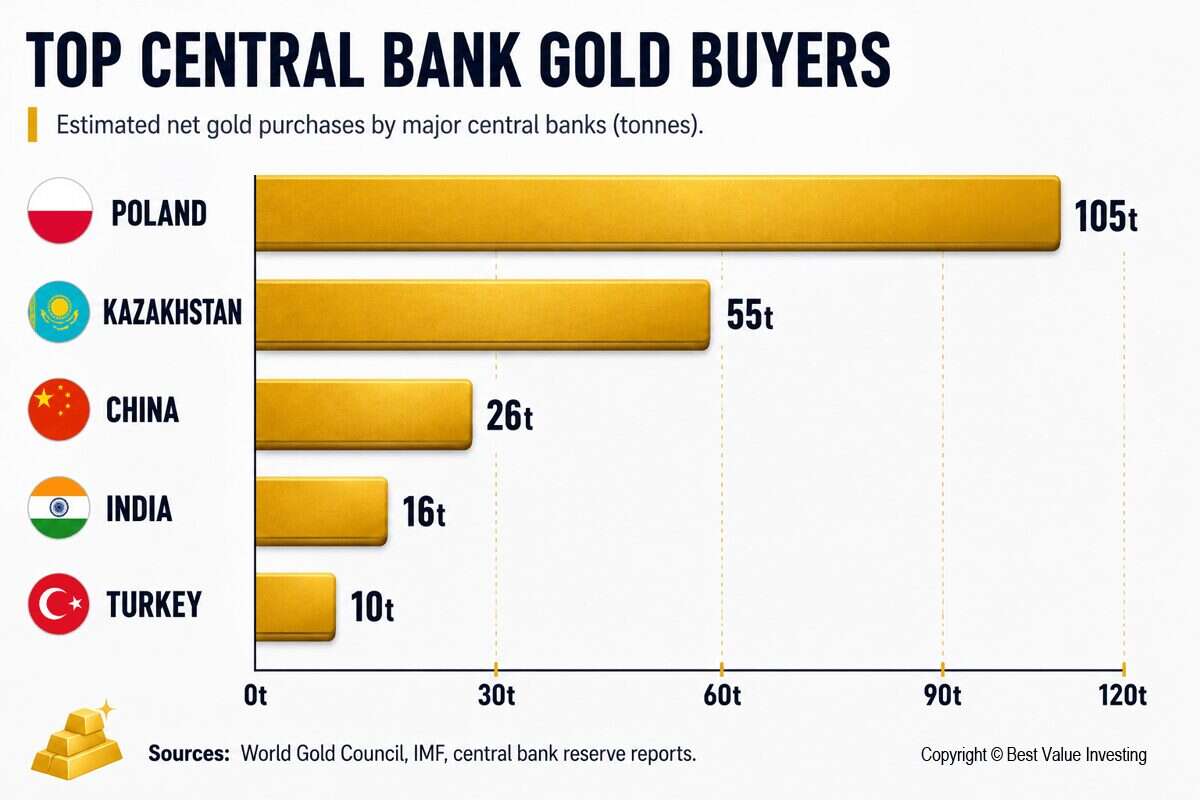
Another major factor supporting gold demand is aggressive buying by central banks. In recent years, central banks globally have accumulated gold at one of the fastest paces seen in decades as countries diversify reserves away from traditional paper assets and strengthen their financial positions. Nations such as Poland, China, India, and Turkey have all significantly expanded their gold reserves.
As shown in the chart below, Poland in particular emerged as one of the largest sovereign gold buyers in 2025 and 2026, reportedly adding more than 80 tonnes of gold to its reserves during the second half of the year. This growing central bank accumulation is viewed by many analysts as a strong long-term bullish signal for the gold market.
As global debt levels continue to rise and economic uncertainty persists, many investors believe gold demand could remain strong for years to come, particularly among retirement savers and long-term wealth preservation investors seeking stability outside the traditional financial system.
When central banks are stocking up on gold, it’s a signal that they know what’s coming. It can be a good idea for investors to mirror this investment strategy. For more information, watch this video about why central banks are dumping paper assets for gold:
Now, let’s take a look at the different investment options available when it comes to gold investments.
Physical GoldWhen it comes to paper gold vs physical gold, the advantage of actually being able to take delivery of physical gold coins or bars is enormous. Here are some of the benefits of owning physical gold:
For this reason, investing in a gold IRA is a method that is becoming more and more popular. With a gold IRA, you get to own physical gold coins or gold bars, while still enjoying the same tax advantages as a conventional IRA. It allows you to enjoy tax-deferred growth on your investment. And when it comes time to take a distribution, you can choose to either receive cash or take possession of your gold coins or bars completely tax and penalty-free. For more details, please visit Gold IRA Tax Rules: The Ultimate Gold IRA Tax Guide. |
Futures Options (ETFs)These indirect forms of investing in gold are much riskier than the physical metal. In fact, physical gold offers you that layer of protection and security, which ETFs (Gold Exchange Traded Funds) do not. Consider this:
Investing in an ETF that owns gold stocks is a higher-risk way to play. Also, the management fees on your holdings will add up, and in practice, this can have much the same effect as inflation. |
Gold Mining Stocks & FundsIf you do not want to purchase physical gold, you can always look to gold mining stocks. But keep in mind that gold stocks do not necessarily move in concert with bullion prices since mining companies succeed or fail based on their individual operating performance and how they deploy their capital and generate profits. If you like the profit potential of gold mining stocks but do not want to buy individual companies, you can invest in gold funds instead. However, be aware that gold stocks rise and fall faster than the price of gold itself. As a result, you do not have the security of physical possession of the metal if the companies you buy are unsuccessful. With physical gold bullion, this would not affect you directly, as you are not relying on any third-party individual or company to look after your wealth for you. Instead, you are in control of your own wealth. It goes without saying:
|
Gold Coins Or Gold Bars?Whether to invest in gold coins or gold bars depends on your individual investment goals and situation. Here are some aspects to consider:
|

If you wonder what gold and silver coins and bars are allowed to be included in an IRA, you can view our list of IRA-approved gold and silver bullion.
Prudent gold investors ensure that they pay the lowest premiums when purchasing their gold. They also want to know they can sell it quickly and easily for the full value when they want to.
The good news is that you can rest assured that there will always be established bullion dealers who are willing to buy your gold instantly over the telephone. In just a few minutes, you can realize the value of your gold and get a bank transfer or instant cash payment on the very same day.
| For example, both gold investment companies Goldco and Birch Gold Group will buy back your precious metals on any business day of the week, and have funds in your possession within 24 hours of a sale. |
If you are ready to take action, 👉 see our list of the top 8 precious metals IRA companies (cash sales also available).
Choosing between gold or silver ultimately depends on your investment goals, budget, and risk tolerance. Both precious metals have historically been used as stores of value and hedges against inflation, but they serve slightly different purposes within an investment portfolio.
Gold is generally considered the more stable and conservative investment. It has long been viewed as a safe-haven asset during economic uncertainty, market volatility, currency devaluation, and geopolitical tensions. Because gold is less volatile than silver, many retirement investors choose physical gold and Gold IRAs as a way to preserve wealth over the long term.
Silver, on the other hand, tends to offer higher growth potential but also comes with greater price volatility. In addition to being a precious metal, silver has extensive industrial uses in sectors such as solar energy, electronics, electric vehicles, and technology manufacturing. This industrial demand can sometimes lead to larger price swings, which may create greater upside potential during strong bull markets.
Many experienced investors choose to own both gold and silver to create a balanced precious metals portfolio. Gold can provide stability and wealth preservation, while silver may offer higher upside potential and affordability for newer investors.
Here are some common reasons investors choose each metal:
For many investors, the best approach is not necessarily choosing one over the other, but owning a combination of both precious metals as part of a diversified long-term investment strategy. But how much gold and silver should you invest to achieve maximum benefit, you may ask? Let’s take a look at that next.
According to the portfolio allocation analysis (based on the seminal work of Richard and Robert Michaud), investors who hold between 2% to 10% of their portfolio in gold can significantly improve their performance.
This is also true when assuming a conservative average annual gold return of a modest 2% to 4%, which is well below its actual long-term historical performance. So, investing as little as 2% to 10% of your total portfolio will set your portfolio up for significant growth. But more importantly, it will offer you financial insurance and a hedge against inflation.
However, there are billionaire investors such as Eric Sprott who even invest up to 98% of their wealth in gold and silver since they know that excessive government spending, currency debasement, and unsustainable debt levels will continue to drive a bullish momentum for precious metals.
It’s ultimately up to the individual investor to decide how much of their investment portfolio they want to dedicate to a tangible asset, instead of more risky investments such as stocks and bonds.
The liquidity of your precious metals investments will depend on what form of precious metals you invest in. But in general, gold and silver are highly liquid. In fact, gold and silver are traded 24/7 around the world. The investor markets for gold coins and bars are highly active. And as previously mentioned, you can rest assured that you will always be able to find a willing buyer for your precious metal investments.
Today, the demand for gold and silver is so high that many investors cannot find enough gold and silver coins. Some mints around the world had to shut down their operations temporarily as a result of geopolitical instability and demand for safe-haven assets, which has had the effect of further spurring demand.
Needless to say, everyone wants to get their hands on gold and silver coins while they still can and before prices rise any further. When investing in, for example, a Gold IRA, and wanting to take a distribution, you can easily take physical possession of your precious metals.
Also, aside from potentially having to sell a portion of your assets to cover any taxes you may owe, you will not necessarily have to worry about liquidating a huge portion of your precious metals.
We cannot state enough how important it is to choose a reputable gold dealer. It can make all the difference, both when it comes to credibility and reassurance, and when assessing the vital elements that can affect your investment return, such as coin selection and tax efficiency. It is of paramount importance to do proper due diligence before transferring your hard-earned money from your bank account.
More importantly, because gold is an expensive purchase, one bad transaction can cost you a lot of money. Reputable gold investment companies will be able to help both experienced investors looking for diversification, as well as those looking to own gold for the first time.
To help you identify the best option to protect and grow your wealth today, we have reviewed and rated the best gold IRA companies in the industry. Each company has been rigorously reviewed and vetted based on several critical factors:
Here’s our list of the top 8 gold IRA companies (reviewed & rated), starting with our #1 recommendation for precious metals company, Birch Gold Group:
>
| Company | Reviews | Annual Fees | Investment Minimums (IRA) | Preferred Custodian | Free Gold Kit |
 |
 |
$180 | $10,000 | Equity Trust |  |
 |
 |
$180 | $25,000 | Entrust | |
 |
 |
$180 | $25,000 | Equity Trust | |
 |
|
$75-$300 | $10,000 | GoldStar Trust Company | |
 |
 |
$200 | $50,000 | Equity Trust | |
 |
 |
$250 | $20,000 | Equity Trust | |
 |
 |
$250 | $10,000 | Equity Trust | |
 |
 |
$48 | $0 | Various | |
You can rest assured that your gold investment will be safe with any of these precious metals companies. Besides, your gold dealer should also be able to offer options such as tax-free gold, pension gold, or a so-called gold IRA, a buy-back program, and so forth.
How To Do Your Due DiligenceStep 1. Research The Internet The internet is the best place to conduct your research. The internet holds information about the impartial experiences, opinions, and recommendations of millions of people all around the world. Simply use the Google Giant, and type in the company or brand name to see what comes up. Step 2. Research Customer Reviews The internet is the world’s largest open forum over which companies have no control. It will quickly become apparent if a gold bullion dealer has a negative online reputation, in which case they should be avoided at all costs. The best way is to research what other customers are sharing about their experiences on independent third-party review sites like the BBB, BCA, TrustLink and Trustpilot. Make sure to choose a company that is Accredited by the BBB to ensure legit business practices. Also, an effective way to identify credible reviews is to type the bullion dealer’s brand name into Google search followed by the word ‘reviews’. For example, “Goldco reviews” or “Augusta Precious Metals reviews”. And anything below 4.0 out of 5 would require some serious further investigation. Step 3. Trust Your Gut Feeling After speaking to a gold bullion dealer, you should feel certain that they have your best interests in mind. Be alarmed if they recommend investing all your assets into precious metals. The whole idea is to diversify your assets. Also, your gold dealer should consider your long-term investing goals and recommend the best solution for you. Overall, Birch Gold Group, Goldco, and Augusta Precious Metals are examples of top-rated precious metals companies that offer the finest 99.9% IRS-approved gold and silver bullion. |
There are 3 primary options for storing your gold bullion:
First of all, you can take personal custody of your bullion. If you choose this option, you will need to store it in a safe place, somewhere it is unlikely to get stolen or destroyed by fire or some other disaster.
Make sure to insure your gold. You can do this easily with your homeowner’s insurance policy to provide coverage in the event of a loss. However, you can’t store a gold IRA at home. The gold in an IRA must be stored at an IRS-approved depository like Delaware Depository. For more information, visit Can I Take Physical Possession Of Gold In My IRA?
You can also store your gold with the gold dealer you bought it from. For example, Goldco charges $0 for storage of non-IRA transactions. Other companies, like GoldenCrest Metals provide a free safe for home storage when you buy precious metals from them.
Third of all, a self-directed gold IRA will allow you to hold bullion in your retirement account with the same tax advantages as a conventional IRA. Setting up a gold IRA is a specialized process, and you will need to find an IRA custodian that specializes in this practice.
For this reason, we highly recommend starting your gold IRA with any of the companies below. They all have Precious Metals Specialists who can help you make the transfer or rollover process quick and painless. You can request a free gold information kit from each company by clicking on the button to the right.
Here’s our list of the top 8 gold IRA companies (reviewed & rated):
>
| Company | Reviews | Annual Fees | Investment Minimums (IRA) | Preferred Custodian | Free Gold Kit |
|
|
$180 | $10,000 | Equity Trust | |
|
|
$180 | $25,000 | Entrust | |
|
|
$180 | $25,000 | Equity Trust | |
|
|
$75-$300 | $10,000 | GoldStar Trust Company | |
|
|
$200 | $50,000 | Equity Trust | |
|
|
$250 | $20,000 | Equity Trust | |
|
|
$250 | $10,000 | Equity Trust | |
|
|
$48 | $0 | Various | |
You should invest in a gold IRA because it allows you to diversify any portion of your retirement portfolio by actually owning physical metals within that retirement plan. Besides, you can include pre-existing IRAs and former 401k(s) or TSPs with previous employers. For more details, visit our guide on how to buy gold with your 401(k) or TSP to gold IRA – how to convert your TSP to gold.
By investing in gold and other precious metals through a gold IRA or precious metals IRA, you can rest assured that your assets are safe and secure. You do not have to worry about a possible stock market crash or inflation, where your paper assets potentially will lose most of their value. Investors can securely possess physical precious metals in a tax-deferred account.
For more details, check out this video about the benefits of investing in a gold IRA:
If you are interested in physical precious metals, starting a gold IRA is easy! Simply fill out this online application, and a precious metals specialist will contact you within 15 minutes. Filling out the short form will also grant you access to a “Gold IRA Guide” or “Investment Kit” that will be shipped to you for free. This comprehensive guide will give you all the information you need to make informed decisions about your investment.
To establish an account, you’ll need to provide personally identifiable information like your social security number. If you don’t have a precious metals custodian company, your chosen gold IRA company will help you set up an account with one of their preferred custodian companies.
This is the gold IRA setup process in short:
To secure your precious metals purchase and understand the company’s terms of doing business, you will review, approve and sign a standard customer agreement.
There are different ways to fund your account, and those are typically either sending funds through a bank wire, or simply mailing a check to the gold IRA company of your choice’s office.
As soon as you have funds in your account, it’s time to start thinking about which precious metals to add to it. You get to pick and then the gold IRA investment firm handles the shipping. Plus, you can choose to have your coins delivered to an independent insured depository, sent straight to you, or you might even qualify for free storage (ask your provider).
For more information about gold IRAs, you can visit these related resources:

While everyone is familiar with gold and silver, they often overlook the other precious metals, those in the platinum group: ruthenium, rhodium, palladium, osmium, iridium, and platinum. So what is the best metal to invest in right now?
 There is a reason people refer to certain benchmarks as a “gold standard” – because gold is the object against which every other good has always been valued. Here are reasons why gold is the most desirable of the metals:
A gold IRA allows owners of tax-advantaged retirement accounts, such as a 401(k), 403(b), TSP, IRA, or similar account, to roll over those funds into an IRA that invests in precious metals such as gold. As mentioned, the gold IRA offers the same tax advantages as any conventional IRA, but with the added protection that an investment in physical gold coins or bars can offer.
 All that glitters is not gold, as silver investors know well. While silver often plays second fiddle to gold, it is an important metal in any investor’s portfolio because of the following reasons:
Like gold, silver can be invested through an IRA. A silver IRA allows investors to hold silver in an IRA and enjoy all the same benefits of a tax-advantaged retirement account, while simultaneously investing in physical silver coins or bars.

 Platinum is the third-most-popular precious metal among investors today. Platinum’s history is not as long as that of gold even though the metal has existed for millennia. Roughly half of the platinum produced today is used in automotive catalytic converters, its primary industrial use. A large portion of platinum is used in jewelry. And the remainder is used for electronics and in various other industries that need platinum’s resistance to corrosion.
The platinum price has been more volatile than gold recently, largely due to falling industrial demand from the automotive industry. Over 80% of today’s platinum production comes from South Africa, which may lead to fears of supply disruption.
However, that also means that in the event of a disruption, the platinum price should rise significantly. With that said, it is hard to imagine platinum becoming any cheaper than it already is. Years from now investors may look back and kick themselves for not investing in platinum when they had the chance.
 Only discovered in the early 19th century, and once of limited use primarily in jewelry, palladium has rocketed in price in recent years. Like its sister, platinum, palladium finds one of its primary uses in the automotive industry in catalytic converters.
Recent supply disruptions have caused the palladium price to skyrocket, reaching over $2,500 at one point in early 2020. Even though the price has fallen back below $2,000, palladium is still more valuable than gold, at least for now.
On a final note, we want to give you something important to consider: The power and freedom precious metals offer.

Gold and silver have served as trusted forms of money and stores of value for thousands of years. Unlike paper currencies that can be printed endlessly by governments and central banks, precious metals are tangible assets with limited supply, which is one reason they have historically maintained their value over long periods of time.
Many investors choose to own physical gold and silver because these assets can be held outside of the traditional financial system. This provides an additional layer of diversification and financial independence that stocks, bonds, and bank-held assets may not offer. During periods of inflation, currency devaluation, banking uncertainty, or market volatility, precious metals have often acted as a form of financial protection.
Gold and silver also represent a separate asset class from traditional investments such as equities and bonds. Because they are partially uncorrelated to the stock market, they may help reduce overall portfolio risk during economic downturns or financial crises. Gold in particular is widely viewed as a form of financial insurance due to its long history as a safe-haven asset and hedge against both inflation and broader market instability.
Even a relatively small allocation to precious metals—often between 2% and 10% of a diversified portfolio—may help improve long-term portfolio resilience during uncertain market conditions. Many retirement investors use Gold IRAs and Silver IRAs as a way to add this layer of protection while also benefiting from potential tax advantages.
Another important factor supporting precious metals is the imbalance between growing global demand and limited physical supply. Central banks, institutional investors, and retail buyers around the world continue accumulating gold and silver as concerns over debt levels, inflation, and currency purchasing power persist. At the same time, mining production remains finite, reinforcing the long-term scarcity value of these metals.
For investors seeking diversification, wealth preservation, and long-term financial stability, physical gold and silver continue to play an important role in a well-balanced investment strategy.
👉 Take action today and request the FREE Ultimate Guide to Gold & Silver!
Learn everything you need to know about owning physical gold in an Individual Retirement Account, 401(k) rollover and transfer rules, the best gold IRA companies, etc.
Learn what the difference between a gold IRA rollover and transfer is, what are the rules and regulations, how to store your IRA gold, when you can take physical possession of your gold, etc.
+1-855-222-6993
Before you go, request a free info guide and learn how to secure your retirement savings with gold and silver!