With gold trading near record highs and economic uncertainty continuing to dominate headlines, many investors are asking the same question: “Is now the right time to buy gold?” For millions of Americans, the answer is yes!
As inflation continues to erode purchasing power, government debt reaches new records, and economic uncertainty remains elevated, many investors are looking for ways to protect their hard-earned wealth. While stocks, bonds, and real estate all have their place in a diversified portfolio, gold has historically served a unique role as a store of value during times of financial stress.
In this article, we’ll share 5 compelling reasons why you should consider investing in gold right now to secure your wealth and join the predicted gold bull run in 2026 and onward. We’ll also share gold price predictions from some major financial institutions and why many Americans saving up for retirement are investing in a Gold IRA to protect and grow their wealth.
5 Reasons Why You Should Invest in Gold Right Now!

In fact, central banks, institutional investors, and everyday Americans have been increasing their exposure to physical gold in recent years. Many experts believe the factors driving gold’s rise are likely to remain in place throughout the remainder of the decade.
Whether you’re looking to preserve wealth, diversify your investments, or protect your retirement savings, here are five compelling reasons why investing in gold right now deserves serious consideration.
1. Gold Helps Protect Against Inflation
One of the primary reasons investors buy gold is its ability to help preserve purchasing power over time. Unlike paper currencies, which can be created in unlimited quantities by governments and central banks, gold is a finite physical asset. Its limited supply has helped it maintain value for thousands of years, making it one of the world’s most trusted stores of wealth.
Inflation may not seem dramatic from year to year, but over decades it can significantly reduce the purchasing power of savings held entirely in cash. A dollar today buys far less than it did twenty years ago, and the long-term trend has consistently favored assets that cannot be easily created out of thin air.
Historically, gold has performed particularly well during periods of elevated inflation, monetary expansion, and declining confidence in fiat currencies. This is one reason why investors often increase their gold holdings when inflation concerns begin to rise.
Key benefits include:
- Protection against declining purchasing power
- Potential hedge against rising consumer prices
- Long-term wealth preservation
- Reduced exposure to currency debasement
Gold’s ability to maintain value is one reason it has remained relevant throughout centuries of economic cycles. However, inflation protection is only part of the story. Another major benefit is gold’s ability to strengthen and diversify an investment portfolio.
2. Gold Can Diversify Your Investment Portfolio
Many Americans unknowingly have retirement portfolios that are heavily concentrated in similar types of assets. Stocks, mutual funds, ETFs, and bonds often make up the majority of retirement savings. While these investments can generate substantial growth during strong economic periods, they may also become vulnerable during market downturns when fear and uncertainty dominate investor sentiment.
Gold offers something different.
Because gold often moves independently of traditional financial assets, it can provide valuable diversification during periods of market stress. When stocks experience sharp declines, investors frequently seek safe-haven assets such as gold, which can help offset losses elsewhere in a portfolio.
Diversification remains one of the most effective strategies for managing risk because it reduces dependence on the performance of any single asset class. Benefits of diversification include:
- Reduced portfolio volatility
- Less dependence on stock market performance
- Exposure to a different asset class
- And improved long-term risk management
Many successful investors view gold as financial insurance rather than a speculative investment. Its role is often to provide stability when other assets become unpredictable. This diversification benefit becomes even more attractive when considering another powerful trend currently supporting gold prices: unprecedented demand from central banks around the world.
3. Central Banks Are Buying Gold at Record Levels
One of the strongest bullish indicators for gold today is the behavior of central banks. Over the past several years, central banks have purchased gold at some of the highest rates seen in decades. Countries across Asia, the Middle East, Eastern Europe, and other regions have been steadily increasing their gold reserves.
Why does this matter?
Central banks manage national reserves and often take a long-term view of economic risks. Their growing interest in gold suggests increasing concern about currency stability, global debt levels, and the future purchasing power of paper money.
By adding gold to their reserves, governments are seeking an asset that cannot be devalued through money printing or political decisions. Record central bank purchases support gold prices by:
- Creating substantial long-term demand
- Reducing available global supply
- Strengthening investor confidence
- And supporting gold’s role as a reserve asset
When institutions responsible for managing trillions of dollars are aggressively accumulating gold, many private investors view that as a signal worth paying attention to. While central bank demand provides a strong foundation for higher gold prices, another major reason investors continue buying gold is its ability to provide protection during uncertain times.
4. Gold Provides Financial Insurance During Uncertain Times
Financial markets thrive on confidence. When confidence begins to weaken, investors often look for assets that have historically held their value during periods of crisis. Gold has repeatedly demonstrated its ability to perform well during times of economic turbulence.
Whether the concern involves recession risks, banking instability, geopolitical conflicts, sovereign debt crises, or stock market volatility, gold has often served as a safe-haven asset that investors trust. Unlike stocks, bonds, or even cash deposits, physical gold carries no counterparty risk.
✔️ It does not rely on a corporation’s profits
✔️ It cannot declare bankruptcy
✔️ It cannot default on obligations
This independence is one of the reasons many investors consider gold to be a form of financial insurance. Common reasons investors buy gold include:
- Banking sector concerns
- Rising government debt
- Economic recessions
- Geopolitical instability
- Currency devaluation
- Stock market volatility
Gold’s ability to provide stability during difficult times has helped it earn a reputation as one of the most reliable wealth-preservation assets in history.
Related: A New Financial System Is Emerging: NESARA GESARA (QFS)—Two Key Assets To Skyrocket Your Wealth!
But while protection is important, investors also want growth. Fortunately, gold’s track record isn’t limited to defense—it has also delivered impressive long-term returns.
5. Gold Has Delivered Strong Long-Term Performance Throughout History
Many people mistakenly believe gold only performs well during economic crises. In reality, gold has produced strong long-term returns across a wide range of market environments.
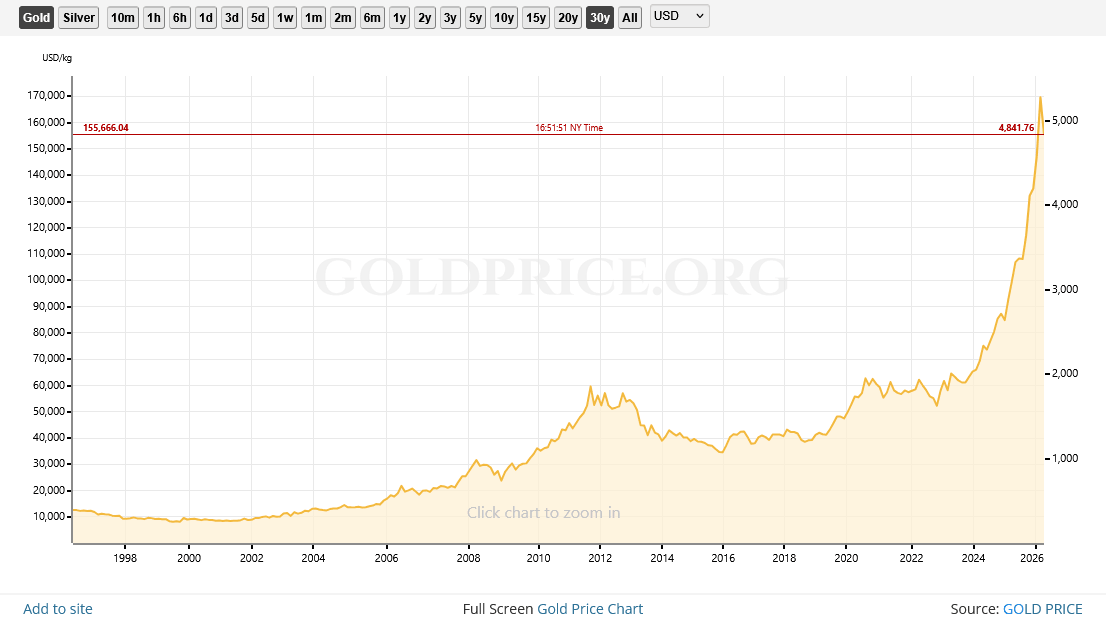
Over the past two decades, gold has significantly outpaced inflation while generating substantial gains for long-term investors. During this period, gold has benefited from increasing global debt, monetary expansion, rising investor demand, and growing central bank purchases.
Several major financial institutions remain optimistic about gold’s future due to ongoing concerns surrounding debt levels, inflation, currency stability, and limited new mine production. Additional factors supporting gold include:
- Growing global demand
- Limited supply growth
- Rising government debt
- Continued central bank accumulation
- And increased investor interest
These long-term drivers suggest that gold may continue playing an important role in wealth preservation and portfolio growth for years to come. Here’s a 30-year gold price history chart, where gold has increased by over 1000%:
With that in mind, let’s move on to key gold price predictions from some major financial institutions.
Gold Price Prediction for 2026: Wall Street Sees Significant Upside Ahead
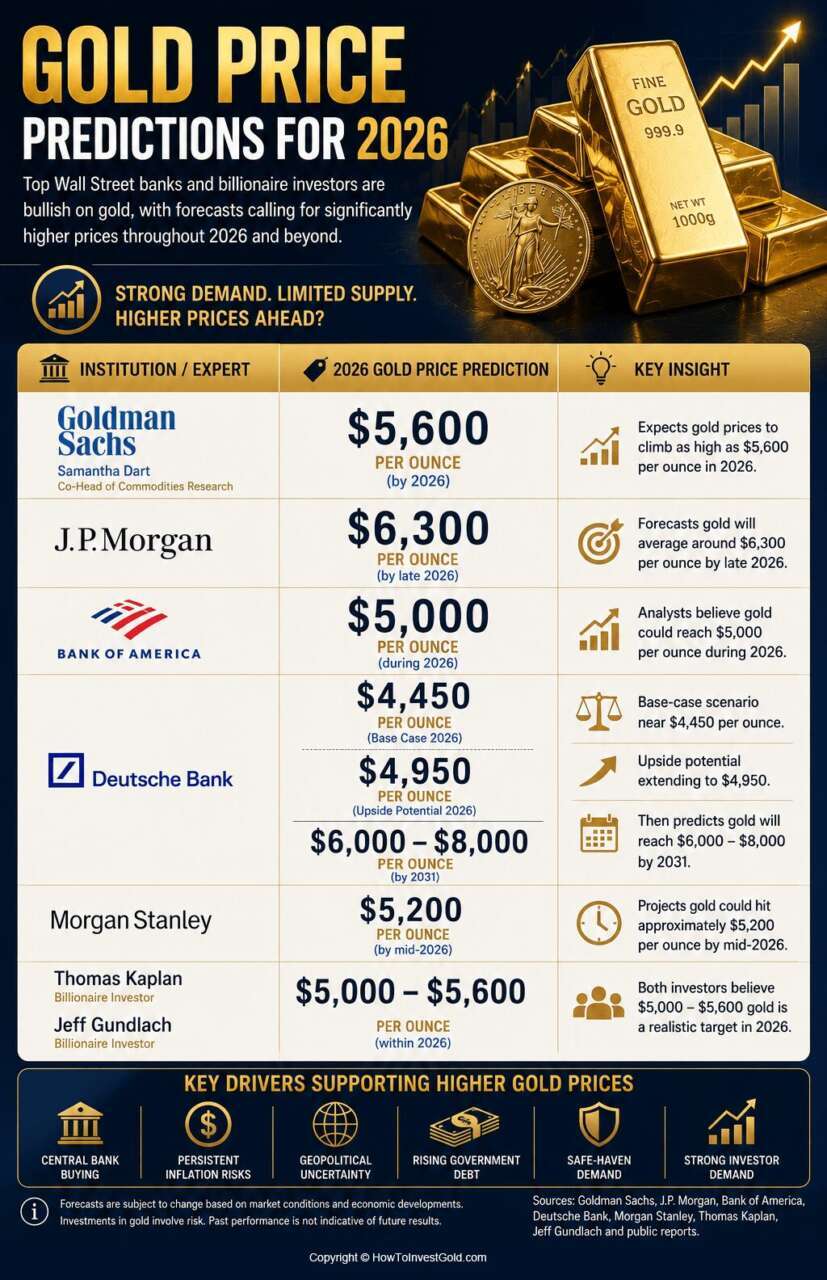
One of the biggest reasons investors remain bullish on gold is the increasingly optimistic outlook from major financial institutions and billionaire investors.
After gold’s strong performance in recent years, many analysts believe the precious metal could continue climbing as inflation concerns, record government debt, geopolitical uncertainty, and aggressive central bank buying support higher prices throughout 2026 and beyond. Several of the world’s leading banks have issued remarkably bullish forecasts:
- Goldman Sachs commodities strategist Samantha Dart expects gold prices could reach as high as $5,600 per ounce in 2026
- J.P. Morgan has one of the most aggressive forecasts, projecting gold could average approximately $6,300 per ounce by late 2026
- Bank of America analysts believe gold could climb to roughly $5,000 per ounce during 2026
- Morgan Stanley forecasts gold prices near $5,200 per ounce by mid-2026
- Deutsche Bank outlines a base-case scenario around $4,450 per ounce, with upside potential extending to approximately $4,950. Looking further ahead, the bank believes gold could eventually reach between $6,000 and $8,000 per ounce by 2031
- Billionaire investors Thomas Kaplan and Jeff Gundlach have both publicly stated that gold prices between $5,000 and $5,600 per ounce are realistic targets within the 2026 timeframe
Taken together, these forecasts paint an exceptionally bullish picture for gold’s long-term outlook.
Why Analysts Expect Gold to Move Higher
Several powerful catalysts continue to support the bull case for gold. Central banks around the world have been purchasing gold at record levels as they seek to diversify reserves away from paper currencies.
At the same time, government debt continues to rise globally, raising concerns about long-term currency stability and fiscal sustainability.
Inflation also remains a major factor. Although inflation rates have moderated from their recent peaks, many economists believe structural inflation pressures could persist for years due to government spending, reshoring of manufacturing, and growing energy demand.
Geopolitical tensions are another key driver. Historically, investors have flocked to gold during periods of uncertainty because it is viewed as a safe-haven asset that can preserve purchasing power when financial markets become volatile.
What Could Gold Be Worth in 2026?
Based on current forecasts, most Wall Street institutions see gold trading somewhere between $5,000 and $6,300 per ounce during 2026, with Deutsche Bank’s more conservative base case starting near $4,450 per ounce, which we have already surpassed.
If these projections prove accurate, gold could deliver substantial gains from current levels while continuing to serve its traditional role as a hedge against inflation, currency devaluation, and economic uncertainty.
For many investors, these forecasts reinforce the case for owning physical gold or holding precious metals through a Gold IRA as part of a diversified long-term wealth preservation strategy.
For many investors, one of the most attractive ways to gain exposure to physical gold is through a retirement account specifically designed to hold precious metals.
Why Many Americans Are Investing In Gold IRAs In 2026
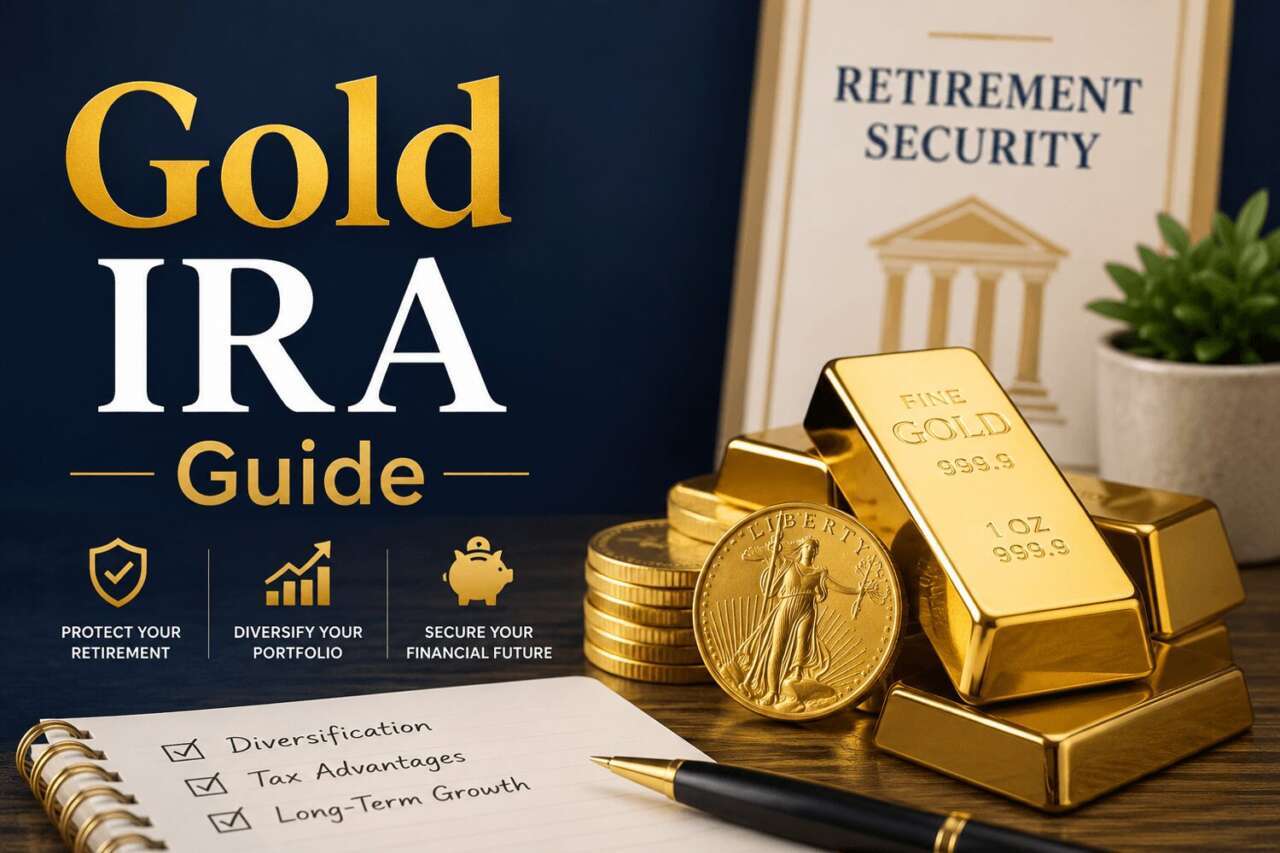
As retirement savers become increasingly concerned about inflation, stock market volatility, and the long-term stability of the financial system, Gold IRAs have grown rapidly in popularity. A Gold IRA is a self-directed retirement account that allows investors to hold IRS-approved physical gold, silver, platinum, and palladium within a tax-advantaged retirement structure.
Unlike traditional retirement accounts that primarily hold paper assets, a Gold IRA provides exposure to tangible physical precious metals that can help diversify retirement savings. Many Americans approaching retirement view Gold IRAs as a way to reduce dependence on Wall Street while adding an additional layer of protection to their nest egg.
Key Benefits of a Gold IRA
To give you an overview, the key benefits of opening a Gold IRA include:
- Portfolio Diversification: Adding precious metals creates exposure to a different asset class that may perform well when traditional investments struggle
- Inflation Protection: Physical gold has historically maintained purchasing power during inflationary periods, helping protect retirement savings from erosion
- Tax Advantages: Traditional Gold IRAs offer tax-deferred growth, while Roth Gold IRAs may provide tax-free qualified withdrawals
- Physical Asset Ownership: Unlike stocks and mutual funds, investors own actual physical precious metals stored in secure, IRS-approved depositories
- Wealth Preservation: Gold has maintained value for centuries and remains one of the most widely recognized stores of wealth in the world
For retirement investors seeking stability, diversification, and long-term wealth protection, a Gold IRA has become an increasingly attractive option in 2026.
Related:
- How to Start a Gold IRA in 3 Simple Steps
- Silver Price Prediction 2026: Why Analysts Expect Higher Prices Ahead
- Silver Demand Forecast 2026: Why Investors Are Bullish on Silver’s Future
Top-Rated Precious Metals Companies to Buy Gold From
But who to buy gold from, you may ask? To help you identify the best option to protect and grow your wealth today, we have reviewed and rated the best gold IRA companies in the industry. We have carefully reviewed and vetted them based on BBB/BCA ratings and complaints, customer reviews, annual fees, precious metals selection, storage options, promotions, and buy-back programs.
You can request a free information kit from each company by clicking on the button to the right:
>
| Company | Reviews | Annual Fees | Investment Minimums (IRA) | Preferred Custodian | Free Gold Kit |
 |
 |
$180 | $10,000 | Equity Trust |  |
 |
 |
$180 | $25,000 | Entrust | |
 |
 |
$180 | $25,000 | Equity Trust | |
 |
|
$75-$300 | $10,000 | GoldStar Trust Company | |
 |
 |
$200 | $50,000 | Equity Trust | |
 |
 |
$250 | $20,000 | Equity Trust | |
 |
 |
$250 | $10,000 | Equity Trust | |
 |
 |
$48 | $0 | Various | |
You can rest assured that your gold investment will be safe with any of these precious metals companies. Besides, your gold dealer should also be able to offer options such as tax-free gold, pension gold, or a so-called gold IRA, a buy-back program, and so forth.
Frequently Asked Questions
Is gold a good investment in 2026?
Many investors believe gold remains attractive in 2026 due to inflation concerns, central bank buying, rising government debt, and ongoing economic uncertainty.
How much gold should I own?
Allocation recommendations vary, but many financial professionals suggest keeping between 5% and 15% of a diversified portfolio in precious metals depending on individual goals and risk tolerance.
What is a Gold IRA?
A Gold IRA is a self-directed retirement account that allows investors to hold IRS-approved physical precious metals while maintaining the tax advantages of a retirement account.
Can I store Gold IRA metals at home?
No. IRS regulations generally require Gold IRA assets to be stored in an approved depository through a qualified custodian.
Does gold protect against inflation?
Gold has historically maintained purchasing power over long periods and is widely considered one of the leading inflation-hedging assets.
Is physical gold better than gold ETFs?
Physical gold provides direct ownership of a tangible asset, while gold ETFs offer convenience and liquidity. The best choice depends on an investor’s goals and preferences.
Can I roll over a 401(k) into a Gold IRA?
In many cases, yes. Eligible retirement accounts such as 401(k)s, Traditional IRAs, TSPs, and certain pension plans can often be rolled into a self-directed Gold IRA without triggering taxes or penalties.
Why are central banks buying so much gold?
Central banks are increasing gold reserves to diversify holdings, reduce dependence on foreign currencies, and strengthen their long-term financial stability.
What precious metals can be held in a Gold IRA?
Most Gold IRAs can hold IRS-approved gold, silver, platinum, and palladium bullion and coins that meet specific purity requirements.
Is gold better than stocks?
Gold and stocks serve different purposes. Stocks are generally used for growth and income, while gold is commonly used for diversification, inflation protection, and wealth preservation. Many investors choose to own both.
Conclusion: Why Should Investors Stock Up on Gold Right Now
Gold’s appeal goes far beyond short-term price movements. Its ability to preserve purchasing power, diversify portfolios, provide financial protection during uncertain times, and support long-term wealth preservation has made it one of the most trusted investment assets in history.
With central banks buying gold at record levels, inflation concerns remaining elevated, and economic uncertainty continuing to shape global markets, many investors believe the case for owning physical gold has rarely been stronger.
Whether you choose to purchase physical bullion directly or hold precious metals through a Gold IRA, adding gold to a diversified portfolio may help strengthen your financial future and provide greater peace of mind in an increasingly uncertain world.