Silver has emerged as one of the most closely watched commodities in 2026. While gold continues to attract attention as a traditional safe-haven asset, silver is benefiting from a unique combination of industrial demand, investment interest, and tightening supply conditions.
Unlike most commodities, silver serves two important functions. It is both a precious metal used for wealth preservation and a critical industrial material required for some of the world’s fastest-growing industries. As demand continues to rise and mine production struggles to keep pace, many analysts believe silver could be poised for significant price appreciation.
The silver price prediction for 2026 remains overwhelmingly positive among major financial institutions, commodity analysts, and precious metals experts. While price targets vary, the consensus view is that silver’s long-term fundamentals remain among the strongest in the commodity sector.
You can either watch the video or continue reading the text below:
Why Silver Is Gaining Attention in 2026
The primary reason for the bullish silver outlook is the growing gap between supply and demand. For example, silver is a vital component in:
- Solar panels
- Artificial intelligence data centers
- Electric vehicles
- Semiconductors
- Consumer electronics
- Telecommunications infrastructure
- Medical technology
- And aerospace applications
As the global economy becomes increasingly dependent on advanced technology and renewable energy, industrial demand for silver continues to expand.
At the same time, global silver production has struggled to grow. Much of the world’s silver is produced as a byproduct of copper, zinc, and lead mining, making it difficult for supply to rapidly increase even when prices rise.
This imbalance has contributed to several consecutive years of silver market deficits, creating a favorable backdrop for higher prices. With that in mind, let’s take a look at why the silver demand forecast support higher silver prices.
Strong Silver Demand Forecast Continues to Support Higher Prices
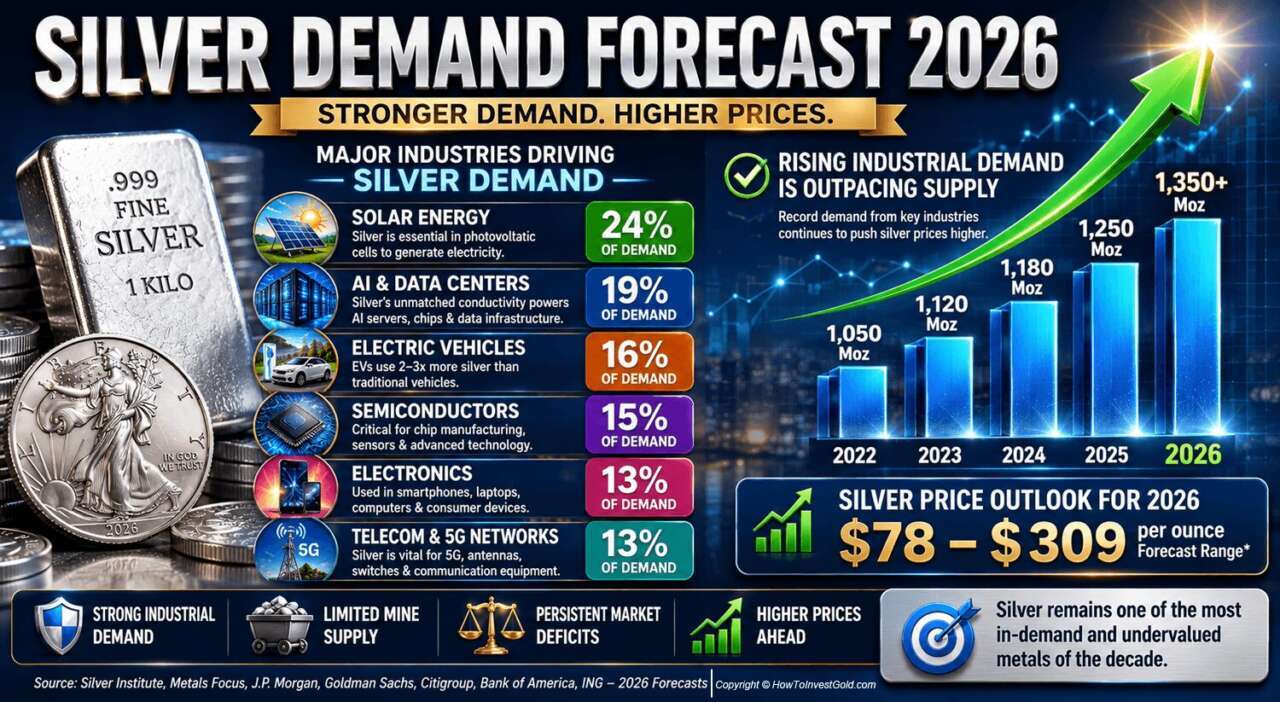
One of the biggest reasons analysts remain bullish on silver is the metal’s exceptionally strong demand outlook. Unlike gold, which is primarily driven by investment and central bank purchases, silver benefits from both investment demand and widespread industrial use.
As the world becomes increasingly dependent on clean energy, artificial intelligence, advanced electronics, and digital connectivity, silver’s unique properties are making it more valuable than ever.
Industry experts expect global silver demand to remain near record highs throughout the remainder of the decade, creating a favorable environment for higher prices.
Solar Energy Continues to Drive Silver Consumption
The renewable energy sector remains one of the largest consumers of silver worldwide. Solar photovoltaic panels rely on silver paste to efficiently conduct electricity and maximize energy output.
As governments and corporations invest trillions of dollars into clean energy initiatives, solar installations are expected to expand significantly. This ongoing transition toward renewable energy is likely to remain a major source of silver demand for years to come.
Artificial Intelligence Is Creating New Demand
The rapid growth of artificial intelligence is fueling massive investments in data centers and computing infrastructure around the globe.
AI systems require sophisticated servers, processors, networking equipment, and power management technologies, all of which depend on silver’s superior electrical conductivity. As AI adoption accelerates across virtually every industry, silver demand from this sector is expected to continue increasing.
Electric Vehicles Require More Silver Than Traditional Cars
Electric vehicles contain substantially more silver than conventional gasoline-powered vehicles due to their advanced electrical systems, battery technologies, sensors, and charging components.
With EV production projected to grow dramatically over the next decade, automotive manufacturers are expected to remain significant consumers of silver.
Semiconductors Depend on Silver’s Conductivity
Semiconductors are the foundation of modern technology, powering everything from smartphones and computers to AI processors and autonomous vehicles.
Silver is used in various semiconductor manufacturing processes because of its exceptional conductivity and reliability. As demand for microchips continues to grow worldwide, semiconductor production is expected to become an increasingly important driver of silver consumption.
Electronics Remain a Core Source of Demand
Silver is found in thousands of consumer and industrial electronic products, including smartphones, tablets, laptops, televisions, medical devices, and industrial equipment.
As global technology adoption continues expanding and consumers upgrade devices more frequently, the electronics industry remains one of the most important long-term demand sources for silver.
Telecom and 5G Networks Are Expanding Silver Usage
The global rollout of 5G networks and advanced telecommunications infrastructure is creating yet another source of demand for silver.
Because silver offers unmatched electrical conductivity, it is widely used in antennas, switches, connectors, circuit boards, and communications equipment. As wireless networks become faster and more sophisticated, telecom providers will likely require increasing amounts of silver to support future infrastructure projects.
A Powerful Combination of Demand Drivers
Few commodities benefit from as many long-term growth trends as silver. The continued expansion of solar energy, artificial intelligence, electric vehicles, semiconductors, electronics, and 5G communications is creating multiple sources of demand at the same time.
Meanwhile, silver mine production has struggled to keep pace with consumption, resulting in recurring supply deficits across the global market.
This combination of rising demand and constrained supply is one of the primary reasons many analysts expect silver prices to remain well-supported and potentially move significantly higher in the years ahead.
👉 See if you qualify for Goldco’s special promotion of 10% in FREE silver!

Related:
- 10 Powerful Reasons Why You Should Invest in Silver: Industrial Demand for Silver Is Booming!
- Buying Silver Bullion As An Investment: Skyrocket Your Wealth!
Now, let’s move on to what seven major financial institutions predict for silver in 2026.
What 7 Major Financial Institutions Predict for Silver in 2026
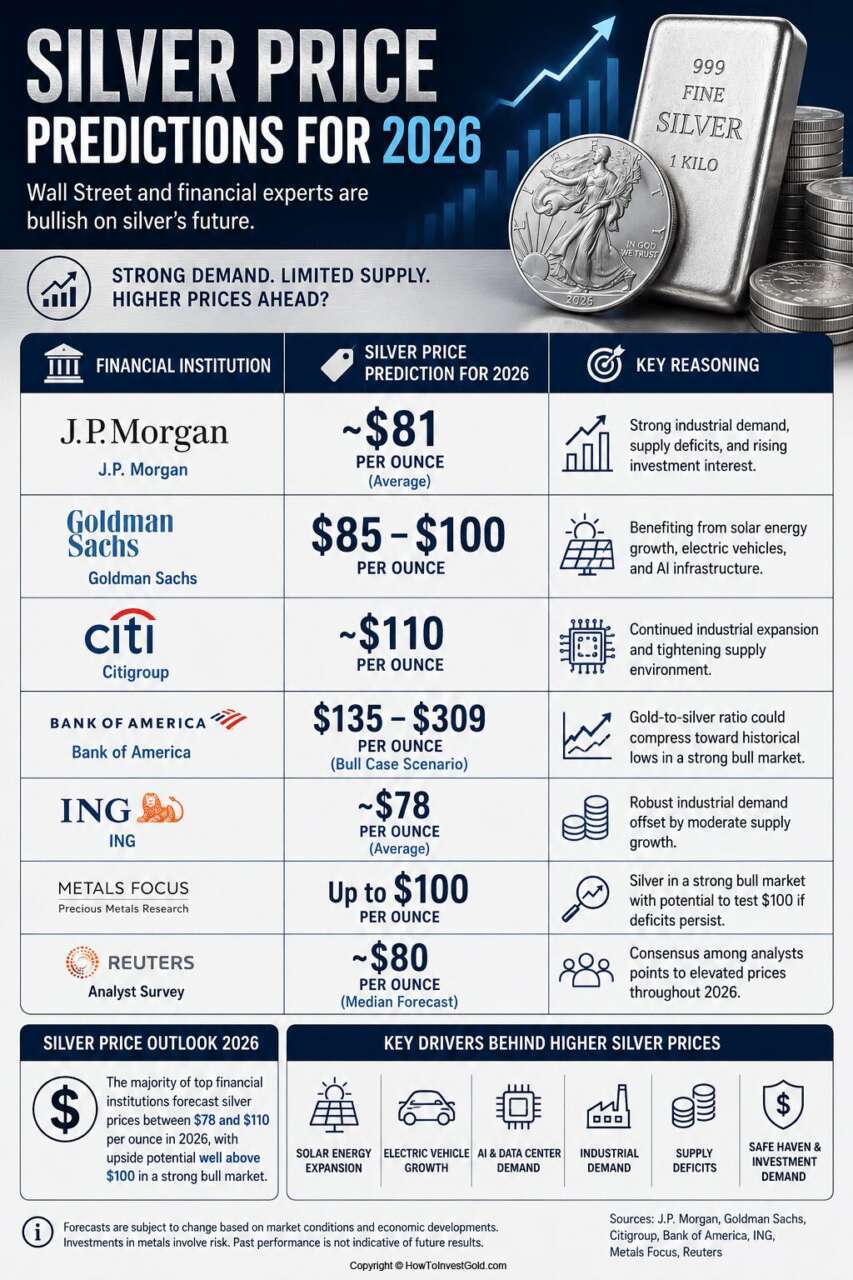
Several of the world’s largest financial institutions have issued bullish forecasts for silver prices. Here are silver price predictions from seven major financial institutions:
1. J.P. Morgan
J.P. Morgan analysts have projected silver could average approximately $81 per ounce during 2026. The bank cites strong industrial demand, ongoing supply deficits, and growing investor interest as primary catalysts.
2. Goldman Sachs
Goldman Sachs remains constructive on silver’s long-term prospects. Various market reports suggest the firm sees silver potentially trading between $85 and $100 per ounce, driven by growing demand from solar energy, electric vehicles, and AI-related infrastructure.
3. Citigroup
Citigroup analysts have projected silver could reach approximately $110 per ounce if industrial demand remains strong and investment flows continue increasing.
4. Bank of America
Among major financial institutions, Bank of America has issued one of the most aggressive forecasts. The bank’s commodity strategists have outlined a bullish scenario in which silver could potentially trade between $135 and $309 per ounce if precious metals enter a major bull market and the gold-to-silver ratio compresses toward historical norms.
5. ING
ING analysts forecast silver averaging around $78 per ounce, supported by robust industrial consumption and constrained mine supply.
6. Metals Focus
The precious metals research firm Metals Focus believes silver could potentially test $100 per ounce if market deficits persist and investment demand accelerates.
7. Reuters
Reuters’ latest survey of precious metals analysts paints a bullish picture for silver over the coming years. According to the survey, the median forecast among leading commodity experts suggests silver prices could average around $80 per ounce in 2026, representing significant upside from historical averages.
👉 See if you qualify for Goldco’s special promotion of 10% in FREE silver!
Although forecasts vary considerably, the common theme is clear: many leading analysts expect silver prices to move higher over the coming years. But could silver outperform gold? Let’s take a look at that next.
Could Silver Outperform Gold?
Historically, silver has often outperformed gold during the later stages of major precious metals bull markets. One reason is the size of the market. Silver’s market capitalization is significantly smaller than gold’s, meaning new investment capital can have a greater impact on prices.
Silver benefits from both investment demand and industrial demand, whereas gold’s demand is primarily investment-related. Many investors also watch the gold-to-silver ratio. Historically, when the ratio reaches elevated levels, silver has sometimes outperformed gold as the ratio moves back toward long-term averages.
While future performance is never guaranteed, many analysts believe silver may have greater upside potential than gold if current market trends continue.
Why More Investors Are Buying Physical Silver
The bullish silver price prediction has encouraged many investors to increase their allocation to physical silver. Common reasons investors purchase silver include:
- Inflation protection
- Portfolio diversification
- Long-term wealth preservation
- Exposure to industrial growth
- Protection from currency debasement
- And ownership of a tangible asset
Unlike paper investments, physical silver cannot be printed, diluted, or created by central banks. For this reason, many investors view silver as a form of financial insurance during uncertain economic conditions.
And silver prices are predicted to soar significantly this year. In fact, $300 silver is actually closer than many investors realize. Learn more in this video:
Let’s now move on to one of the most popular ways of securing your retirement savings with physical silver through an IRA.
Silver IRAs Are Growing in Popularity
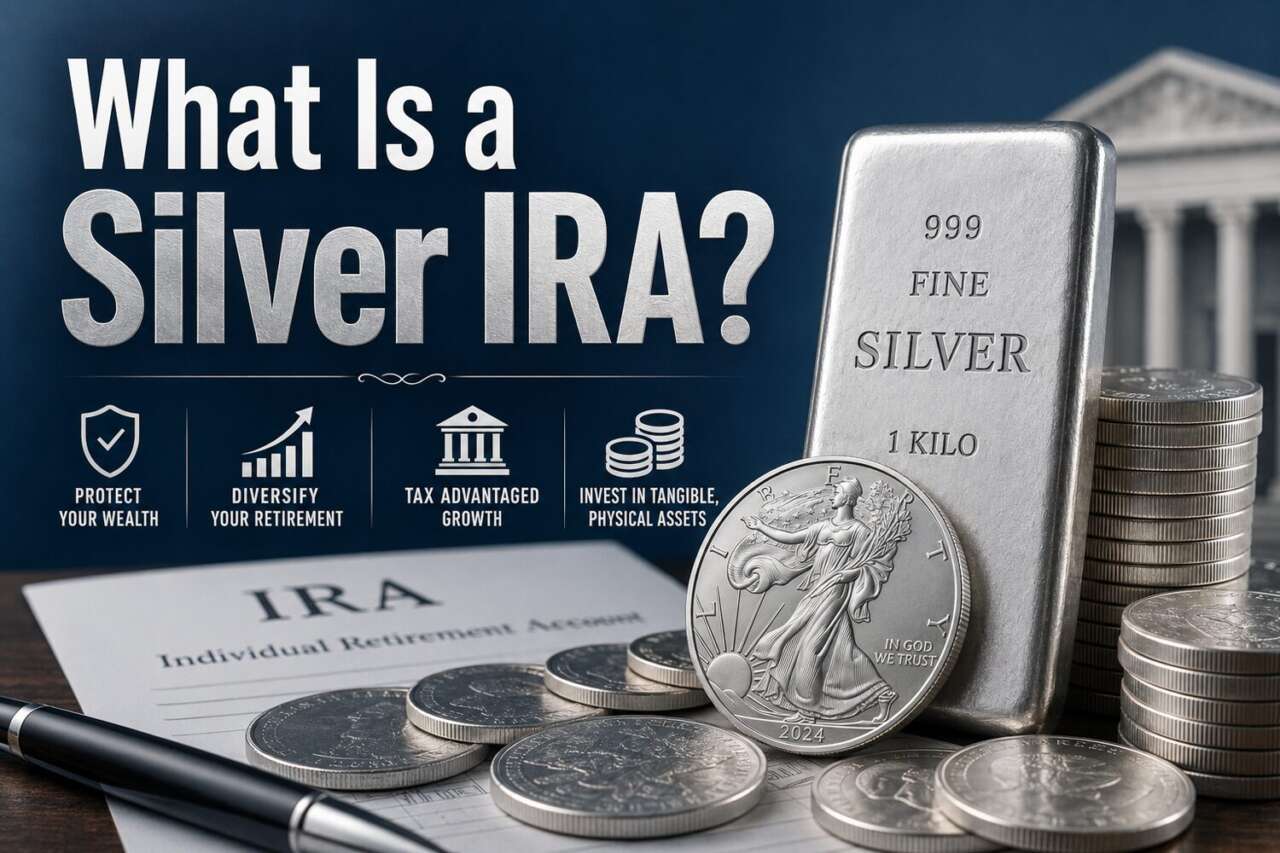
Many retirement savers are also gaining exposure to silver through Silver IRAs. A Silver IRA allows investors to hold IRS-approved silver bullion and qualifying silver coins within a tax-advantaged retirement account. Potential benefits include:
- Tax-deferred or tax-free growth
- Protection against inflation
- Portfolio diversification
- Exposure to rising silver demand
- Long-term wealth preservation
As concerns about inflation, government debt, and market volatility continue to grow, many investors are turning to Silver IRAs as a way to secure and diversify their retirement savings.
Can You Roll Over a 401(k) or Similar Retirement Account Into a Silver IRA?
Yes, in many cases, you can transfer funds from an existing 401(k), 403(b), 457 plan, Thrift Savings Plan (TSP), or Traditional IRA into a Silver IRA without triggering taxes or early withdrawal penalties. This process is commonly known as a rollover and is one of the most popular ways investors fund a self-directed precious metals retirement account.
A Silver IRA rollover allows retirement savers to move a portion of their existing retirement savings into physical silver while maintaining the tax advantages of their retirement account.
Rather than being limited to stocks, bonds, mutual funds, and other paper assets, investors can gain exposure to IRS-approved silver bullion and coins held in a secure depository.
How a Silver IRA Rollover Works
The rollover process is typically straightforward and is often handled by the Silver IRA company and custodian on your behalf. The basic steps include:
✅ Opening a self-directed Silver IRA with an IRS-approved custodian
✅ Requesting a rollover or transfer from your existing retirement account
✅ Funding the new Silver IRA once the transfer is complete
✅ Selecting IRS-approved silver products for your account
✅ Having the silver securely stored in an approved depository
Many Silver IRA providers assist investors throughout the entire process to help ensure the rollover is completed correctly and in compliance with IRS regulations.
Eligible Retirement Accounts for a Silver IRA Rollover
You may be able to roll over funds from:
- Traditional 401(k) plans
- Former employer 401(k) accounts
- 403(b) retirement plans
- 457 government plans
- Thrift Savings Plans (TSP)
- Traditional IRAs
- SEP IRAs
- SIMPLE IRAs (subject to IRS requirements)
If you currently participate in an active employer-sponsored retirement plan, additional restrictions may apply. It’s often best to consult your plan administrator or a Silver IRA specialist to determine eligibility.
👉 See if you qualify for Goldco’s special promotion of 10% in FREE silver!
Why Investors Roll Over Retirement Funds Into a Silver IRA
Many retirement savers choose a Silver IRA rollover because it allows them to diversify beyond traditional financial assets while gaining exposure to physical precious metals.
Common reasons include:
- Protection against inflation
- Reduced dependence on the stock market
- Portfolio diversification
- Long-term wealth preservation
- Exposure to growing industrial demand for silver
- Lastly, ownership of a tangible asset with intrinsic value
As demand from solar energy, artificial intelligence, electric vehicles, and advanced electronics continues to grow, many investors view silver as both a wealth-preservation asset and a potential growth opportunity.
Direct vs Indirect Rollovers
Most investors choose a direct rollover because funds move directly from one retirement account to another without passing through the account holder’s hands. This method is generally simpler and helps avoid potential tax complications.
An indirect rollover involves receiving the funds personally and redepositing them into a qualified retirement account within a specific time frame. Failure to meet IRS deadlines can result in taxes and penalties, which is why direct rollovers are often preferred.
A Silver IRA Is a Tax-Advantaged Way to Diversify Retirement Savings
For investors looking to add physical precious metals to their retirement strategy, a Silver IRA rollover can provide an efficient and tax-advantaged solution.
By transferring funds from an existing retirement account into a Silver IRA, investors can diversify their portfolios, gain exposure to one of the world’s most important industrial metals, and potentially protect their retirement savings from inflation, market volatility, and economic uncertainty.
But what are the costs? Let’s take a look at what it costs to open a Silver IRA.
How Much Does It Cost to Open a Silver IRA?
The cost of establishing a Silver IRA can vary depending on the provider you choose, the custodian administering the account, and the storage option selected for your metals.
Most self-directed IRA custodians charge a one-time account setup fee, which is often around $50 to $100, along with a small wire transfer or transaction fee. In addition, investors can expect an annual account administration fee that generally ranges from $75 to $150 per year.
Another important expense is storage. Because IRS regulations require precious metals held within an IRA to be stored at an approved depository, investors must pay annual storage fees.
Popular facilities such as the Delaware Depository and other IRS-approved vaults offer two primary storage options:
- Segregated Storage: Approximately $150 per year, where your metals are stored separately from other investors’ holdings
- Non-Segregated Storage: Approximately $100 per year, where your metals are securely stored alongside assets belonging to other account holders
While some investors may consider storing precious metals at home, doing so can violate IRS rules for IRA-owned assets and potentially trigger taxes and penalties. For this reason, professional storage at an approved depository is generally the safest and most compliant option.
Overall, the annual cost of maintaining a Silver IRA or Precious Metals IRA typically falls between $180 and $350 per year, depending on the custodian, storage method, and account features selected.
Many investors consider these costs worthwhile for the benefits of owning physical precious metals within a tax-advantaged retirement account.
Risks Investors Should Consider
While the outlook for silver remains positive, investors should recognize that silver prices can be volatile. Factors that could impact silver prices include:
- Changes in interest rates
- Economic slowdowns
- Strength in the U.S. dollar
- Reduced industrial activity
- And market sentiment shifts
Like any investment, silver should be considered as part of a diversified portfolio rather than a standalone strategy.
Related: How to Start a Silver IRA in 3 Simple Steps
Final Thoughts: Is Silver Headed Higher in 2026?
The silver price prediction for 2026 remains one of the most compelling stories in the precious metals market. Silver benefits from powerful long-term trends, including artificial intelligence, renewable energy, electric vehicles, semiconductors, and growing investment demand. Meanwhile, constrained mine production and recurring supply deficits continue to support a favorable market environment.
With major financial institutions forecasting prices ranging from approximately $78 to over $100 per ounce—and some bullish scenarios projecting even higher levels—many analysts believe silver could be one of the top-performing commodities of the decade.
For investors seeking portfolio diversification, inflation protection, and exposure to long-term industrial growth, silver remains an asset worth serious consideration in 2026 and beyond.
👉 See if you qualify for Goldco’s special promotion of 10% in FREE silver!