Could gold reach $6,300 an ounce in 2027, or even $50,000, as billionaire Thomas Kaplan is suggesting? Or are Wall Street’s biggest banks becoming too optimistic about the precious metal?
Earlier in 2026, some of the world’s most influential financial institutions predicted extraordinary gains for gold. J.P. Morgan projected gold prices approaching $6,300 in 2027, while other analysts anticipated continued strength driven by central bank purchases, growing government debt, and geopolitical uncertainty.
But something unexpected happened.
Gold prices began falling sharply, and several major banks started lowering their forecasts.
Goldman Sachs, for example, reduced its year-end 2027 gold price target from $5,400 to $4,800 in November, with subsequent reporting indicating another reduction to $4,650.
Meanwhile, J.P. Morgan’s previously published $6,300 forecast remains one of the more optimistic institutional projections.
So what’s going on?
Why are gold prices struggling when central banks continue buying billions of dollars’ worth of bullion? And could the correction eventually create the conditions for another major rally?
Key Takeaways:
In this gold price prediction for 2027, we’ll cover:
- ✔️ The latest gold price forecasts from J.P. Morgan, Goldman Sachs, Bank of America, Metals Focus, and other leading institutions
- ✔️ Why gold prices have declined despite strong central bank demand and limited supply
- ✔️ What billionaire investors Ray Dalio and Thomas Kaplan believe about gold’s long-term potential
- ✔️ The economic developments that could push gold toward $5,000, $6,000, or even $6,300
- ✔️ Three possible gold price scenarios for 2027
- ✔️ What the outlook could mean for investors interested in physical gold and Gold IRAs
You can either watch the video or continue reading the text below:
Let’s begin with the forecasts that have surprised investors.
Gold Price Predictions for 2027: What the Major Banks Expect
Wall Street analysts are far from unanimous about where gold prices are heading. Some expect a powerful recovery, supported by central bank accumulation and renewed demand for safe-haven assets.
Others believe higher interest rates and a strong U.S. dollar could limit gold’s upside. Here is a comparison of notable 2027 gold price forecasts:
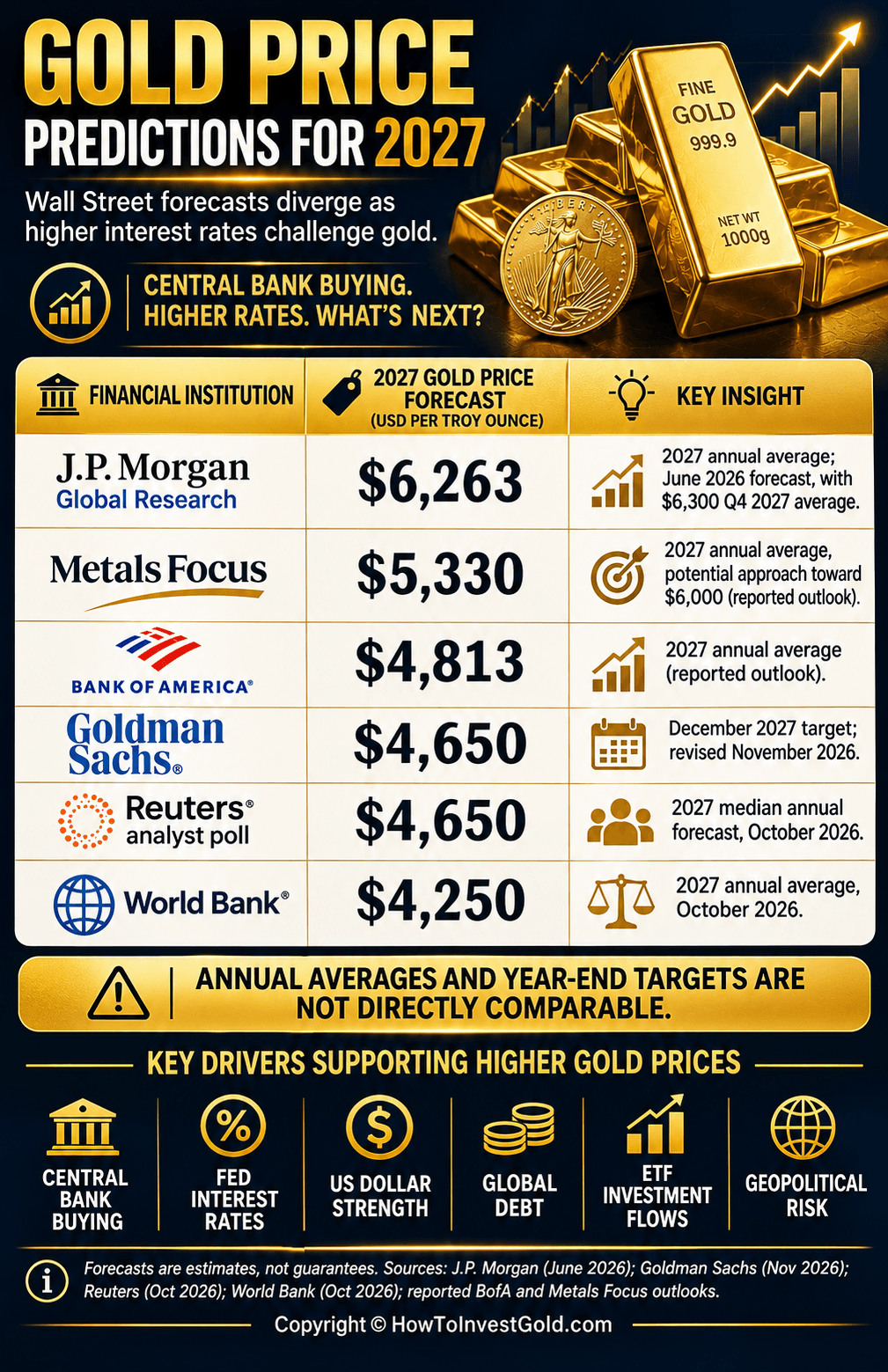
| Financial Institution | 2027 Gold Price Forecast | Forecast Type |
|---|---|---|
| J.P. Morgan Global Research | $6,300 | Fourth-quarter average, June 2026 forecast |
| Metals Focus | $5,330 | Annual average |
| Bank of America | $4,813 | Annual average |
| Goldman Sachs | $4,650 | Year-end target, reported November 21 |
| Reuters Analyst Poll | $4,650 | Median annual forecast |
| World Bank | $4,250 | Annual average |
Important: These forecasts were published at different times and measure different things. A fourth-quarter average cannot be compared directly with an annual average or a single year-end target.
The forecasts also remain subject to revision as economic conditions change.
1. J.P. Morgan Gold Price Prediction 2027: Could Gold Reach $6,300?
J.P. Morgan has issued one of the most bullish institutional gold price forecasts. Its June 2026 research projected an average gold price of approximately $6,263 per ounce in 2027, with a fourth-quarter average of approximately $6,300.
That prediction reflects expectations that structural demand for gold could remain strong despite temporary corrections.
Several factors support the bank’s earlier bullish outlook:
- ☑️ Continued purchases by central banks
- ☑️ Demand for portfolio diversification
- ☑️ Concerns about sovereign debt and currency stability
- ☑️ Potential investment inflows into gold-backed exchange-traded funds
- ☑️ And expectations that monetary policy could eventually become more supportive
However, J.P. Morgan’s more recent private-banking commentary has been considerably more cautious.
This highlights an important distinction: forecasts from different divisions of the same institution may reflect different assumptions, publication dates, and investment horizons.
The takeaway: J.P. Morgan’s $6,300 projection remains an important bullish reference point, but investors should not assume it represents a guaranteed outcome or the bank’s latest unified position.
2. Goldman Sachs Gold Forecast 2027: Why Did the Bank Lower Its Target?
Goldman Sachs has become more cautious about gold’s near-term prospects. In November 2026, its commodities strategists reduced their year-end 2027 gold price target from $5,400 to $4,800.
Subsequent reporting indicated another reduction to approximately $4,650.
Why the change? The primary reason is the Federal Reserve’s more restrictive monetary-policy outlook. Higher interest rates increase the attractiveness of interest-bearing assets such as Treasury bonds.
Since physical gold does not generate interest or dividends, rising real yields can make it less appealing to some investors. A stronger U.S. dollar can also put pressure on gold prices.
Yet Goldman Sachs has not abandoned its long-term bullish thesis. Its analysts continue to emphasize central bank demand, expecting purchases averaging approximately 60 tonnes per month through 2027.
That’s significantly above the pre-2022 monthly average of roughly 17 tonnes cited in the bank’s research.
Goldman Sachs also expects a potential improvement in gold’s outlook if the Federal Reserve begins cutting interest rates during the second half of 2027.
In other words, the bank sees near-term challenges but still recognizes gold’s longer-term structural support.
 Unlock the power of gold & silver for investing by requesting a FREE Gold IRA Guide:

3. Bank of America Gold Price Forecast 2027: A More Moderate Outlook
Bank of America’s reported 2027 forecast places gold at an average of approximately $4,813 per ounce. This is considerably below J.P. Morgan’s earlier projection.
However, it still reflects the possibility of substantial gold prices relative to historical levels.
Bank of America has previously identified several developments that could support the precious metal:
- ☑️ Persistent fiscal deficits
- ☑️ Growing government debt
- ☑️ Changes in U.S. monetary policy
- ☑️ Currency diversification
- ☑️ Demand for safe-haven investments
The challenge is that these factors do not necessarily produce an immediate rally. For example, government borrowing may increase long-term concerns about currency stability, but higher Treasury yields can simultaneously pressure gold prices.
This helps explain why bullish long-term fundamentals and bearish short-term price action can coexist.
4. Metals Focus Gold Price Prediction 2027: Could Gold Approach $6,000?
Precious metals research firm Metals Focus has presented a relatively optimistic 2027 outlook. Its reported forecast calls for gold to average approximately $5,330 per ounce, with prices potentially approaching $6,000 during the year.
Unlike a year-end target, an annual average represents the expected price across the entire year. For gold to average $5,330, the market would generally need to sustain elevated prices rather than briefly touch that level.
The firm’s outlook reflects the importance of investment demand, central bank accumulation, and the broader economic environment.
Nevertheless, higher borrowing costs and investor selling could delay a recovery.
5. Reuters Analyst Poll: What Does the Broader Market Expect?
An October 2026 Reuters survey of 30 analysts and traders produced a median 2027 gold price forecast of approximately $4,650 per ounce.
The poll highlighted competing forces affecting the market. On one side are high Treasury yields, a strong dollar, and restrictive interest rates.
On the other are central bank purchases, physical demand, and longer-term concerns about currency debasement. The result is a cautiously constructive outlook rather than an expectation of uninterrupted gains.
This is an important reminder that even professional analysts disagree considerably about gold’s future.
Related:
- Silver Price Predictions for 2027: They Said $300 Silver, But Now They Say WHAT?!
- 8 Gold IRA Scam Warning Signs Before You Buy
- Physical Gold Taxes: What US Investors Need to Know
Why Are Gold Prices Falling Despite Strong Central Bank Demand?
 Here’s the question that has puzzled many precious metals investors: If central banks continue accumulating gold, why isn’t its price soaring?
The answer is that gold prices respond to several competing forces, including:
1. Higher Interest Rates Are Competing With Gold
Gold is a non-yielding asset. When investors can earn attractive returns on Treasury bills, government bonds, or money-market instruments, the opportunity cost of holding gold increases.
Real interest rates are especially important. A real interest rate represents the return on an investment after accounting for inflation.
When real yields rise, investors may prefer income-generating assets over bullion. Conversely, falling real yields can make gold more attractive.
2. A Stronger U.S. Dollar Can Pressure Gold Prices
Gold is generally quoted internationally in U.S. dollars. When the dollar strengthens, gold becomes more expensive for buyers using other currencies, potentially reducing demand.
A strong dollar can also reflect investor expectations of tighter monetary policy.
However, the relationship is not absolute. Gold and the dollar can occasionally rise together during periods of severe financial uncertainty.
3. Investors Are Taking Profits After Gold’s Historic Rally
Gold experienced an extraordinary rally before its 2026 correction. According to Reuters, the precious metal reached approximately $5,595 per ounce in January 2026, before falling toward $4,000 later in the year.
Such a dramatic reversal can occur when investors take profits, leveraged positions unwind, or interest-rate expectations change.
Even fundamentally strong markets experience corrections.
4. Central Bank Buying Does Not Guarantee Higher Prices
Central banks often purchase gold for strategic reasons rather than short-term profits. Their objectives may include reserve diversification, financial security, and reducing dependence on foreign currencies.
These purchases can provide long-term support. However, they may not fully offset selling by institutional investors, hedge funds, or exchange-traded funds.
The key point is that strong physical demand and declining gold prices are not mutually exclusive.
Request a FREE Gold & Silver Guide

Central Banks Could Remain One of Gold’s Biggest Supporters in 2027
Central bank purchases have become one of the most closely watched developments in the gold market. Countries such as China, India, Poland, Kazakhstan, and Turkey have attracted attention for their gold reserve strategies:
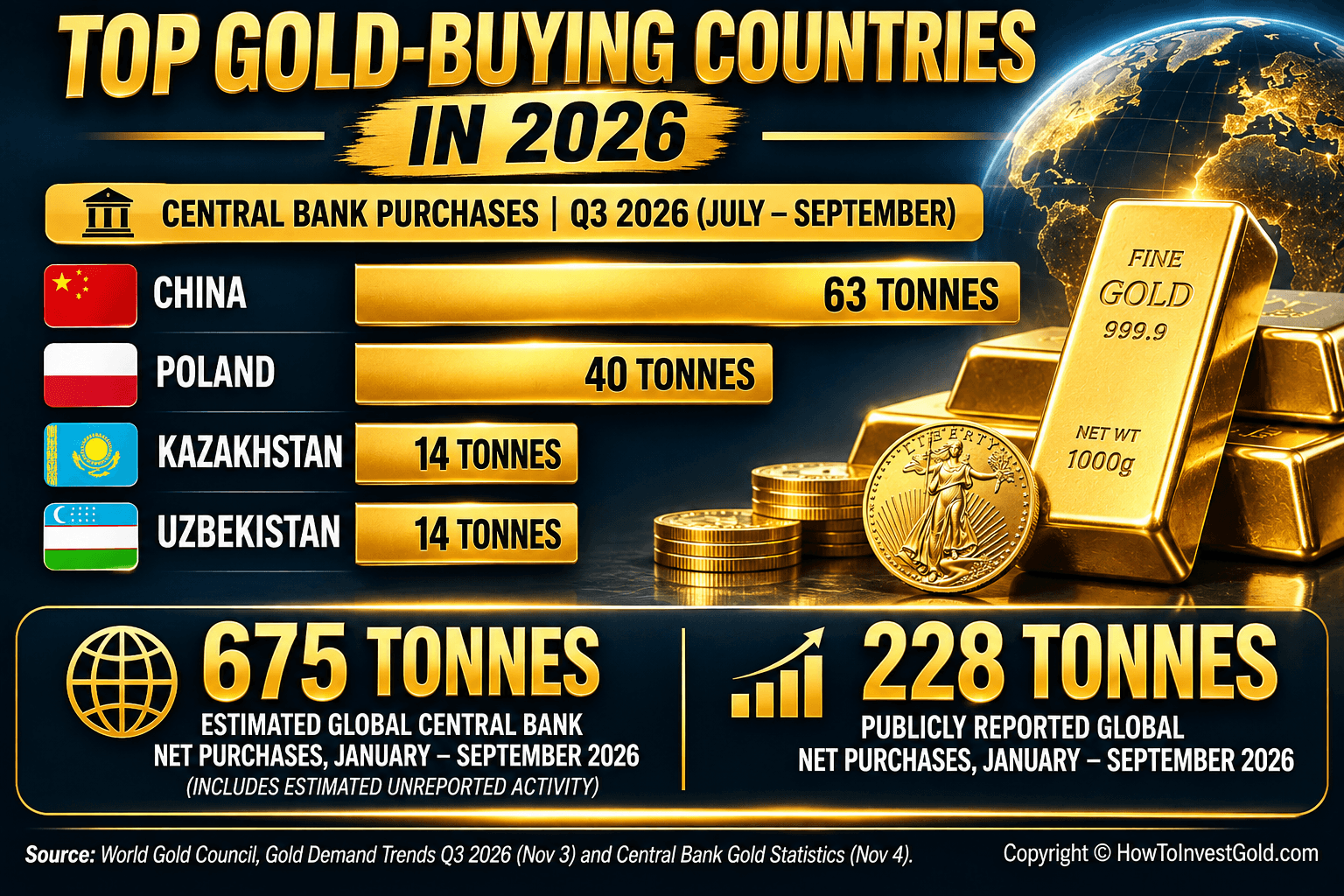
Their motivations vary, but reserve diversification, geopolitical uncertainty, sanctions risk, and concerns about debt levels are recurring themes.
Overall, mirroring central banks can be a good idea since they know what’s REALLY going on, and are preparing for it.
With that said, here are 3 recurring themes that can help explain the broader trend:
1. Diversification Away From the U.S. Dollar
Many central banks hold substantial reserves in U.S. dollars and government securities. Gold offers an alternative reserve asset that is not another country’s direct financial liability.
This distinction can become increasingly important during geopolitical disputes, financial sanctions, or periods of currency uncertainty.
2. Growing Concerns About Government Debt
Government borrowing has increased substantially across major economies.
Although debt growth does not automatically cause gold prices to rise, concerns about long-term fiscal sustainability can increase interest in assets that cannot be created through monetary expansion.
3. Gold’s Limited Supply
Unlike fiat currencies, physical gold cannot be produced through central bank policy. New mine supply depends on exploration, development, production costs, and geological availability.
This limited supply is one reason gold has historically attracted interest as a long-term store of value.
However, scarcity alone does not determine price. Investment flows and economic conditions remain crucial.
The Billionaire Gold Price Forecast of $30,000 – $50,000

Wall Street banks aren’t the only influential voices discussing gold’s future. Several billionaire investors have expressed strong views about the precious metal’s role in protecting wealth.
Let’s take a look at two prominent billionaire investors who advocate for gold.
Ray Dalio: Gold as Protection Against Financial Uncertainty
Ray Dalio, founder of Bridgewater Associates, has frequently discussed the importance of diversification and the risks associated with excessive debt.
His investment philosophy emphasizes preparing for different economic environments rather than relying on a single market outcome.
Dalio has discussed gold allocations of approximately 5% to 15% in certain portfolio contexts. His broader argument is that gold can serve as a diversifying asset when conventional financial investments face challenges.
This is particularly relevant during periods of:
- ☑️ Currency instability
- ☑️ Persistent inflation
- ☑️ Sovereign debt concerns
- ☑️ Financial-system stress
- ☑️ Geopolitical uncertainty
Dalio’s views should not be interpreted as a prediction that gold will reach a specific price in 2027. Instead, they emphasize gold’s potential role in managing long-term financial risks.
Let’s now move on to Thomas Kaplan’s bold gold price prediction.
Thomas Kaplan: Could Gold Eventually Reach $50,000?
Billionaire precious metals investor Thomas Kaplan has expressed an exceptionally bullish long-term outlook.
In an August 2026 interview, Kaplan discussed the possibility of gold eventually reaching $30,000, $40,000, or even $50,000 per ounce.
Those numbers are extraordinary. However, there is an important qualification. Kaplan did not establish a specific 2027 deadline for those price levels.
His comments reflected a longer-term perspective on gold’s potential value under significantly different monetary and financial conditions.
For gold to reach such levels, major changes in currency values, investor demand, or the global monetary system would likely be necessary.
These possibilities are speculative and should not be confused with mainstream 2027 forecasts. Nevertheless, Kaplan’s comments demonstrate just how bullish some experienced precious metals investors remain about gold’s long-term prospects.
3 Possible Price Scenarios for 2027
 Instead of relying on one prediction, investors can evaluate several potential outcomes. The following scenarios are illustrative, not guaranteed price targets:
Scenario 1: Bullish — Gold Reaches $5,500 to $6,300
In a bullish scenario, gold could recover strongly if several supportive conditions emerge simultaneously. Potential catalysts include:
- ✅ The Federal Reserve begins cutting interest rates
- ✅ Real bond yields decline
- ✅ The U.S. dollar weakens
- ✅ Central banks maintain strong gold purchases
- ✅ Investors increase allocations to physical gold and gold-backed funds
- ✅ Government debt and currency concerns intensify
Under these circumstances, gold could potentially approach the higher end of institutional forecasts. J.P. Morgan’s earlier $6,300 projection provides a reference point for this scenario.
However, reaching such a level would likely require a meaningful improvement in investor sentiment and monetary conditions.
Scenario 2: Moderate Recovery — Gold Trades Around $4,500 to $5,300
A more moderate outcome would involve continued central bank demand alongside relatively restrictive interest rates. Gold might recover gradually without returning immediately to its previous highs.
This scenario is broadly consistent with several published institutional forecasts, including those from Bank of America, Goldman Sachs, and Metals Focus.
Prices could remain volatile as investors respond to inflation data, Federal Reserve decisions, and geopolitical developments. For long-term investors, this environment would reinforce the importance of diversification and realistic expectations.
Scenario 3: Bearish — Gold Struggles Below $4,500
Gold could experience further pressure if:
- ✅ Interest rates remain higher than expected
- ✅ Inflation declines while real yields stay elevated
- ✅ The U.S. dollar strengthens
- ✅ Gold-backed ETFs experience continued outflows
- ✅ Investors favor stocks, bonds, or cash
- ✅ And central bank purchases slow
A sustained combination of these conditions could limit gold’s recovery or trigger further declines. Even if central banks remain buyers, that demand may not be enough to prevent a prolonged correction.
The lesson: Gold can be a useful portfolio diversifier without delivering positive returns every year.
Gold Price Predictions for 2027: The Four Factors to Watch Most Closely

While many developments influence gold, four deserve particular attention heading into 2027. Here are 4 key factors to watch closely when it comes to gold prices:
1. Interest Rates and Real Yields
Gold is priced in US dollars and does not generate income. That means rising interest rates can create competition from bonds, Treasury bills, and savings products.
But the key figure is not simply the stated interest rate. It is the real yield, or the return investors receive after accounting for inflation. If inflation runs above or close to interest rates, holding cash and many fixed-income investments may still erode purchasing power.
That environment can support gold. Conversely, materially higher real yields can make income-producing assets more attractive and may limit gold’s upside, at least temporarily.
Rate-cut expectations can also affect gold before the Federal Reserve makes an actual move. Markets tend to price in anticipated policy changes early.
A forecast based only on the next Fed meeting can therefore miss the broader trend in inflation, employment, growth, and bond-market expectations.
2. Inflation Is Not the Only Reason to Own Gold
Gold is commonly associated with inflation protection, and for good reason. A dollar can be created through monetary policy, while the supply of newly mined gold expands slowly.
Yet gold does not always move in a straight line with monthly inflation reports. There can be long stretches when inflation remains elevated but gold trades sideways or declines.
The stronger case for gold is broader wealth preservation. Inflation reduces purchasing power over time, while high government borrowing, currency devaluation concerns, and financial-system stress can increase the appeal of an asset held outside the banking system.
Physical gold cannot be printed out of thin air or devalued in an instant by a policy decision.
3. The U.S. Dollar and Government Debt
A stronger US dollar can make gold more expensive for buyers using other currencies, which can weigh on demand. A weaker dollar often provides the opposite effect.
However, the relationship is not absolute. During severe market stress, investors may seek both dollars and gold at the same time.
Geopolitical events also matter because they expose risks that are difficult to model in earnings forecasts or bond yields. War, trade disputes, supply disruptions, banking concerns, and sovereign-debt pressure can rapidly shift investor behavior.
Gold’s value in these moments is not that it predicts every crisis. It is that it may provide a measure of insurance when traditional financial assets are moving together in the wrong direction. These influences can pull prices in different directions.
4. Investor Demand for Physical Gold and ETFs
Central banks aren’t the only important buyers. Retail investors, institutional funds, and gold-backed ETFs can significantly influence market prices.
A renewed wave of investment inflows could accelerate a recovery. Conversely, sustained selling could prolong the correction.
What the 2027 Gold Price Forecast Means for Retirement Investors
 For retirement savers, the most important question may not be whether gold reaches $6,300. It may be whether physical gold has a useful role within a diversified long-term retirement strategy.
Traditional retirement portfolios often depend heavily on stocks, bonds, and cash-based investments. Physical precious metals can provide exposure to an asset with different characteristics.
Potential advantages include:
- ☑️ Diversification
- ☑️ Tangible ownership
- ☑️ And a possible hedge against certain financial risks
- ☑️ Also, the new Quantum Financial System (QFS) will be backed by precious metals, making owning these assets very powerful
However, gold also has disadvantages. It does not generate income, can experience significant price declines, and may involve premiums, insurance, storage costs, and transaction fees.
The appropriate allocation depends on an investor’s financial goals, time horizon, liquidity needs, and risk tolerance.
Can You Own Physical Gold in an IRA?
Yes. A self-directed Gold IRA allows qualifying physical gold bullion to be held within a retirement account.
However, the IRS imposes specific requirements. Generally, IRA-eligible gold must meet minimum purity standards of 99.5%, although certain coins, including American Gold Eagles, qualify under statutory exceptions.
The account must also follow applicable custody and storage rules. Investors generally cannot personally store IRA-owned bullion at home without risking adverse tax consequences.
A Gold IRA may be funded through eligible contributions, transfers, or rollovers from qualifying retirement accounts.
Depending on individual circumstances, these may include Traditional IRAs, certain 401(k) plans, 403(b) plans, and Thrift Savings Plans.
Before proceeding, investors should compare:
- ☑️ Custodial fees
- ☑️ Storage charges
- ☑️ Bullion premiums
- ☑️ Buyback policies
- ☑️ And the reputation of the companies involved
What This Gold Price Forecast Means for Retirement Savers
A gold price forecast should support a plan, not replace one. If your retirement savings are concentrated in equities, bonds, cash, or dollar-based funds, physical precious metals may offer diversification that behaves differently during periods of stress.
The right allocation depends on your time horizon, liquidity needs, existing holdings, tax situation, and comfort with price swings. Investors who want direct ownership can purchase bullion outright and arrange secure storage.
 Those using retirement funds may consider a self-directed Precious Metals IRA, which allows qualifying gold and other approved metals to be held through an IRS-approved custodian and depository.
The account must follow specific rules. You generally cannot store IRA-owned bullion at home, and collectible coins or non-approved metals may not qualify.
A rollover or transfer should also be handled carefully. Moving funds from a former employer’s 401(k), 403(b), a Traditional IRA, or certain TSP accounts can often be done without creating a taxable distribution when the process is structured correctly.
The distinction between a direct transfer, a direct rollover, and an indirect rollover matters. A knowledgeable Gold IRA company or custodian can help explain the process, fees, storage options, and eligible bullion before you commit funds.
If you’re searching for the best company, request a FREE Gold IRA Checklist:

Related:
- How to Start a Gold IRA in 3 Simple Steps
- 401(k) to Gold IRA Rollover Without Penalty: Rules and Steps
- TSP to Gold IRA Transfer Rules: Traditional vs Roth and Direct Rollovers
How to Protect Retirement Savings Without Chasing Gold Prices
 One of the biggest mistakes investors can make is allowing a dramatic price forecast to dictate their entire retirement strategy. Whether gold reaches $4,500 or $6,300, a long-term plan should account for the possibility of substantial volatility.
Consider the purpose of any gold allocation. Is the goal to diversify an equity-heavy portfolio, preserve purchasing power, or maintain exposure to a tangible asset outside traditional securities?
The answer should guide the investment decision more than any individual analyst’s prediction. For additional information, explore our guides to Gold IRA investing and 401(k) to Gold IRA rollovers.
Interested in learning how physical gold and silver can be held in a retirement account? Request your FREE Gold & Silver IRA Guide to explore your options, compare providers, and understand the rules before making a decision.

Top-Rated Gold Companies

With numerous precious metals companies available today, how do you know which one to select? To simplify your decision-making process, we’ve compiled a curated list of the best precious metals and Gold/Silver IRA companies in the industry. Each company has been rigorously reviewed and vetted based on several critical factors:
- BBB/BCA Ratings and Complaints: We have analyzed Better Business Bureau and Business Consumer Alliance ratings and complaints to ensure the company’s credibility and reliability
- Customer Reviews: Real customer feedback provides valuable insights into the company’s service quality and customer satisfaction
- Annual Fees: Transparent fee structures can save you from unexpected costs
- Precious Metals Selection: A diverse range of investment options allows for a more tailored portfolio
- Storage Options: Secure and accessible storage is paramount for the safety of your investments
- Promotions: Special offers and promotions can add additional value to your investment
- Buy-back Programs: Flexible buy-back programs ensure liquidity and ease of selling your assets
By considering these factors, you can make a well-informed decision that aligns with your financial goals and investment strategy. Whether you’re a retiree looking to safeguard your nest egg, an investor seeking diversification, a financial planner advising clients, or a precious metals enthusiast, this list is designed to help you find the most reliable precious metals company for your needs:
>
| Company | Reviews | Annual Fees | Investment Minimums (IRA) | Preferred Custodian | Free Gold Kit |
 |
 |
$180 | $10,000 | Equity Trust |  |
 |
 |
$180 | $25,000 | Entrust | |
 |
 |
$0 | $25,000 | Equity Trust | |
 |
|
$75-$300 | $10,000 | GoldStar Trust Company | |
 |
 |
$200 | $50,000 | Equity Trust | |
 |
 |
$250 | $20,000 | Equity Trust | |
 |
 |
$250 | $10,000 | Equity Trust | |
 |
 |
$48 | $0 | Various | |
Gold Price Prediction 2027: FAQ
Will gold reach $6,300 in 2027?
It is possible, but far from certain. J.P. Morgan’s June 2026 research projected a fourth-quarter 2027 average near $6,300. More recent forecasts from several other institutions are substantially lower.
What is Goldman Sachs’ gold price prediction for 2027?
Goldman Sachs reduced its year-end 2027 forecast to $4,800 in November 2026. Subsequent reporting indicated a further reduction to approximately $4,650.
What is Bank of America’s gold forecast for 2027?
Bank of America’s reported forecast calls for gold to average approximately $4,813 per ounce during 2027.
Why are gold prices falling if central banks are buying?
Higher interest rates, stronger Treasury yields, a rising U.S. dollar, investor selling, and changes in market expectations can outweigh central bank demand in the short term.
Could gold reach $10,000 an ounce?
Gold could theoretically reach $10,000 under sufficiently strong demand or major monetary changes. However, that is not a consensus forecast for 2027, and there is no reliable way to predict when or whether it will happen.
Did Thomas Kaplan predict $50,000 gold in 2027?
No. Kaplan discussed the possibility of gold eventually reaching $30,000–$50,000, but he did not specify 2027 as the timeframe.
Is gold a good investment for retirement?
Gold may provide diversification and exposure to a tangible asset, but it also carries price, liquidity, and ownership costs. Whether it is appropriate depends on the investor’s circumstances.
Can gold prices fall further in 2027?
Yes. Higher real interest rates, a strong dollar, reduced investment demand, or slowing central bank purchases could put additional pressure on prices.
Final Thoughts: Will Gold Reach $4,800, $6,300, or $50,000 in 2027?
 The gold price outlook for 2027 presents a fascinating contradiction. On one hand, central banks continue accumulating bullion, government debt remains a major concern, and several prominent investors believe gold has significant long-term potential.
On the other hand, restrictive monetary policy, high bond yields, and a strong dollar have contributed to substantial price volatility.
J.P. Morgan’s earlier $6,300 projection demonstrates how bullish the outlook can become when structural demand and favorable monetary conditions align.
Not to forget Thomas Kaplan’s bold prediction of $30,000 – $50,000 per ounce, and he was right about gold reaching $5,000 per ounce three years ago when that sounded like a long shot!
Meanwhile, the more cautious forecasts from Goldman Sachs, Bank of America, and the broader analyst community illustrate the challenges gold could face.
The biggest question isn’t simply whether gold can reach $6,300. It’s whether the economic forces currently pressuring gold will reverse during 2027.
If interest rates decline, the dollar weakens, and investment demand returns while central banks continue buying, another significant gold rally becomes more plausible. If those conditions fail to materialize, gold may struggle despite its longer-term appeal.
For retirement savers, the sensible approach is to evaluate gold as part of an overall financial strategy rather than relying on any single price prediction.
After all, preserving wealth isn’t about correctly predicting every market move. It’s about building a financial plan capable of navigating uncertainty.
Related:
- How to Do a Dealer Complaint Analysis for Gold IRA Investors
- IRS-Approved Gold Coins List for Gold IRAs: Avoid Expensive Mistakes
- Are Gold IRA Fees Deductible for Tax Purposes?
Request a FREE Gold & Silver Guide
Disclaimer: This article is for educational purposes only and does not constitute personalized financial or investment advice. Gold price forecasts are speculative and subject to change. Precious metals investments involve risk, including the potential loss of principal.