An Ethereum investment can serve two very different purposes: a long-term retirement allocation or a readily available position you can buy and sell whenever markets move.
That is why the Ethereum IRA versus brokerage decision is not simply about which platform has lower fees. It is about where the money comes from, how it is taxed, who controls custody, and whether the investment belongs in your retirement plan at all.For investors concerned about inflation, currency dilution, and the concentration risk of conventional stock-and-bond portfolios,
Ethereum may be worth researching as a smaller, higher-volatility diversification allocation. But the account structure matters. A decision made for convenience today can create avoidable taxes, restrictions, or security concerns later.
In this article, we’ll explore whether Ethereum IRA versus brokerage is the better option for your retirement investment. We’ll also cover important factors to consider when it comes to holding Ethereum and its tax treatment.
Let’s begin by taking a look at the real difference between an Ethereum IRA and a brokerage.
Ethereum IRA Versus Brokerage: The Real Difference
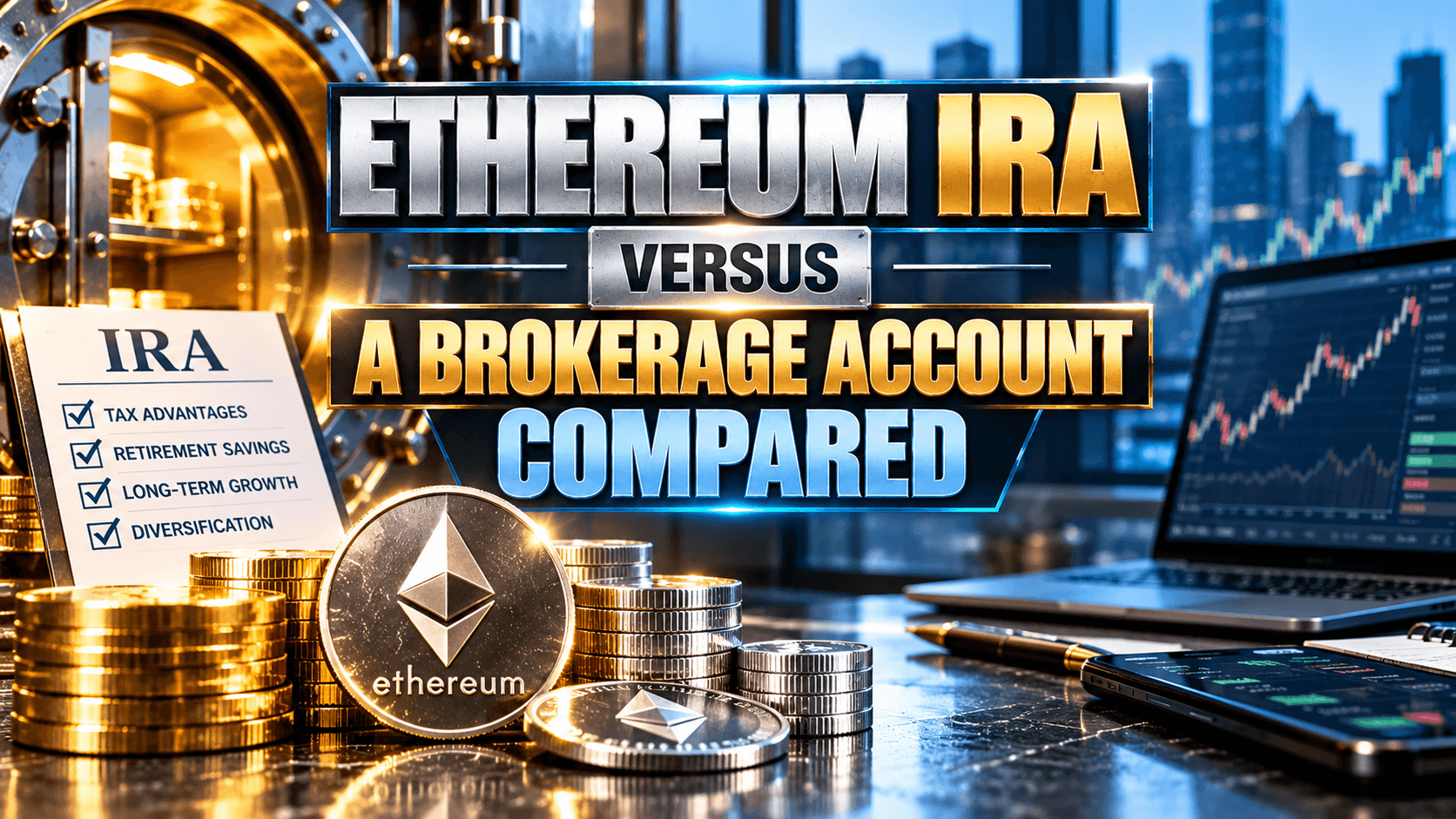
An Ethereum IRA is a self-directed retirement account that holds Ethereum through an IRS-compliant custodian and, typically, a specialized crypto IRA provider.
It may be a Traditional IRA, Roth IRA, SEP IRA, or, in some cases, a rollover account funded from a former employer plan. The Ethereum remains inside a tax-advantaged retirement wrapper.
A brokerage account is an investing account, usually funded with after-tax dollars. Depending on the firm, it may let you buy Ethereum directly, buy shares of a spot Ethereum exchange-traded fund, or gain related market exposure.
A standard taxable brokerage account has no retirement contribution limits, no required minimum distributions, and no IRA distribution rules. It also has no IRA tax shelter.
There is one point that causes frequent confusion: a major brokerage can also offer an IRA. If you buy Ethereum-related investments inside a brokerage IRA, you are still using an IRA for tax purposes.
The practical difference then comes down to what the brokerage permits you to own, whether it supports direct Ethereum or only an ETF, its custody arrangement, and its service model.
 Take action today, and request BitIRA’s FREE Guide on Digital IRAs!
Tax Treatment to Consider
In a taxable brokerage account, selling Ethereum at a gain generally creates a capital gain. The tax rate may be more favorable when an asset is held longer than one year, but every sale, swap, or use of crypto can create a reportable transaction.
Active trading may leave an investor with complicated records and a tax bill even if the proceeds remain invested.
A Traditional Ethereum IRA generally allows tax-deferred growth. If you fund it with a rollover from a pre-tax 401(k), TSP, or Traditional IRA, taxes are usually deferred until qualified withdrawals begin.
Distributions are generally taxed as ordinary income, and Traditional IRAs are subject to required minimum distributions at the applicable age.
A Roth Ethereum IRA is funded with after-tax money, or by converting pre-tax retirement funds and paying the tax due on the conversion. If Roth rules are met, qualified withdrawals can be tax-free.
For an investor who believes Ethereum could appreciate over a long holding period, that potential tax-free treatment can be compelling. It does not eliminate investment risk, and it should not be a reason to overallocate to a volatile asset.
The right choice depends heavily on your time horizon. Someone saving for retirement who does not intend to trade may value the tax structure of an IRA.
Someone who wants immediate access to funds for a home repair, business opportunity, or family need may prefer the flexibility of a taxable brokerage account.
Custody and Control Are Not the Same
 Many crypto investors are drawn to Ethereum because it is decentralized. Yet an Ethereum IRA requires a different level of operational discipline than holding coins personally.
IRS rules generally require IRA assets to be held by a qualified custodian. Moving IRA-owned Ethereum to your own hardware wallet, using it personally, or mixing it with non-retirement crypto can create prohibited-transaction concerns and may jeopardize the account’s tax-advantaged status.
That can feel restrictive, but it is also the structure that keeps retirement assets properly administered.
A reputable crypto IRA provider should explain:
- ☑️ Where assets are held
- ☑️ Which custodian is responsible
- ☑️ What security measures are used
- ☑️ Whether assets are insured under specific circumstances
- ☑️ And how trades are authorized
A taxable brokerage account may be simpler for investors who want a familiar dashboard and quick liquidity. Direct Ethereum purchased through a platform is commonly held in platform custody unless you withdraw it to a personal wallet.
An Ethereum ETF, meanwhile, gives you price exposure through a security held in your brokerage account. You do not control the underlying coins, cannot use them on the Ethereum network, and do not manage a wallet or private keys.
For retirement-focused investors, the key question is not whether self-custody is philosophically appealing. It is whether you are prepared to protect private keys, avoid scams, manage transaction risk, and maintain accurate records.
Convenience can be valuable, but so can an institutional custody framework when the assets are intended to support your later years.
Fees Deserve a Closer Look Than the Headline Price
Brokerage accounts may appear less expensive because account-opening fees are often low or nonexistent. Still, costs can show up in:
- ☑️ Trading spreads
- ☑️ Commissions
- ☑️ ETF expense ratios
- ☑️ Transfer charges
- ☑️ And the difference between the price quoted and the price executed
Investors using an Ethereum ETF should understand that an expense ratio can reduce returns over time.
Ethereum IRA providers often have more visible fees because the account requires specialized administration. You may see setup fees, annual account fees, custody charges, storage or wallet-security charges, and transaction fees.
A provider that does not clearly disclose its full fee schedule should not receive your retirement funds.
Do not judge the choice by one fee alone. Compare the total expected cost over several years, based on your planned balance and trading frequency.
A higher annual fee may be tolerable for a long-term investor who values retirement-account administration and specialized support. It is harder to justify for a small account that will be traded frequently.
Take action today, and request BitIRA’s FREE Guide on Digital IRAs!
Access, Liquidity, and Discipline
A brokerage account offers flexibility. You can add money whenever you choose, sell when you need cash, and withdraw without an IRA distribution process.
That flexibility is useful, but it can also encourage emotional decisions during sharp crypto price swings. Ethereum has experienced significant drawdowns as well as rapid recoveries. No account type removes that volatility.
An Ethereum IRA imposes useful boundaries for some investors. Annual contribution limits apply, and early withdrawals may trigger taxes and penalties unless an exception applies.
Rolling over a former 401(k), TSP, or Traditional IRA can provide a larger starting balance, but the process should be handled carefully.
A direct trustee-to-trustee transfer or direct rollover is generally cleaner than receiving funds personally and risking a missed deadline or withholding issue.
If your employer plan is active, ask the plan administrator whether an in-service rollover is permitted. Never assume that every 401(k) or TSP balance can be moved immediately.
Related:
- How to Compare Crypto IRA Providers
- Bitcoin IRAs for Retirement Diversification: Pros, Risks, & Rollover Tips
- BitIRA Review (With Fees): The Best Self-Directed IRA For Cryptocurrency?
How to Decide Which Account Fits Your Plan
 Start with the purpose of the investment. If Ethereum is a retirement allocation and you can tolerate a long holding period, an IRA may offer tax advantages worth the additional administration.
If you want flexible access, plan to invest modest after-tax money, or prefer an Ethereum ETF in a conventional account, a brokerage may be the more practical route.
Before opening either account, consider four questions:
- ☑️ Is this money truly earmarked for retirement, or might you need it within the next several years?
- ☑️ Do you want direct Ethereum ownership, or is market exposure through an ETF sufficient?
- ☑️ Can you withstand a major decline without selling at the wrong time?
- ☑️ Have you compared custody practices, total fees, customer support, and provider reputation?
For a crypto IRA provider, research should include more than marketing claims. Review its fee disclosures, trading process, custodian relationship, security procedures, complaint history, and ratings or reviews from independent consumer-reputation sources.
For a brokerage, examine whether the offering is direct crypto or an ETF, how assets are held, and what happens if you later want to transfer or liquidate the position.
Keep Ethereum in Its Proper Place
Ethereum can offer exposure to a major blockchain network, but it is not a replacement for cash reserves, income-producing investments, or the wealth-preservation role that physical gold and silver can play in a diversified plan.
Precious metals have a long history as tangible stores of value outside the financial system, while crypto brings a different growth profile and a different set of risks.
The strongest retirement plans are built around purpose, not headlines. Choose an Ethereum IRA when tax-advantaged, long-term ownership and specialized custody support your retirement strategy.
Choose a brokerage account when flexibility and straightforward access matter more. Then size the position carefully, protect the assets you have already built, and give your future self fewer reasons to make a rushed decision when markets become uncertain.
Take action today, and request BitIRA’s FREE Guide on Crypto IRAs!

Related:
- How to Open a Crypto IRA Without Costly Mistakes
- The Best Crypto Trading Course in 2026 (With One-on-One Mentorship)
- Decentralized Masters Review (2026): Top-Rated DeFi Education Platform Or A Scam?