Silver can play a meaningful role in a retirement plan built to withstand inflation, currency pressure, and market volatility. But silver held inside an IRA comes with rules that do not apply when you buy coins or bars for personal possession.
Understanding the rules for adding physical silver in an IRA before moving retirement funds can help you preserve the account’s tax advantages and avoid an expensive prohibited transaction.In this guide, we’ll break down step-by-step how to include physical silver in an IRA, which silver bullion is eligible, how to fund your IRA, tax and storage rules, and reputable Silver IRA companies to open an IRA with.
Let’s begin by taking a look at what a Silver IRA is.
What Is a Silver IRA?
A Silver IRA is generally a self-directed IRA that holds physical, IRS-approved silver through a qualified custodian and an approved depository.
Unlike traditional IRAs, which typically include investments in stocks, bonds, and mutual funds, a silver IRA is a self-directed account that allows you to hold tangible assets such as silver, gold, platinum, and palladium.
You still receive the tax treatment associated with a Traditional or Roth IRA, but the account must follow specialized rules on the metal you buy, where it is stored, and how money enters and leaves the account.
Key Benefits of a Silver IRA
Many retirement savers choose a Silver IRA rollover because it allows them to diversify beyond traditional financial assets while gaining exposure to physical precious metals.
Some key benefits and reasons for this popular investment vehicle are:
- Protection against inflation
- Reduced dependence on the stock market
- Portfolio diversification
- Long-term wealth preservation
- Exposure to growing industrial demand for silver
- And ownership of a tangible asset with intrinsic value
As demand from solar energy, artificial intelligence, electric vehicles, and advanced electronics continues to grow, many investors view silver as both a wealth-preservation asset and a potential growth opportunity.
For more details, watch this video about silver price predictions from some of Wall Street’s major financial institutions and precious metals specialists to see where silver is heading:
A Silver IRA Is a Tax-Advantaged Way to Diversify Retirement Savings
For investors looking to add physical precious metals to their retirement strategy, a Silver IRA rollover can provide an efficient and tax-advantaged solution.
By transferring funds from an existing retirement account into a Silver IRA, investors can diversify their portfolios, gain exposure to one of the world’s most important industrial metals, and potentially protect their retirement savings from inflation, market volatility, and economic uncertainty.
Related:
- Silver Demand Is Exploding: Could Prices Hit Record Highs?
- Silver Price Prediction 2026: Why Analysts Expect Higher Prices Ahead
With that brief introduction, let’s take a closer look at key rules when it comes to investing in a Silver IRA.
The Core Silver IRA Investment Rules
The IRS does not allow an IRA owner to buy just any silver item. Collectible coins, jewelry, flatware, and most rare or numismatic products generally do not qualify.
The account is intended to hold investment-grade bullion, not personal collectibles whose value depends heavily on rarity, condition, or a dealer’s sales pitch.
For most silver products, the required minimum IRA-approved fineness is .999, or 99.9% pure silver.
Eligible options often include widely traded sovereign-mint coins and qualifying bars or rounds from approved refiners.
 American Silver Eagles or Canadian Silver Maple Leafs are common examples. Silver bars can also qualify when they meet purity standards and are produced by an acceptable manufacturer.
The practical lesson is simple:
Do not assume a product is IRA eligible because it contains silver. Ask the custodian or precious metals provider to confirm that the exact coin, round, or bar is approved before your IRA sends funds.
That confirmation matters more than a product label saying “IRA suitable.”
Eligible Bullion Is Not Always the Best Bullion
 Eligibility is the starting point, not the entire decision. A one-ounce government-minted coin can carry a higher premium than a larger silver bar.
Smaller units may be easier to sell in portions, while larger bars can sometimes lower the premium per ounce. The right mix depends on your budget, storage costs, and preference for potential liquidity later.
Many retirement investors favor recognizable bullion because it is easier for dealers to quote and resell.
That does not guarantee a future price or eliminate bid-ask spreads, but it can make the liquidation process more straightforward than owning obscure products.
 See if you qualify for Goldco’s special promotion of 10% in FREE silver!

Your Silver Must Stay With a Qualified, IRS-Approved Custodian
 Physical silver in an IRA cannot be stored in your home, personal safe, bank safe-deposit box, or a vault you control.
The metals must be held by an IRS-approved trustee or custodian, typically in a professional depository arranged through that custodian.
This is one of the most misunderstood rules in precious metals investing. A home-storage arrangement may sound appealing because it promises direct access and control.
Yet if the IRA owner takes possession of the metal, the IRS may treat it as a distribution. For a Traditional IRA, that can create ordinary income taxes and, if you are under age 59 1/2, a potential additional 10% early-distribution penalty.
A properly structured Silver IRA separates your personal assets from your retirement account. The Silver IRA company or the custodian administers the account, the dealer supplies the bullion, and the depository stores it.
You direct the investment decisions, but you do not personally take possession while the silver remains inside the IRA.
Segregated vs Non-Segregated Storage
When reviewing storage arrangements, ask whether the depository offers segregated or non-segregated storage.
Segregated storage means your specific bars or coins are separately identified and held apart from other clients’ metals.
Non-segregated, sometimes called commingled storage, means you own a specified quantity and type of silver held alongside similar bullion belonging to other clients.
Neither choice is automatically better. Segregated storage may provide added reassurance for investors who want their exact products returned, but it can cost a bit more (typically $150 per year).
Non-segregated storage may be less expensive (generally $100 per year) and still provides allocated ownership under the depository’s records. Common depositories are the Delaware Depository and Brinks.
Review the custodian agreement, insurance coverage, audit practices, and annual storage fees before deciding.
Related:
- How to Buy Silver Bullion Without Costly Mistakes: A Beginner’s Guide
- 10 Powerful Reasons Why You Should Invest in Silver: Industrial Demand for Silver Is Booming!
- Buying Silver Bullion As An Investment: Skyrocket Your Wealth!
How to Fund a Silver IRA Without Creating Tax Trouble
 You can fund a Silver IRA with annual contributions, an IRA-to-IRA transfer, or a rollover from an eligible workplace plan such as a 401(k), 403(b), or TSP.
The cleanest route is often a direct transfer or direct rollover, where funds move between institutions without being paid to you personally.
A direct trustee-to-trustee IRA transfer does not have the same 60-day deadline as an indirect rollover. It also avoids the risk of having retirement funds temporarily pass through your bank account.
For investors moving funds from a former employer plan, a direct rollover to the new self-directed IRA is usually the more controlled approach.
An indirect rollover is more demanding. If you receive the funds yourself, you generally have 60 days to deposit the full amount into the receiving IRA.
Missing the deadline can make the amount taxable. There are also withholding issues with employer plans and limits that can apply to IRA-to-IRA rollovers, so this is not a process to handle casually.
If you are still employed, your current 401(k) or TSP may restrict rollovers until you separate from service or meet plan-specific conditions. However, you can always start a new Self-Directed IRA.
So, contact the plan administrator before opening an account based on assumptions about what can be moved.
Annual IRA contributions are subject to IRS limits that can change from year to year. Contribution eligibility and deductibility can also depend on income, tax filing status, and participation in an employer retirement plan.
Check the current IRS limits or speak with a qualified tax professional before contributing new cash. For more information, you can check out our ultimate gold IRA tax rules guide.
Eligible Retirement Accounts for a Silver IRA Rollover
You may be able to roll over funds from:
- Traditional 401(k) plans
- Former employer 401(k) accounts
- 403(b) retirement plans
- 457 government plans
- Thrift Savings Plans (TSP)
- Traditional IRAs
- SEP IRAs
- SIMPLE IRAs (subject to IRS requirements)
If you currently participate in an active employer-sponsored retirement plan, additional restrictions may apply. It’s often best to consult your plan administrator or a Silver IRA specialist to determine eligibility.
Request a FREE Info Kit to learn about a little-known IRS loophole!

What Are the Taxes, Distributions, and Required Withdrawals?
A Silver IRA does not make silver gains permanently tax-free by itself. Tax treatment depends on whether you use a Traditional or Roth account and whether you follow the applicable distribution rules.
Here are the different rules for Traditional vs Roth Silver IRA:
✅ Traditional Silver IRA
With a Traditional Silver IRA, contributions may be tax-deductible if you qualify, and growth is generally tax-deferred.
Withdrawals are generally taxed as ordinary income. That means the tax treatment differs from owning silver personally, where certain gains may receive collectible tax treatment instead.
✅ Roth Silver IRA
A Roth Silver IRA is funded with after-tax dollars. Qualified distributions can be tax-free if the Roth rules are met.
Roth accounts can be powerful for investors who expect taxes to be higher later, although eligibility to contribute directly to a Roth is income-dependent.
Traditional IRA owners must also plan for required minimum distributions, or RMDs, beginning at the applicable age under current law.
Silver creates an added logistical issue: RMDs are calculated in dollars, while the account holds physical metal.
You may need to sell enough bullion for cash, take an in-kind distribution of silver valued at fair market value, or use distributions from another Traditional IRA to satisfy the requirement if your tax professional confirms that approach fits your situation.
Taking silver as an in-kind distribution means the metal leaves the IRA and becomes your personal property. Its value on the distribution date is generally taxable in a Traditional IRA, but you may then hold or sell it personally.
Make sure to plan ahead rather than waiting until the final weeks of the year, when pricing, shipping, and dealer availability can complicate a sale.
See if you qualify for Goldco’s special promotion of 10% in FREE silver!
Fees and Liquidity Deserve the Same Attention as Purity
Silver is often less expensive per ounce than gold, but it requires far more physical space for the same dollar value. That can make storage fees especially relevant. Before funding an account, request a clear fee schedule covering:
- Account setup
- Annual custodian administration
- Storage
- Insurance
- Transaction charges
- And any fees tied to selling or taking delivery
Most self-directed IRA custodians charge a one-time account setup fee, which is often around $50 to $100, along with a small wire transfer or transaction fee.
In addition, investors can expect an annual account administration fee that generally ranges from $75 to $150 per year, so the total cost is typically around $280-300 per year for a Silver IRA.
However, companies like Goldco and Augusta Precious Metals are currently offering promotions of $0 IRA fees for qualifying accounts.
A Buyback Program Is Crucial
Also ask how the provider handles buybacks. A dealer’s willingness to buy metals back does not mean it guarantees a price, timeline, or liquidity under every market condition.
Still, understanding the process before you buy is a prudent part of retirement planning. Avoid making a decision based only on a promotional offer or a low advertised price.
Compare the total cost of ownership, the premium over the silver spot price, the provider’s reputation, customer service record, and the clarity of its paperwork.
A transparent provider should be able to explain each cost without pressure or vague answers.
A Safe and Legit Process for Opening a Silver IRA
Start by deciding how much of your retirement savings you want exposed to precious metals. Silver can support diversification, but it can also be volatile and is not a substitute for a complete retirement plan.
Your allocation should reflect your time horizon, income needs, existing holdings, and comfort with price swings.
To get started, we suggest requesting this FREE Gold & Silver Guide. This comprehensive guide details how you can incorporate precious metals into your retirement savings.
Within 15 minutes of your request, a precious metals specialist from our #1 recommendation for a precious metals IRA company, Goldco, will reach out to answer any questions you may have.
Here’s the simple 3-step process to start a silver IRA:
✓ Step 1. Sign Your Agreement
Sign Your Agreement: Review, approve, and sign a standard customer agreement to secure your precious metals purchase and understand the terms of doing business. Choose a custodian company: If you don’t have a precious metals custodian company, the precious metals IRA company you choose will assist you in setting up an account with one of their preferred custodians.
✓ Step 2. Fund Your Account
Fund Your Account: Most gold and silver IRA companies offer convenient options for funding your account, such as bank wire transfers or mailing a check to their local offices.
✓ Step 3. Select Your Precious Metals
Select Your Precious Metals: With funds in your account, it’s time to decide which precious metals to add to your portfolio. Choose your preferred metals, and your silver IRA provider will handle the shipping to your choice of IRS-approved depository.
Keep every account statement, transaction confirmation, fee disclosure, and valuation record. These documents help you monitor costs and make future distribution or estate-planning decisions with greater confidence.
Silver is both a monetary metal and an industrial metal, which can create opportunity as demand changes across manufacturing, energy, technology, and investment markets.
That dual role can also bring sharper price moves. Following the rules carefully allows you to pursue silver’s long-term wealth-preservation potential without putting the tax-advantaged foundation of your retirement account at risk.
But the future looks promising for silver, which we’ll take a look at next.
Silver Price Predictions for 2026
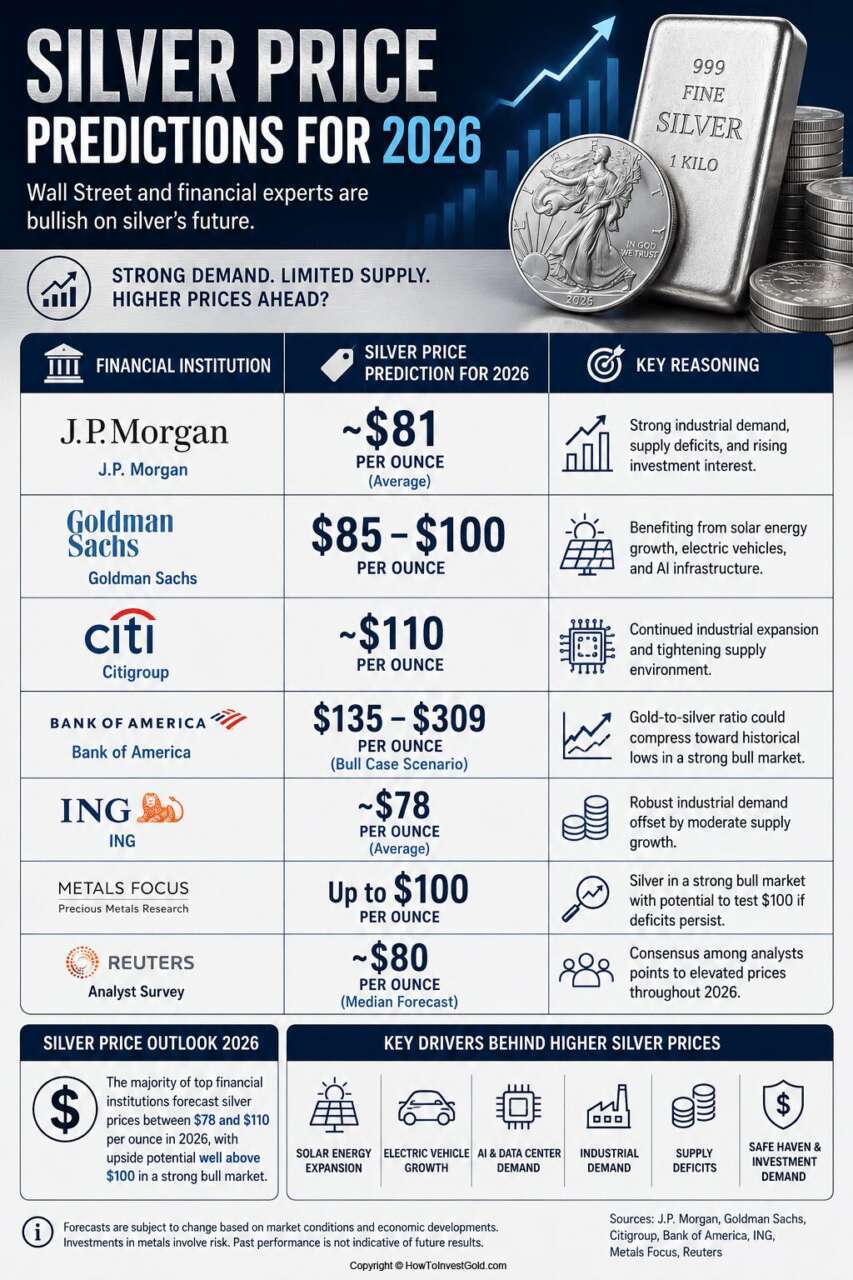
Several of the world’s largest financial institutions have issued bullish forecasts for silver prices. Here’s an infographic showcasing silver price predictions from seven major financial institutions:
You can also watch this video about an expected silver price breakout because of increasing industrial demand while silver supply is limited:
Risks Investors Should Consider
While the outlook for silver remains positive, investors should recognize that silver prices can be volatile. Factors that could impact silver prices include:
- Changes in interest rates
- Economic slowdowns
- Strength in the U.S. dollar
- Reduced industrial activity
- And market sentiment shifts
Like any investment, silver should be considered as part of a diversified portfolio rather than a standalone strategy.
With the price predictions and risks in mind, let’s move on to presenting the most reputable precious metals companies in the industry to help you set up your Silver IRA.
Top-Rated Silver IRA Companies
With numerous precious metals IRA companies available today, how do you know which one to select? To simplify your decision-making process, we’ve compiled a curated list of the best precious metals companies in the industry. Each company has been rigorously reviewed and vetted based on several critical factors:
- BBB/BCA Ratings and Complaints: We have analyzed Better Business Bureau and Business Consumer Alliance ratings and complaints to ensure the company’s credibility and reliability
- Customer Reviews: Real customer feedback provides valuable insights into the company’s service quality and customer satisfaction
- Annual Fees: Transparent fee structures can save you from unexpected costs
- Precious Metals Selection: A diverse range of investment options allows for a more tailored portfolio
- Storage Options: Secure and accessible storage is paramount for the safety of your investments
- Promotions: Special offers and promotions can add additional value to your investment
- Buy-back Programs: Flexible buy-back programs ensure liquidity and ease of selling your assets
By considering these factors, you can make a well-informed decision that aligns with your financial goals and investment strategy. Whether you’re a retiree looking to safeguard your nest egg, an investor seeking diversification, a financial planner advising clients, or a precious metals enthusiast, this list is designed to help you find the most reliable precious metals IRA company for your needs:
>
| Company | Reviews | Annual Fees | Investment Minimums (IRA) | Preferred Custodian | Free Gold Kit |
 |
 |
$180 | $10,000 | Equity Trust |  |
 |
 |
$180 | $25,000 | Entrust | |
 |
 |
$0 | $25,000 | Equity Trust | |
 |
|
$75-$300 | $10,000 | GoldStar Trust Company | |
 |
 |
$200 | $50,000 | Equity Trust | |
 |
 |
$250 | $20,000 | Equity Trust | |
 |
 |
$250 | $10,000 | Equity Trust | |
 |
 |
$48 | $0 | Various | |
Physical Silver in an IRA: FAQ
What is a Silver IRA and how does it differ from a traditional IRA?
A Silver IRA is generally a self-directed IRA that holds physical, IRS-approved silver through a qualified custodian and an approved depository.
Unlike traditional IRAs that typically invest in stocks, bonds, and mutual funds, a Silver IRA allows you to hold tangible assets such as silver, gold, platinum, and palladium, while still receiving the tax treatment of a Traditional or Roth IRA, and following specialized rules on the metal, its storage, and how money enters and leaves the account.
What silver products are eligible for a Silver IRA?
The IRS does not allow every silver item; collectibles and most numismatic products do not qualify. Eligible options include investment-grade bullion with IRA-approved fineness of .999 (99.9% pure).
And qualifying bars or rounds from approved refiners, such as widely traded sovereign-mint coins like American Silver Eagles or Canadian Silver Maple Leafs, and bars that meet purity standards and come from acceptable manufacturers.
Where must the silver in a Silver IRA be stored?
The metals must be held by an IRS-approved trustee or custodian, typically in a professional depository arranged through that custodian. You cannot store physical silver at home, in a personal safe, or in a bank safe-deposit box; the custody and depository arrangements separate your personal assets from the retirement account.
How can you fund a Silver IRA and what about rollovers?
You can fund a Silver IRA with annual contributions, an IRA-to-IRA transfer, or a rollover from an eligible workplace plan such as a 401(k), 403(b), or TSP. The cleanest route is often a direct transfer or direct rollover, where funds move between institutions without being paid to you personally.
An indirect rollover requires you to deposit the funds within 60 days, and missing the deadline can make the amount taxable.
What are the taxes and distribution rules for a Silver IRA?
With a Traditional Silver IRA, contributions may be tax-deductible and growth is generally tax-deferred, while withdrawals are taxed as ordinary income. A Roth Silver IRA is funded with after-tax dollars, and qualified distributions can be tax-free.
Traditional IRA owners must plan for RMDs, which can be complex with physical silver since RMDs are calculated in dollars while the account holds metal. An in-kind distribution leaves the silver from the IRA and becomes personal property, generally taxable on the distribution date for Traditional IRAs.
See if you qualify for Goldco’s special promotion of 10% in FREE silver!