The answer depends less on a headline claim and more on your experience level, risk tolerance, and ability to verify what you are being offered before you commit.
Crypto can be a meaningful diversification tool, but it is not a safe-haven asset in the same way physical gold has historically served investors.
Digital assets can experience sharp gains and equally sharp declines. Education may help you understand the market, but no course, community, or analyst can remove that risk.
In this Decentralized Masters reviews article, we’ll take a look at the company and their background, what to look for when vetting a crypto trading platform, potential risks with crypto investing, and provide a due diligence checklist.
Let’s begin by taking a look at what Decentralized Masters is.
What Is Decentralized Masters?
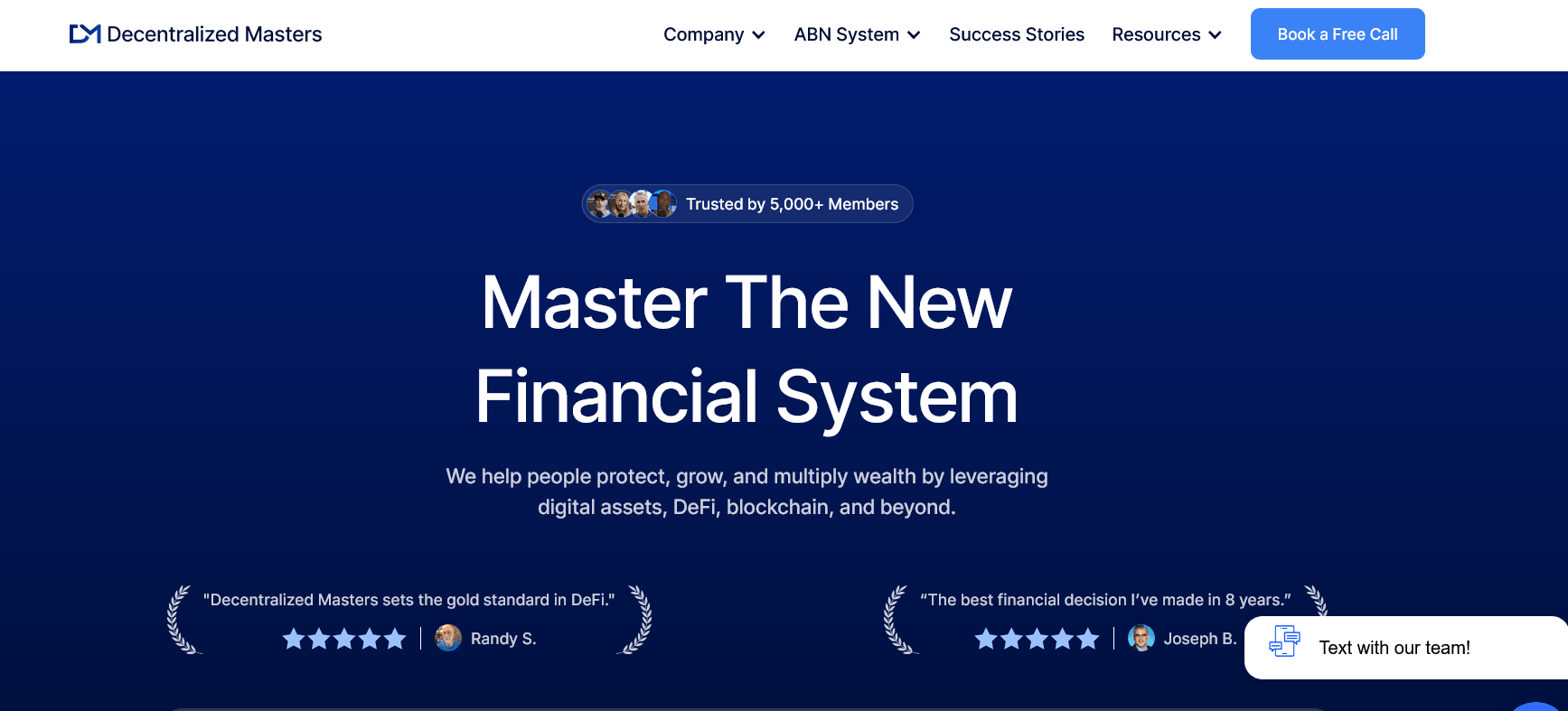
Decentralized Masters is a cryptocurrency education and research platform associated with teaching members about digital assets, market cycles, decentralized finance, and portfolio ideas.
Its model is centered on educational content and a member community rather than acting as a bank, exchange, IRA custodian, or investment adviser managing client money.
That distinction matters. A crypto education company may provide research, frameworks, training, and access to market commentary, but the member generally remains responsible for each purchase, sale, wallet decision, and tax consequence.
It should not be confused with a Crypto IRA provider that helps establish a tax-advantaged retirement account or with a qualified custodian that safeguards retirement assets.
For self-directed investors, the appeal is understandable. Cryptocurrency markets move quickly, jargon can be intimidating, and bad information is everywhere.
A structured learning environment may be valuable for someone who wants to develop a process instead of reacting to social-media hype or chasing every new token.
 Take action today and learn how to navigate the DeFi landscape professionally!

What Decentralized Masters Reviews Should Examine
The most useful Decentralized Masters reviews do not stop at testimonials or a list of course modules. They assess whether the program’s approach fits the investor and whether its claims are presented with appropriate caution.
Start with the curriculum. A credible program should explain fundamental concepts such as:
 Blockchain networks
- Wallets
- Private keys
- Exchange risk
- Stablecoins
- Token supply
- Liquidity
- And the difference between spot ownership and leveraged trading
It should also address risk management. If the emphasis is only on finding the next asset that could multiply in value, prospective members should be cautious.
Next, look at the quality and timing of the research. Crypto markets are cyclical, and an idea that appeared successful during a strong bull market may look very different during a downturn.
Ask whether the educational material explains why a thesis could fail, what would invalidate it, and how position sizing affects a portfolio.
Good research gives readers a framework for uncertainty. Promotional research often treats uncertainty as an inconvenience.
Community access can be another important consideration. Some investors value the ability to ask questions, compare notes, and hear from experienced market participants.

Yet a busy community can also create pressure to act quickly. A group consensus is not due diligence, and a popular trade is not automatically a prudent one.
Finally, separate educational value from expected investment returns. Paying for training may be worthwhile if it helps you become more informed and disciplined.
It is not worthwhile if you are treating the membership fee as a shortcut to guaranteed gains. Cryptocurrency remains speculative, even when the analysis is thoughtful.
Decentralized Masters Reviews
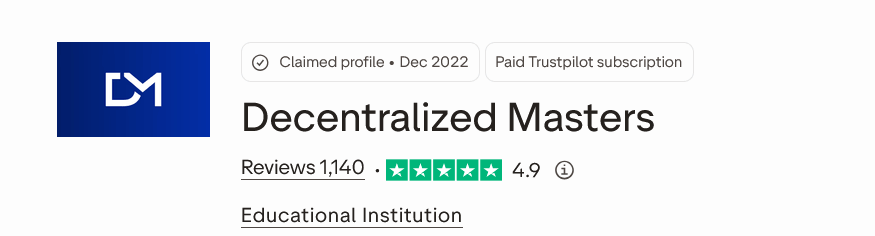
We’ve analyzed available reviews across various platforms to provide a comprehensive picture of member experiences with Decentralized Masters, and here’s a summary of some recent reviews:
- Firstly, Decentralized Masters has maintained a 4.9 out of 5-star rating on Trustpilot based on 1140 member reviews
- Secondly, the company has received positive testimonials highlighting the quality of education and mentorship
- Best of all, there are no significant complaints found on major review platforms, which shows the company is doing legitimate business

Who May Benefit From the Program?
 Decentralized Masters may be a better fit for investors who already understand that crypto is high risk and want a structured way to learn more about the sector.
This can include investors who have a defined allocation for digital assets, are willing to study market fundamentals, and can tolerate volatility without making emotional decisions.
It may also appeal to people who want to explore decentralized finance, smaller cryptocurrency projects, or broader market research beyond the largest coins.
These areas can offer opportunity, but they often bring higher complexity, thinner liquidity, technology risk, and greater exposure to fraud or failure.
The program may be less appropriate for someone nearing retirement who needs predictable income, cannot afford major losses, or is still establishing an emergency fund.
It may also be a poor match for an investor who expects personal financial advice, account management, or retirement-account administration.
Educational content is not a substitute for individualized guidance from a qualified tax, legal, or financial professional.
For many retirement savers, crypto should be considered a limited satellite position rather than the foundation of a wealth-preservation strategy.
Physical gold and silver can serve a different role because they are tangible assets with a long history as stores of value and are not dependent on a digital network, a protocol upgrade, or a trading platform remaining available.
Take action today and download the FREE DeFi Investment Strategy Kit!

The Risks That Reviews Can Miss
 Online reviews can be useful, but they are only one input. Positive experiences may reflect strong customer service, an engaging instructor, or timely market calls.
Negative experiences may reflect billing concerns, a mismatch in expectations, or investment losses after acting on information from the program. None of these factors alone proves the quality of the education.
Before purchasing, read the terms carefully. Confirm the total cost, whether there are recurring charges, what is included at each membership level, and whether a refund policy applies.
Keep records of the offer you accepted. If a program includes live calls, private groups, or time-sensitive research, determine whether those features are available for the full period you are paying for.
It is also wise to research the company independently:
- Check multiple third-party consumer review platforms
- Read the details behind both favorable and critical feedback
- And look for responses to complaints
- Also, focus on patterns rather than a small number of unusually enthusiastic or unusually angry reviews
A company’s own testimonials may be informative, but they are selected marketing material, not a complete picture.
Be particularly careful with performance claims. Crypto markets can make a strategy look brilliant for a short period, especially when prices are rising across the board.
Ask whether results account for losses, fees, taxes, drawdowns, and the difficulty of following every recommendation in real time. Past performance does not predict future results, and hypothetical gains deserve additional skepticism.
A Practical Due-Diligence Checklist
Before joining any crypto education community, take a measured approach. You should be able to answer four basic questions:
- What exactly am I buying?
- What is the full cost?
- What risks am I accepting?
- What would make me leave or decide not to renew?
Review the program’s public materials and member terms before entering payment information. Confirm whether the content is designed for beginners, active traders, or long-term investors.
If you are using retirement funds, do not assume a standard education membership makes an investment IRA-eligible.
Crypto held in an IRA must be structured through the appropriate account and custody arrangement, and the rules around prohibited transactions deserve careful attention.
Set an allocation limit before you receive a new market idea. For example, an investor may decide that speculative digital assets will represent only a modest percentage of investable assets, while the remainder stays diversified among more established holdings, cash reserves, and hard assets such as gold or silver.
The right percentage varies by age, goals, income needs, and tolerance for loss. Protect custody as seriously as asset selection.
Learn the difference between holding coins on an exchange and using a personal wallet.
Understand that losing a private key, approving a malicious transaction, or sending funds to the wrong address can result in permanent loss. No course can fully protect an investor who ignores basic security practices.
Related:
- Decentralized Masters Review (2026): Top-Rated DeFi Education Platform Or A Scam?
- The Best Crypto Trading Course in 2026 (With One-on-One Mentorship)
Remember That Education Is a Tool, Not a Retirement Plan
The strongest reason to consider a program like Decentralized Masters is not to copy someone else’s trades. It is to improve your ability to ask better questions, recognize speculation, and build a plan that does not depend on perfect timing.
For Americans protecting a lifetime of savings, diversification should remain the guiding principle.
Crypto may offer long-term growth potential and exposure to a developing financial technology, but it should be balanced against assets designed for resilience.
Gold and silver can help provide that counterweight because they cannot be printed out of thin air or devalued by a single policy decision.
Take your time, verify the offer, and invest only what fits your broader plan. Confidence in retirement is built through disciplined decisions, not urgency, headlines, or promises of the next big winner.
Related:
- BitIRA Review 2026 (With Fees): The Best Self-Directed IRA For Cryptocurrency?
- A New Financial System Is Emerging: NESARA GESARA (QFS)—Two Key Assets To Skyrocket Your Wealth!