A retirement account can show a healthy dollar balance while quietly losing buying power. If groceries, energy, housing, and medical costs keep climbing, the question is not simply whether your portfolio is growing. It is whether it can still support the retirement lifestyle you planned for.
This inflation hedge asset list can help you evaluate assets that may offer protection when cash and traditional fixed-income holdings fall behind rising prices.No single asset defeats inflation in every market cycle. Gold can go through long stretches of flat or declining prices. Real estate can be hurt by high borrowing costs.
Treasury inflation-protected securities may not keep pace with every household expense. The practical goal is diversification: owning assets with different drivers of return so your retirement security does not depend entirely on the dollar, stock market valuations, or bond yields.
Let’s dive in!
Inflation Hedge Asset List: Top 6 Safe Haven Assets

An effective inflation strategy starts with understanding what you are trying to protect. For many Americans nearing retirement, that means preserving purchasing power, limiting the damage from market shocks, and keeping enough liquidity for near-term expenses.
It does not mean chasing whichever asset had the best performance last year. The following assets have historically been considered potential inflation hedges.
Each carries its own role, risks, tax considerations, and ownership requirements. Here are the top 6 safe haven assets available to create an inflation hedge:
1. Physical Gold
 Gold has served as a store of value for centuries because it cannot be printed out of thin air, diluted by a central bank decision, or tied to the earnings of one company.
When confidence in paper currencies, government debt, or financial markets weakens, investors often turn to gold as a safe haven asset.
Gold does not produce income, and its price can be volatile over shorter periods. Still, its value as a diversifier is often most visible when stocks, bonds, and the dollar face pressure at the same time.
Central bank gold buying and concerns about long-term debt levels have also kept attention on the metal as a form of monetary insurance.
For more details, check out this video about why central banks are dumping paper assets for gold right now:
Investors can own physical gold outright or hold qualifying bullion through a self-directed Gold IRA. IRA-held metals must meet IRS purity standards and be stored with an approved depository, not at home.
That added structure brings custodian and storage fees, but it can also allow for tax-deferred or, in a Roth structure, potentially tax-free qualified growth.
2. Physical Silver
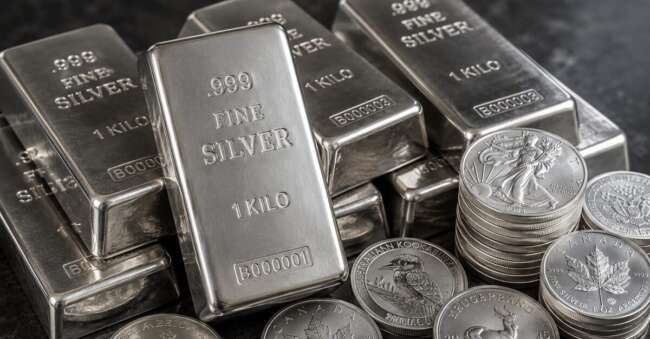 Silver shares many of gold’s monetary characteristics, but it also has a major industrial side. It is used in solar panels, electronics, medical applications, and other technologies.
That dual demand can create upside during periods of growing industrial consumption, though it can also make silver more volatile than gold.
For investors who want precious-metals exposure at a lower dollar price per ounce, silver can be a useful complement to gold.
It should not be viewed as a direct substitute, however. Gold tends to be the more established monetary reserve asset, while silver can move more sharply in both directions.
A Silver IRA can hold approved coins and bars under the same general self-directed IRA framework. As with gold, work through the costs carefully: dealer spreads, annual account fees, and storage expenses all affect long-term results.
Check out this video about silver price predictions from some of Wall Street’s major financial institutions by the end of 2026:
3. TIPS
Treasury Inflation-Protected Securities, commonly called TIPS, are U.S. government bonds whose principal adjusts with changes in the Consumer Price Index.
When reported inflation rises, the bond’s principal value rises as well, and interest payments are calculated from that adjusted principal.
TIPS are designed specifically for inflation protection, but they are not a perfect answer. Their performance depends on interest rates, market expectations, and the gap between actual inflation and what markets already expected.
A retiree also needs to recognize that the CPI may not match personal expenses, particularly if health care, insurance, or housing costs are rising faster than the index.
TIPS can fit investors who want a more conservative, income-oriented inflation hedge. They are fundamentally different from precious metals: they remain part of the government bond system, while gold and silver are tangible assets held outside the banking system.
 If you’re searching for the best company, request a FREE Gold IRA Checklist:

4. Real Estate and REITs
 Real estate can provide inflation resistance because rents and property values may rise over time with prices and wages.
A landlord who can increase rents may have a better chance of preserving income than a bondholder receiving a fixed payment.
Directly owned property can also offer a tangible asset that cannot be created with a keystroke.
But real estate is not automatically protective. Properties require maintenance, insurance, taxes, management, and patience.
High interest rates can reduce property values and make refinancing difficult. Publicly traded real estate investment trusts, or REITs, offer easier access and liquidity, but their share prices can decline with the broader stock market.
For retirement investors, real estate can make sense as one piece of a diversified plan rather than a reason to concentrate savings in a single rental property or local market.
5. Broad Commodities
Commodities such as energy, industrial metals, and agricultural products are closely tied to the real-world inputs that drive inflation.
When fuel, food, or raw-material prices surge, broad commodity exposure may rise alongside them.
The challenge is that commodities can be cyclical and unpredictable. They do not generate cash flow, and a broad commodities fund can be affected by futures contracts, rolling costs, and market structure.
Commodity exposure may be useful as a limited tactical or diversifying allocation, but it is usually not a complete retirement foundation.
Gold and silver differ from broad commodities because they carry both supply-and-demand dynamics and a long history as monetary metals.
That distinction matters for investors seeking protection from currency debasement and financial-system uncertainty, not merely higher oil or wheat prices.
6. Bitcoin and Other Cryptocurrency
 Bitcoin is often described as a digital scarcity asset because its supply is capped at 21 million coins. Supporters see it as a potential hedge against currency debasement and an alternative to assets controlled by governments or banks.
For investors comfortable with technology and volatility, a Crypto IRA may offer a tax-advantaged way to gain exposure.
The trade-off is substantial price risk. Cryptocurrency has experienced deep drawdowns, regulatory changes, exchange failures, and periods when it traded more like a speculative technology asset than an inflation hedge.
It has a much shorter history than gold, and its role during future inflationary cycles remains uncertain.
For that reason, crypto may be better treated as a measured satellite holding than the core of a retirement inflation plan. Investors should also understand:
 Custody
- Trading fees
- Platform security
- And which digital assets are available through a particular IRA provider
Related:
- How to Start a Gold IRA in 3 Simple Steps
- How to Start a Silver IRA in 3 Simple Steps
- Crypto IRA Tax Advantages: Traditional vs Roth IRA Explained
How to Build an Inflation-Resistant Mix
The right mix depends on your time horizon, income needs, existing holdings, and ability to tolerate price swings.
Someone already heavily invested in stocks and bonds may look to precious metals for diversification. Someone who needs dependable income soon may place greater weight on TIPS, cash reserves, and high-quality bonds.
A younger investor with a long runway may accept a modest allocation to more volatile assets such as silver, real estate, or bitcoin.
Start by reviewing what you already own. Many 401(k) and traditional IRA investors discover they have significant exposure to the same underlying risks: publicly traded stocks, corporate bonds, and dollar-based funds.
Diversification is not achieved by owning several funds that all decline when inflation surprises markets or confidence deteriorates.
If you are considering a rollover to a self-directed Precious Metals IRA or Crypto IRA, understand the mechanics before moving funds.
A direct trustee-to-trustee transfer is generally different from a 60-day rollover, and the rules can affect timing and taxes.
Ask clear questions about:
- Custodians
- Approved assets
- Storage
- Fees
- Buyback policies
- And the provider’s standing with independent consumer-review organizations
A reputable company should explain the process without pressuring you to make a rushed decision.
Take action today, and request BitIRA’s FREE Guide on Digital IRAs!
What Not to Expect From an Inflation Hedge Asset
An inflation hedge is not a guarantee against loss. It is a tool for reducing a specific risk: the risk that your dollars purchase less over time.
During some periods, stocks may outperform gold. During others, cash may briefly look attractive because interest rates rise. The value of diversification is that you do not have to predict every turn correctly.
Avoid making a major allocation decision based on fear-driven headlines, a single price forecast, or promises of guaranteed returns.
Consider liquidity as carefully as growth potential. Retirement assets should support real spending needs, not create a situation where you must sell a volatile holding at the wrong time.
Protecting retirement wealth is less about finding one perfect investment and more about refusing to leave your future exposed to one fragile system.
A deliberate allocation to tangible assets, inflation-linked securities, and carefully sized alternative investments can give you more confidence that the wealth you built will still work for you and your family when it matters most.
Related:
- How to Compare Crypto IRA Providers
- 8 Gold IRA Scam Warning Signs Before You Buy
- Gold IRA Tax Rules: The Ultimate Gold IRA Tax Guide
Inflation Hedge List: FAQ
What is the purpose of an inflation hedge asset list for retirement savers?
The purpose is diversification to own assets with different drivers of return so retirement security does not depend entirely on the dollar, stock market valuations, or bond yields, while preserving purchasing power as everyday costs rise.
What are the top inflation hedge assets and their general roles?
The list includes physical gold, physical silver, TIPS, real estate and REITs, broad commodities, and Bitcoin or other cryptocurrency, each offering different mechanisms to help protect purchasing power and diversify risk in retirement portfolios.
How does gold function as a safe haven asset, and what are its limitations?
Gold has served as a store of value and can act as a safe haven when confidence in paper currencies or markets weakens, but it does not produce income and can be volatile in shorter periods.
What are TIPS and how do they compare to precious metals as inflation hedges?
TIPS are U.S. government bonds whose principal adjusts with CPI changes, providing inflation protection through the bond system, unlike gold or silver, which are tangible assets held outside the banking system.
How should investors approach building an inflation-resistant mix for retirement?
Start by reviewing current holdings, aiming for a diversified plan that can include tangible assets, inflation-linked securities, and carefully sized alternatives, with attention to liquidity and the specific risks of each asset class.