A retirement account concentrated in paper assets can feel exposed when inflation erodes purchasing power, markets turn volatile, or confidence in the dollar weakens.
Learning how to establish a Silver IRA gives eligible investors a regulated way to hold physical silver inside a tax-advantaged retirement account, rather than simply adding another fund or stock to the portfolio.Silver is not a guaranteed investment, and its price can move sharply in either direction. But it has a role that many retirement savers value: it is a tangible asset with monetary history, growing industrial demand, and no ability to be printed out of thin air.
A properly structured Silver IRA can help add diversification for investors who want part of their long-term wealth positioned outside the traditional financial system.
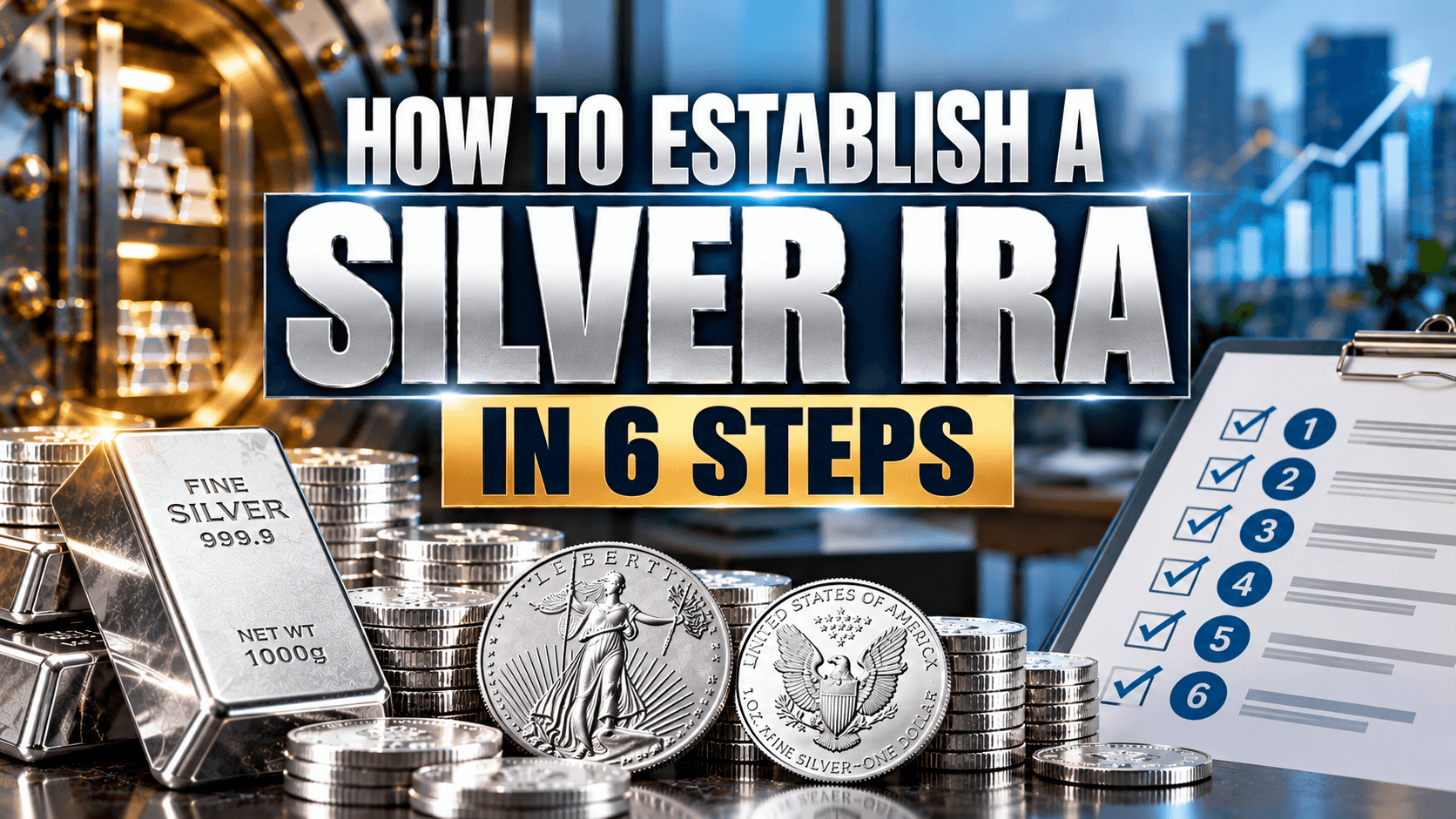
Let’s get straight to the point and show you how to establish a Silver IRA in 6 simple steps.
How to Establish a Silver IRA: The Simple 6-Step Process
A Silver IRA is usually a self-directed IRA that holds IRS-approved physical silver. The account must follow specific rules concerning the custodian, the metals purchased, and where those metals are stored.
The process is manageable when each party has a clearly defined role:
1. Decide Whether Silver Fits Your Retirement Savings Strategy
Before opening an account, decide what job silver should perform in your portfolio. Some investors use it as a modest diversification position alongside stocks, bonds, and cash.
Others view physical bullion as a long-term store of value and a potential hedge against currency devaluation, banking stress, and geopolitical uncertainty.
Your silver allocation should depend on your time horizon, liquidity needs, risk tolerance, and existing holdings.
Silver generally has greater price volatility than gold because it has a smaller market and significant industrial uses in areas such as electronics, solar technology, and manufacturing.
That volatility can create upside potential, but it can also produce larger short-term declines.
Avoid treating a Silver IRA as an all-or-nothing decision. Retirement security is built through disciplined diversification, not through trying to predict the next headline or price move.
2. Choose a Self-Directed Silver IRA Company and Custodian
You cannot buy silver yourself, take it home, and then place it into an IRA. The account must be administered by an IRS-approved custodian.
The custodian handles account reporting, recordkeeping, transactions, and tax documentation.
Many investors work with a Precious Metals IRA company that helps coordinate the process among the custodian, bullion dealer, and approved depository.
That assistance can be valuable for first-time buyers, but it is still wise to understand who does what and how each party is compensated.
As you compare providers, review their:
 Fee schedule
- Customer service process
- Product selection
- Buyback policies
- And storage options
Look beyond advertising claims. Independent reputation sources, complaint histories, and the clarity of a company’s written disclosures can reveal far more than a promotional offer.
Ask whether quoted pricing includes any spread between the wholesale and retail price of silver. Also ask whether the company offers only popular coins or provides several IRA-eligible bar and coin choices.
A provider should explain the trade-offs plainly, without pressuring you to purchase collectible products that may carry higher markups.
 See if you qualify for Goldco’s special promotion of 10% in FREE silver!

3. Open the Right Type of Silver IRA
Your account type should match the retirement funds you are using and the tax treatment you want. A traditional Silver IRA generally allows tax-deferred growth, with taxes due when qualified distributions are taken.
A Roth Silver IRA is funded with after-tax dollars and may allow qualified tax-free distributions if IRS requirements are met.
If you are moving money from an existing traditional IRA, 401(k), 403(b), TSP, or similar pre-tax plan, a traditional self-directed IRA is often the most straightforward destination.
A Roth conversion can be appropriate in some circumstances, but it may create a current-year tax bill. This is a decision to review with a qualified tax professional who understands your full income and retirement picture.
The application typically requests personal identification, beneficiary information, and account selections. Naming and updating beneficiaries matters.
Physical silver can be part of a family legacy plan, but only if the account paperwork reflects your wishes.
4. Fund the Account Through a Transfer, Rollover, or New Contribution
Most Silver IRAs are funded by moving existing retirement assets, not by writing a large new check. The correct funding method depends on where your money is held.
An IRA-to-IRA transfer moves funds directly from one custodian to another. Because you do not receive the money, this is usually the simplest approach and helps reduce the risk of an accidental taxable distribution.
A rollover is more commonly associated with moving funds from an employer-sponsored plan, such as a former employer’s 401(k) or a TSP, into an IRA.
A direct rollover sends funds to the new custodian without passing through your personal bank account. That is generally preferable to an indirect rollover, where the funds are paid to you first and strict deadlines and withholding rules can apply.
If you are still employed, check whether your current plan permits an in-service rollover. Some plans allow it after a certain age or under specific conditions, while others do not.
You may also make annual IRA contributions if you are eligible, subject to IRS contribution limits and income rules.
5. Select IRS-Approved Silver Bullion
A Silver IRA can hold certain bullion coins and bars, but not every silver item qualifies. In general, silver must meet a minimum fineness standard of .999, with limited statutory exceptions.
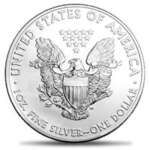 Common eligible choices can include American Silver Eagle coins and qualifying bars or rounds produced by approved refiners.
What does not belong in a Silver IRA? Personal jewelry, most collectible coins, rare numismatic pieces, and metals that fail IRS purity requirements.
Even if a product has historical appeal, it may be inappropriate for a retirement account if it is not specifically IRA eligible.
The metal selection should be based on liquidity, premium, recognizability, and your goals. Government-minted coins are familiar to many buyers but can carry higher premiums.
 Larger bars may offer a lower cost per ounce, although they can be less flexible if you later need to sell only part of your holdings. There is no universal best choice.
Before authorizing a purchase, confirm the exact product, quantity, total cost, and storage arrangement in writing. A responsible provider should make these details easy to understand.
6. Arrange Approved Depository Storage and Monitor the Account
IRS rules require IRA-owned silver to be held by an approved depository or trustee. Storing Silver IRA metals at home, in a personal safe, or in a standard bank safe-deposit box can put the account’s tax-advantaged status at risk.
This is one of the most misunderstood rules in precious metals investing.
Depositories typically offer segregated or non-segregated storage. Segregated storage means your specific bars or coins are kept separately from other clients’ metals.
Non-segregated storage means you own a specified quantity and type of metal stored together with like products. Segregated storage may cost more, while non-segregated storage can be more economical.
Ask which arrangement applies before you fund the purchase. Once the account is active, review statements, fees, and beneficiary designations periodically.
You should also understand future distribution rules. When the time comes, you may be able to sell metals for cash or take an in-kind distribution of the physical silver, depending on custodian procedures.
Traditional IRA distributions are generally taxable, and required minimum distributions may apply under current IRS rules.
Related:
- How to Include Physical Silver in an IRA: Ultimate Silver IRA Guide
- Silver Demand Is Exploding: Could Prices Hit Record Highs?
- Silver Price Prediction 2026: Why Analysts Expect Higher Prices Ahead
If you want to see where silver prices are heading, check out this video about silver price predictions from some of Wall Street’s major financial institutions:
Costs to Understand Before Opening a Silver IRA
 Physical silver requires more administration than a standard brokerage IRA, so costs deserve careful attention:
- Setup fees
- Annual custodian fees
- Storage fees
- Insurance
- And dealer spreads can all affect results
Fee structures vary widely, and a low introductory offer does not necessarily mean low long-term ownership costs.
Price matters, but service matters too. A reputable provider that communicates clearly during a rollover, confirms your order details, and remains available after the sale can help prevent costly confusion.
Be cautious with high-pressure sales tactics, promises of guaranteed returns, or claims that one metal is certain to outperform every other asset.
See if you qualify for Goldco’s special promotion of 10% in FREE silver!
When a Silver IRA May Not Be the Best Fit for Your Savings Strategy
 A Silver IRA may be less suitable if you need immediate access to retirement funds, have a very small account balance that fees could disproportionately affect, or are uncomfortable with commodity price swings.
Investors seeking income may also prefer assets that pay interest or dividends, since bullion itself does not generate cash flow.
It can also be sensible to hold both gold and silver rather than relying solely on silver.
Gold has historically been the larger monetary metal and may be less volatile, while silver can offer a lower entry price and added industrial-demand exposure.
The right balance depends on what you already own and what risks concern you most.
A Silver IRA is not about abandoning the rest of your retirement plan. It is about building a more resilient one, with a measured allocation to an asset that has endured through changing currencies, market cycles, and periods of uncertainty.
Related:
- 10 Powerful Reasons Why You Should Invest in Silver: Industrial Demand for Silver Is Booming!
- Buying Silver Bullion As An Investment: Skyrocket Your Wealth!
- Silver Price News Today: 4 Drivers Shaping the Move