Your IRA itself is not a federally insured deposit account. Protection generally comes from the qualified depository that stores the metals, and the details of that protection matter.
A well-structured Precious Metals IRA can include significant safeguards against theft, damage, and certain physical losses. It does not insure you against a falling metal price, an unsuitable product purchase, or every possible operational mistake.
Knowing the difference helps you choose a custodian, dealer, and storage arrangement with greater confidence. In this article, we’ll answer whether a Bullion IRA is insured by the FDIC or SIPC and how to best protect your bullion investment.
Is a Bullion IRA Insured by the FDIC or SIPC? Crucial to Know!
 Generally, no. Physical bullion held in an IRA is not covered by Federal Deposit Insurance Corporation insurance.
FDIC protection applies to qualifying deposits at insured banks, such as checking accounts, savings accounts, and certain certificates of deposit, up to applicable limits. Gold and silver bars and coins are not bank deposits.
Securities Investor Protection Corporation coverage is also commonly misunderstood. SIPC can help when a member brokerage fails and customer securities or cash are missing.
It does not protect the market value of investments, and it generally does not apply to physical bullion stored at a precious-metals depository for a self-directed IRA.
That does not mean your metals are left unprotected. It means the protection comes from a different place: the depository’s commercial insurance policy and its security, auditing, and inventory-control procedures.
Where Bullion IRA Insurance Usually Comes From
IRS rules require IRA-owned physical precious metals to be held by a qualified trustee or custodian, typically using an approved third-party depository.
Reputable depositories maintain insurance intended to cover stored assets against risks such as theft, fire, physical damage, and sometimes employee dishonesty or mysterious disappearance.
The policy is usually held by the depository, not purchased individually by each IRA owner. Coverage may be issued through major commercial insurers and may apply to the depository’s total inventory up to a stated limit.
That distinction is crucial. A large policy limit sounds reassuring, but you should understand whether it is sufficient for all assets held at the facility, how claims are handled, and whether your metals are specifically accounted for.
Insurance is only one layer of protection. A strong storage facility also uses:
 Controlled access
- Surveillance
- Alarm systems
- Dual-control procedures
- Regular audits
- And detailed inventory records
Those systems reduce the likelihood that an insurance claim will ever be necessary.
 Request a FREE Info Kit to learn more about an IRS loophole on gold & silver!

Allocated and Segregated Storage Matter
 Ask how your metals are recorded and stored. In an allocated arrangement, the depository identifies a specific quantity and type of bullion as belonging to your IRA.
Your account has a defined claim to particular inventory, rather than a general unsecured claim against a provider.
With segregated storage, your specific coins or bars are physically separated from other customers’ holdings. This option is often available for gold, silver, platinum, and palladium, although availability and costs can vary by metal and depository.
Segregation can provide an additional level of clarity for investors who want their exact items held apart.
Some facilities use commingled or non-segregated storage for certain products, particularly large quantities of silver. This is not automatically unsafe, but it should be disclosed clearly.
Understand whether you will receive equivalent bullion upon distribution or the same serial-numbered bars and specific coins originally purchased.
Related:
- How to Start a Gold IRA in 3 Simple Steps
- How to Start a Silver IRA in 3 Simple Steps
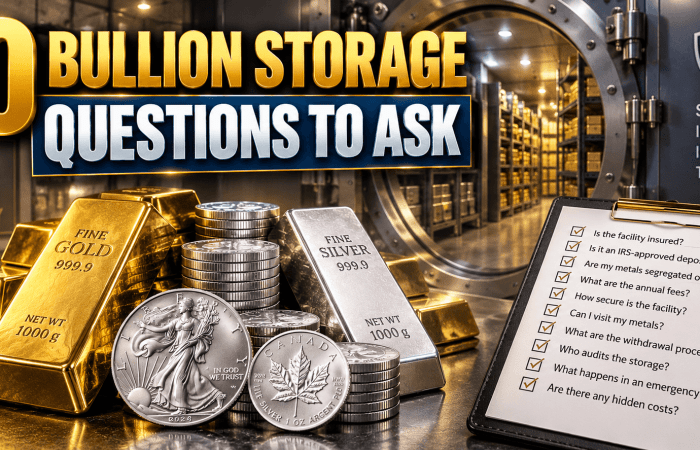
- Protect Your Metals: Top 10 Bullion Storage Questions to Ask
What Depository Insurance May Cover
The exact terms differ by facility and insurer, but depository coverage often addresses direct physical losses. Depending on the policy, that can include theft, burglary, fire, natural disasters, transit-related losses, and damage while metals are under the depository’s control.
Coverage is not a promise that every loss will be paid without question. Commercial policies have definitions, exclusions, deductibles, aggregate limits, and claims procedures.
For example, a policy may cover a loss while bullion is in a vault but have different rules while assets are being transported between a dealer and the depository.
Your custodian and bullion dealer should be able to explain the chain of custody. A disciplined purchase process sends IRA funds from the custodian to the dealer, then sends qualifying bullion directly to the approved depository.
The less ambiguity there is about where the metals were at each stage, the stronger your documentation will be.
Learn What Bullion IRA Insurance Does Not Cover
 Insurance should not be confused with an investment guarantee. Precious metals can rise or fall in value, sometimes sharply over shorter periods. If gold or silver declines after you buy, depository insurance does not make up the difference.
It also does not protect you from paying excessive premiums, selecting non-IRA-eligible products, or making a rushed decision during a volatile market.
Nor does it eliminate ordinary IRA expenses, including custodian fees, storage fees, transaction costs, and possible liquidation spreads.
Most importantly, insurance does not cure an improper IRA structure. Taking personal possession of IRA metals, storing them at home, or using an arrangement that does not meet IRA custody requirements can create serious tax consequences.
The appeal of holding gold close at hand is understandable, especially for investors concerned about financial instability. Yet retirement-account bullion and personally owned bullion must be handled differently.
If direct personal control is a priority, some investors choose to own a separate allocation of metals outside an IRA while keeping IRA metals in qualified storage.
That approach can offer both retirement-account tax treatment and personal-access planning, but it should be weighed against your liquidity needs, tax situation, and broader asset allocation.
See if you qualify for Goldco’s special promotion of 10% in FREE silver!

Questions to Ask Before Opening a Bullion IRA
Before transferring a 401(k), TSP, or existing IRA, request direct answers about custody and insurance. You do not need to become an insurance expert, but vague assurances should not be enough when retirement savings are involved.
Ask:
- Whether the storage facility is independent of the bullion dealer
- Whether bullion is allocated or segregated, and whether the facility is regularly audited
- Ask for the name of the depository
- The nature of its insurance coverage
- And whether coverage applies to the full value of metals stored there
- Also, ask how often you receive statements and what records identify your holdings
You should also clarify who is responsible if an error occurs. If the wrong product is shipped, if a transfer is delayed, or if there is a discrepancy in your inventory statement, know whether your dealer, custodian, or depository is your first point of contact.
A reputable provider will explain these roles plainly instead of treating the transaction as a one-time sale.
Verify the Products, Not Just the Vault
Secure storage cannot fix a poor purchase. For a Precious Metals IRA, bullion must meet IRS fineness requirements, with certain statutory coin exceptions. Gold generally must be .995 fine, while silver generally must be .999 fine.
Many popular products qualify, but not every collectible, rare coin, or promotional offering belongs in an IRA.
Focus on widely recognized, IRA-eligible bullion with transparent pricing and dependable resale markets. This is particularly relevant for retirement investors who may eventually need to take required minimum distributions, sell a portion of holdings, or arrange an in-kind distribution.
Liquidity and reasonable spreads deserve as much attention as insurance language.
Related:
- Best Gold IRA Companies for 2026 (Reviewed & Rated)
- Gold Demand and Supply: 4 Key Forces Behind Price Swings
- Silver Supply and Demand Forecast Into 2026—What to Know
A Better Way to Think About Your Bullion IRA Protection
A bullion IRA is protected best through layers, not one label. The custodian keeps the account aligned with IRA rules. The depository provides secure storage, documented inventory, and commercial insurance.
The dealer supplies eligible bullion at a fair, clearly explained price. Your own due diligence ties those layers together.
For investors seeking a store of value outside assets that can be created or devalued by policy decisions, physical precious metals can serve a meaningful role in a diversified retirement plan.
Still, gold is not a substitute for careful provider selection. A secure vault is valuable, but transparency, custody discipline, product quality, and a clear exit process are what turn storage into genuine retirement protection.
Before moving retirement funds, take the extra time to compare written fee schedules, storage choices, and provider reputations.
The strongest bullion IRA is not simply the one that says it is insured – it is the one where you can clearly verify who holds your metals, how they are recorded, what risks are covered, and what happens if you need access to your wealth.
Request a FREE Info Kit to learn more about an IRS loophole on gold & silver!
Is a Bullion IRA Insured: FAQ
Is a Bullion IRA insured by the FDIC or SIPC?
Generally, no. Physical bullion held in an IRA is not covered by FDIC insurance, and SIPC coverage does not protect the market value of investments or physical bullion stored for a self‑directed IRA.
Where does Bullion IRA insurance usually come from?
Insurance for bullion in an IRA typically comes from the depository’s commercial insurance policy and its security, auditing, and inventory-control procedures, rather than from the IRA owner purchasing insurance individually.
What should I verify about storage when considering a Bullion IRA?
Ask how your metals are recorded and stored, whether storage is allocated or segregated, and how often statements and records identify your holdings, since clear documentation supports your ownership and protection.
What does depository insurance typically cover and what are the limits?
Depository coverage often addresses direct physical losses such as theft, fire, or damage while the metals are under the depository’s control, but terms vary by facility and policy, including exclusions, deductibles, and aggregate limits.
What Bullion IRA protections do not come from insurance?
Insurance does not guarantee investment performance, protect against price declines, prevent poor product choices, or eliminate IRA costs and tax consequences. It also does not replace proper custodian, dealer selection, and compliant IRA structure.