A gold or silver purchase is only as secure as the arrangement behind it. That is why bullion storage questions deserve the same attention you give to metal prices, dealer premiums, and account fees.
Whether you are buying coins outright or moving retirement funds into a Gold IRA, storage determines who controls the metal, how it is protected, and what happens when you want to sell or take delivery.
Physical bullion can help diversify wealth beyond assets that exist only as account entries or paper promises. But “stored in a vault” is not a complete answer.
A careful investor should know where the vault is, who owns the metals, what insurance covers, and which fees apply before funding an account.In this article, we’ll cover the top 10 bullion storage questions to ask that will protect your precious metals purchase the right way.
Let’s dive in!
Top 10 Bullion Storage Questions That Protect Your Purchase
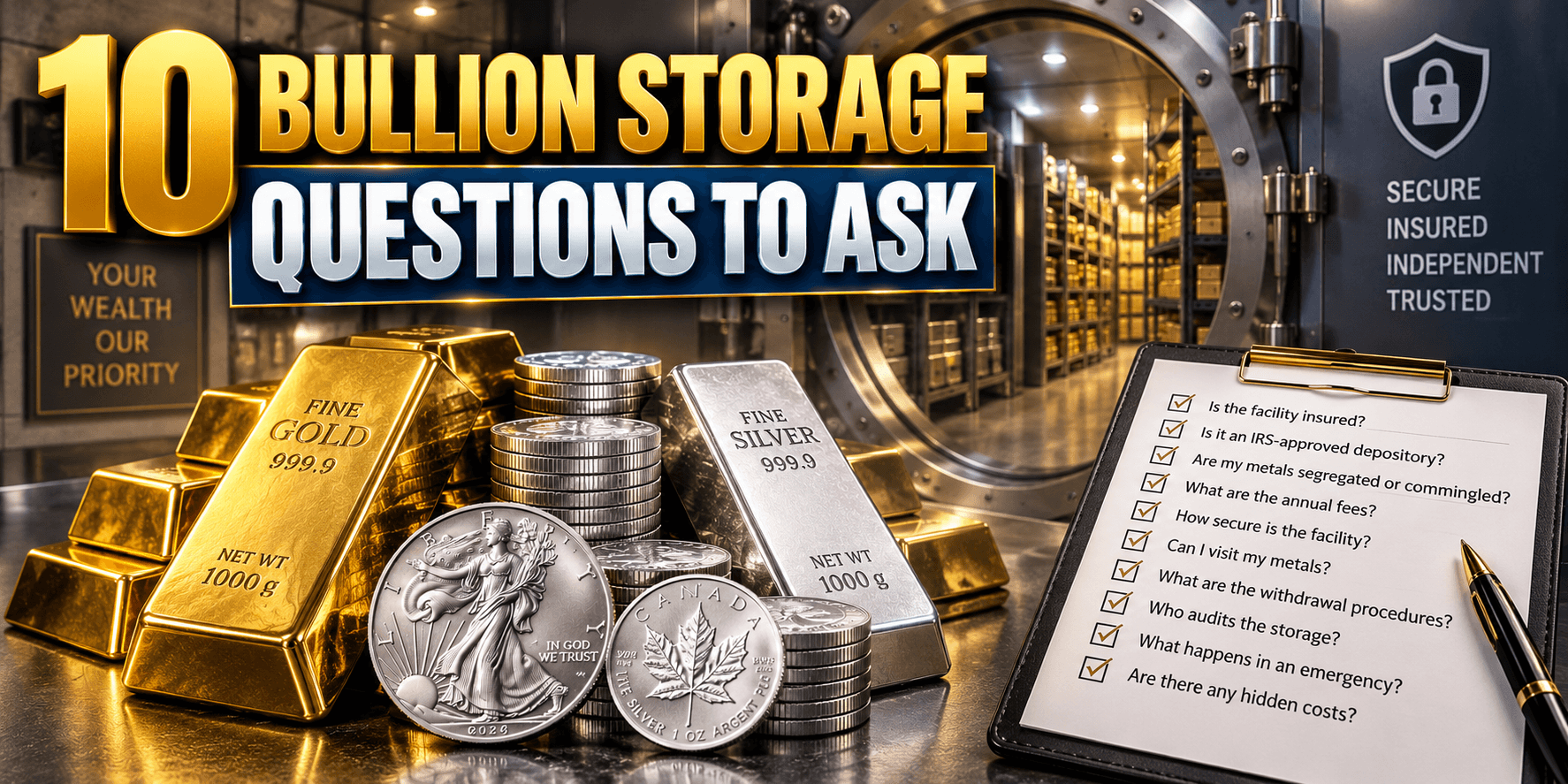
Here is a summary of the top 10 bullion storage questions that investors typically ask that will protect your purchase and help you avoid costly mistakes:
1. Is the Bullion Held at Home, With a Dealer, or in an Independent Vault?
For metals purchased with after-tax dollars, you can choose home storage, a safe-deposit box, or professional private vaulting. Each option involves a trade-off.
Home storage gives you immediate possession, but it can increase theft risk and may create insurance gaps. A bank safe-deposit box may add physical security, but access can be limited, and contents are generally not insured by the bank.
Professional vault storage can provide:
 Controlled access
- Surveillance
- Inventory procedures
- And specialized insurance
 Controlled access
It also removes the need to disclose that precious metals are kept at your residence. The right choice depends on how much bullion you own, your need for access, and your comfort with personal security responsibilities.
Related: How to Buy Silver Bullion Without Costly Mistakes: A Beginner’s Guide
2. Is the Storage Segregated or Commingled?
Segregated storage means your specific bars or coins are stored separately from another customer’s holdings.
In many cases, the exact products identified on your purchase records are the products you receive upon liquidation or distribution.
Commingled, sometimes called allocated pooled storage, means your bullion is recorded as your property but stored alongside like-kind bullion belonging to other customers.
You still own a defined quantity and type of metal, but not necessarily the same serial-numbered bar or specific coin you originally purchased.
Segregated storage commonly costs more, particularly for silver because it takes up more space than gold.
Investors who value identification of specific assets may consider the additional expense worthwhile.
Others may prefer lower-cost commingled storage if the provider clearly documents ownership and redemption procedures.
3. Is the Bullion Allocated to You?
 Allocated storage is a core distinction. Allocated bullion is held for the customer and should not appear on the custodian’s or vault operator’s balance sheet as an asset available for its own use.
Your records should establish the weight, purity, product type, and ownership of your holdings.
Be cautious with vague terms such as “metal exposure,” “backed,” or “reserved.” Those phrases can describe very different arrangements.
Ask directly whether the provider holds fully allocated physical bullion, whether it can lend or pledge the metal, and how ownership is documented.
For investors using gold as a long-term store of value outside the traditional financial system, clarity on this point matters.
 Request a Free Wealth Preservation Guide or call (866) 329-4945 to learn how to protect your wealth!

4. Who Is Responsible for Insurance, and What Does It Cover?
A vault’s statement that it is insured is a starting point, not the finish line. Ask whether the policy covers the full replacement value of:
- Customer holdings
- Theft
- Physical loss
- Damage
- Employee dishonesty
- And transit when metals are shipped
Also ask whether coverage has limits that apply to a single customer, a single event, or a shipment.
For home storage, do not assume a homeowners policy fully covers bullion. Many policies impose low limits on coins, precious metals, and collectibles, or require a separate rider.
Obtain the answer in writing from your insurer rather than relying on a general policy description.
5. Can an Independent Party Verify the Inventory?
Reputable storage programs like the Delaware Depository or Brinks use regular inventory controls and often arrange third-party audits. The useful question is not merely whether an audit occurs, but what it verifies:
- Does it reconcile physical holdings with customer records?
- Is it conducted by an independent firm?
- Can account holders receive documentation or confirmation of their holdings?
An audit does not eliminate every risk, but it is a meaningful safeguard. It helps establish that the metal recorded in your account is actually present in the vault and properly reconciled.
For retirement investors who may hold bullion for decades, disciplined recordkeeping is part of wealth preservation.
6. What Are the Annual Storage Fees and Transaction Costs?
Storage fees may be a flat annual amount, a percentage of asset value, or a tiered charge based on account size. Some providers bundle custody, storage, and insurance into one annual fee.
Others itemize them separately. Neither approach is automatically better, but investors should understand the full cost before opening an account.
Ask about:
- Setup fees
- Annual administration fees
- Storage charges
- Wire fees
- Purchase or sale transaction fees
- Shipping fees
- And fees for taking physical delivery
Also ask whether prices can rise after an introductory period. A low first-year offer can still become expensive if the ongoing schedule is unclear.
If you choose to buy precious metals through a retirement account, a so-called Gold IRA, annual fees typically range between $180 to $300 per year.
See if you qualify for Goldco’s special promotion of 10% in FREE silver!

7. Can You Visit, Inspect, Sell, or Take Delivery of Your Precious Metals?
Access rules differ by vault and account type. A privately held bullion account may permit inspection by appointment, although security rules can be strict.
If you intend to take delivery eventually, ask about minimum withdrawal sizes, delivery charges, insurance during transit, and expected timing.
Selling is equally important. Find out whether you may sell to any buyer or whether the provider offers a buyback process.
A dealer buyback option can simplify liquidation, but you should understand how the price is determined. Compare the likely spread between the price you pay and the price you could receive when selling.
8. What Changes When Bullion Is Held in a Gold IRA?
 This is one of the most consequential bullion storage questions for retirement savers. IRS rules generally require precious metals held in an IRA to be maintained by a qualified trustee or custodian.
Taking personal possession of IRA metals, including storing them at home, can be treated as a distribution, potentially triggering taxes and penalties.
A Gold IRA usually involves three parties:
- The IRA custodian
- The bullion dealer
- And an approved depository
The custodian administers the account and reporting. The dealer facilitates the metals purchase. The depository stores the assets.
Some firms coordinate these steps for clients, but you should still know which company performs each role and what each one charges.
Not every coin or bar qualifies for IRA ownership. In general, qualifying bullion must meet IRS fineness standards, with limited exceptions for certain widely recognized coins.
Before completing a rollover from a 401(k), TSP, or traditional IRA, confirm that the intended products and depository arrangement meet current requirements.
Related:
9. Where Is the Depository Located, and Does Location Matter?
 Many US investors prefer a domestic depository because it can simplify logistics, account administration, and future distributions. Others see value in geographic diversification through international storage.
There is no one answer for every investor.
Domestic storage can offer familiarity and a straightforward framework for US retirement accounts.
International storage may provide jurisdictional diversification, but it can involve additional complexity, travel constraints, taxes, reporting considerations, and delivery logistics.
If you are building a retirement-focused allocation, convenience and regulatory clarity often deserve significant weight.
10. How Do You Evaluate the Company Arranging Bullion Storage?
Do not choose a precious metals dealer solely because it advertises free storage or a limited-time promotion. Review its:
- Fee disclosures
- Account agreements
- Buyback practices
- Depository relationships
- And customer-service process
Established firms should be able to explain segregated versus commingled options without pressure or evasive language.
It is also wise to check independent reputation sources, including:
- BBB
- Business Consumer Alliance
- TrustLink
- Trustpilot
- Google
- And Ripoff Report
Read beyond the headline rating. Look for recurring concerns about delays, unexpected fees, aggressive sales tactics, or difficulty completing a sale.
A few complaints are not unusual for any large business. A repeated pattern deserves attention.
If you still wonder whether precious metals are a good investment right now, check out this video about how a dollar collapse is inevitable and how to protect your money in these volatile times:
A Simple and Effective Way to Compare Storage Arrangements
 When you speak with a bullion dealer, custodian, or vault operator, request the answers in writing.
A clear proposal should identify the legal owner of the bullion, storage type, vault location, insurance framework, audit process, annual costs, and delivery rules. If any item remains unclear, pause before sending funds.
For a Gold IRA, keep the rollover process separate from the storage decision in your mind.
A direct trustee-to-trustee transfer or properly handled rollover may preserve the tax-advantaged status of retirement funds, but it does not guarantee that the provider, products, or depository are right for you. Evaluate each decision on its own merits.
Physical gold and silver are often purchased for reassurance during inflation, market volatility, currency weakness, and geopolitical uncertainty.
That purpose is better served when your storage plan is as deliberate as your investment plan.
The best arrangement is not necessarily the cheapest or most elaborate one. It is the one you fully understand, can afford over time, and can explain with confidence to the family members who may one day inherit your holdings.
Related:
- Best Gold IRA Companies for 2026 (Reviewed & Rated)
- Gold Demand and Supply: 4 Key Forces Behind Price Swings
- Silver Supply and Demand Forecast Into 2026—What to Know
If you’re searching for the best company, request a FREE Gold IRA Checklist: