Silver has a reputation for making patient investors wait, then moving quickly when confidence in paper assets weakens, or industrial demand tightens supply.
A responsible silver price forecast should not promise a precise number. It should show what could move the metal higher, what could interrupt the trend, and how retirement investors can position themselves without betting their financial future on a single forecast.In this article, we’ll share a silver price forecast for the remainder of 2026, and three likely scenarios for silver that can drive the next move.
Let’s begin by taking a look at the case for higher silver prices.
Silver Price Forecast: The Case for Higher Prices
 For Americans protecting a 401(k), Traditional IRA, TSP, or taxable savings, silver can serve two roles at once. It is a tangible monetary metal that cannot be printed out of thin air, and it is an industrial material needed in technologies that use electricity, energy, and advanced electronics.
That combination gives silver more upside potential than many investors expect, but it can also make the price more volatile than gold. Here are two key drivers for higher silver prices:
1. Industrial Demand
The long-term case for silver begins with supply and demand. Silver is used in:
 Solar panels
- Electric vehicles
- Electronics
- Medical equipment
- Batteries
- AI data centers
- 5G networks
- And a wide range of other industrial applications
As manufacturers require more silver for energy infrastructure and technology, industrial demand can put meaningful pressure on available supply.
Unlike gold, much of the world’s silver is produced as a byproduct of mining for copper, lead, zinc, and gold. That matters because higher silver prices alone do not necessarily lead to a fast increase in mine production.
A mining company may need stronger economics in its primary metal before expanding output. When demand rises faster than supply, the silver market can tighten.
This creates a problem because there’s already a shortage of silver, and combining that with increased demand can boost prices significantly.
Watch this video to learn more about the next demand boom for silver:
2. Investment Demand
Investment demand is the second major force. Physical coins, bars, exchange-traded products, and Silver IRAs tend to attract more interest when investors are worried about:
- Inflation
- Federal debt
- Banking stress
- Geopolitical conflict
- Or the long-term purchasing power of the US dollar
Silver has historically been more affordable per ounce than gold, which can make it an accessible entry point for investors who want physical precious metals without committing a large amount of capital all at once.
A lower interest-rate environment could also support silver. When cash and bonds offer less attractive real returns, hard assets often receive more attention.
If inflation remains persistent while rates decline, investors may look for stores of value that stand outside the conventional financial system.
Silver does not pay income, so it competes with yield-bearing assets. Its appeal often improves when the opportunity cost of holding it falls.
 See if you qualify for Goldco’s special promotion of 10% in FREE silver!

Related:
- 10 Powerful Reasons Why You Should Invest in Silver: Industrial Demand for Silver Is Booming!
- Buying Silver Bullion As An Investment: Skyrocket Your Wealth!
- Silver Price News Today: 4 Drivers Shaping the Move
Why Silver Can Pull Back Even in a Bullish Cycle
 A bullish outlook does not mean a straight line higher. Silver is a smaller and more volatile market than gold. It can rise sharply during periods of strong demand, then give back a significant portion of those gains when the US dollar strengthens, interest rates rise, or traders reduce risk across commodity markets.
Economic weakness is another trade-off. A mild slowdown that leads to lower rates and higher safe-haven demand could be supportive for silver.
A deeper global recession, however, could reduce industrial consumption from manufacturers. In that scenario, silver may lag gold for a period because gold is driven more directly by monetary demand and central-bank buying.
The dollar is especially important. Since silver is commonly priced in US dollars, a stronger dollar can make the metal more expensive for overseas buyers and pressure prices.
Rising real interest rates can create a similar headwind. Investors should therefore be careful with claims that silver must rise simply because inflation exists. Inflation, monetary policy, economic growth, currency strength, and investor positioning all matter at the same time.
Short-term price swings are not proof that silver has failed as a diversification asset. They are part of the asset class.
The mistake is treating silver like a quick trade when its most useful role may be preserving purchasing power and reducing dependence on stocks, bonds, and cash over a longer holding period.
What a Realistic Silver Price Forecast Looks Like
 The most useful way to view silver is through scenarios rather than a single headline target.
Forecasts from banks and metals specialists can vary widely because small changes in industrial demand, interest rates, or investor flows can create large price changes in a relatively compact market. Here are three realistic silver price scenarios:
1. Base Scenario
In a base-case scenario, silver may trend gradually higher if industrial consumption remains healthy, mine supply stays constrained, and inflation concerns persist.
This environment could reward disciplined buyers who accumulate over time rather than chasing sudden rallies.
2. Bullish Scenario
In a bullish scenario, silver could move substantially higher if rate cuts weaken the dollar, investment demand accelerates, and supply deficits continue.
Renewed concern over government debt, bank stability, or currency devaluation could add momentum. Silver often attracts attention after gold has already advanced, which means it can experience sharp late-cycle moves.
3. Bearish Scenario
In a bearish scenario, the price could weaken if global manufacturing contracts, real rates remain elevated, or the dollar strengthens significantly.
This is why investors should avoid using money they may need for near-term living expenses.
A retirement allocation to physical metals works best when it is built around time horizon, risk tolerance, and the need for diversification, not a prediction that next month’s price will be higher.
Gold-to-Silver Ratio: A Useful Signal, Not a Guarantee
Many precious-metals investors watch the gold-to-silver ratio, which measures how many ounces of silver equal the price of one ounce of gold.
When the ratio is high relative to historic norms, some investors believe silver may be undervalued compared with gold. When the ratio falls, silver may have already outperformed.
The ratio is useful context, but it cannot tell you exactly when silver will move. Gold and silver respond to some of the same forces, yet gold is more closely tied to central-bank purchases and monetary protection, while silver carries greater industrial exposure.
A high ratio can persist longer than investors expect, especially during periods of economic stress.
For many retirement savers, the better question is not whether silver will outperform gold next quarter. It is whether owning both metals creates a stronger hedge against inflation, financial instability, and currency risk than relying entirely on conventional assets.
Ways to Own Silver Without Taking Unnecessary Risks
 Physical silver can be purchased outright as coins or bars, or held in a self-directed Silver IRA. Each approach has different benefits.
Direct ownership gives investors personal control over their bullion, but they must plan for secure storage, insurance, and resale.
A Silver IRA offers potential tax-deferred or tax-free growth depending on account type, but IRS rules require approved bullion, a qualified custodian, and storage at an approved depository.
For IRA investors, not every silver item qualifies. Collectibles and many proof coins may not meet IRS requirements. Eligible silver generally must meet specific purity standards, with certain government-minted coins receiving separate treatment.
A reputable precious-metals provider can help investors understand and walk them through:
- Eligible products
- Account setup
- Rollover paperwork
- Storage fees
- And delivery procedures
A rollover from a former employer’s 401(k), a Traditional IRA transfer, or certain TSP transfers may allow eligible investors to diversify into physical silver without taking a taxable distribution.
The process needs to be handled carefully. Direct rollovers and trustee-to-trustee transfers can help reduce avoidable tax complications, while taking possession of retirement funds before completing the transaction can create unnecessary risk.
It also makes sense to compare providers before moving retirement assets. Also:
- Look beyond promotional offers
- Review fee disclosures
- Buyback policies
- Storage arrangements
- Educational support
- And independent reputation information from sources such as the Better Business Bureau, Business Consumer Alliance, Trustpilot, and TrustLink
Retirement savings deserve that level of due diligence.
How a Silver IRA Rollover Works
The rollover process is typically straightforward and is often handled by the Silver IRA company and custodian on your behalf. The basic steps include:
 Opening a self-directed Silver IRA with an IRS-approved custodian
Requesting a rollover or transfer from your existing retirement account
Funding the new Silver IRA once the transfer is complete
Selecting IRS-approved silver products for your account
Having the silver securely stored in an approved depository
Many Silver IRA providers assist investors throughout the entire process to help ensure the rollover is completed correctly and in compliance with IRS regulations.
Eligible Retirement Accounts for a Silver IRA Rollover
You may be able to roll over funds from:
- Traditional 401(k) plans
- Former employer 401(k) accounts
- 403(b) retirement plans
- 457 government plans
- Thrift Savings Plans (TSP)
- Traditional IRAs
- SEP IRAs
- SIMPLE IRAs (subject to IRS requirements)
If you currently participate in an active employer-sponsored retirement plan, additional restrictions may apply. It’s often best to consult your plan administrator or a Silver IRA specialist to determine eligibility.
How Much Does It Cost to Open a Silver IRA?
 The cost of establishing a Silver IRA can vary depending on the provider you choose, the custodian administering the account, and the storage option selected for your metals.
Most self-directed IRA custodians charge a one-time account setup fee, which is often around $50 to $100, along with a small wire transfer or transaction fee. In addition, investors can expect an annual account administration fee that generally ranges from $75 to $150 per year.
Another important expense is storage. Because IRS regulations require precious metals held within an IRA to be stored at an approved depository, investors must pay annual storage fees.
Popular facilities such as the Delaware Depository and other IRS-approved vaults offer two primary storage options:
- Segregated Storage: Approximately $150 per year, where your metals are stored separately from other investors’ holdings
- Non-Segregated Storage: Approximately $100 per year, where your metals are securely stored alongside assets belonging to other account holders
While some investors may consider storing precious metals at home, doing so can violate IRS rules for IRA-owned assets and potentially trigger taxes and penalties. For this reason, professional storage at an approved depository is generally the safest and most compliant option.
Overall, the annual cost of maintaining a Silver IRA or Precious Metals IRA typically falls between $180 and $350 per year, depending on the custodian, storage method, and account features selected.
Many investors consider these costs worthwhile for the benefits of owning physical precious metals within a tax-advantaged retirement account.
Related: How to Start a Silver IRA in 3 Simple Steps
How Much Silver Should Retirees Consider Buying?
 There is no universal percentage that fits every investor. Someone with a heavy concentration in stocks, long-term concerns about inflation, and no precious-metals exposure may reasonably see a role for silver alongside gold.
Someone who needs predictable income in the next few years may need a more conservative approach because silver prices can fluctuate materially.
Many investors view gold as the steadier monetary anchor and silver as the higher-volatility complement. That balance can be adjusted according to personal goals.
Gold may be more appropriate for preserving large amounts of wealth, while silver can provide exposure to industrial demand and potential upside at a lower per-ounce price. Neither metal should replace an emergency fund or a retirement income plan.
A measured approach is often more durable than an all-or-nothing decision.
Rather than trying to identify the perfect entry price, investors can establish an allocation they can hold through both rallies and pullbacks. This reduces the temptation to buy after headlines turn euphoric or sell after a temporary decline.
Silver’s future will be shaped by forces no analyst can fully control:
- Industrial demand
- Mine output
- The dollar
- Interest rates
- Federal debt
- And investor confidence in the financial system
That uncertainty is precisely why physical metals can deserve a place in a diversified plan. The goal is not to win every price move. It is to build retirement wealth that is less vulnerable to the next one.
Now, let’s move on to what seven major financial institutions predict for silver in 2026.
Silver Price Forecast 2026
If you rather watch a video than read the text below, just hit play!
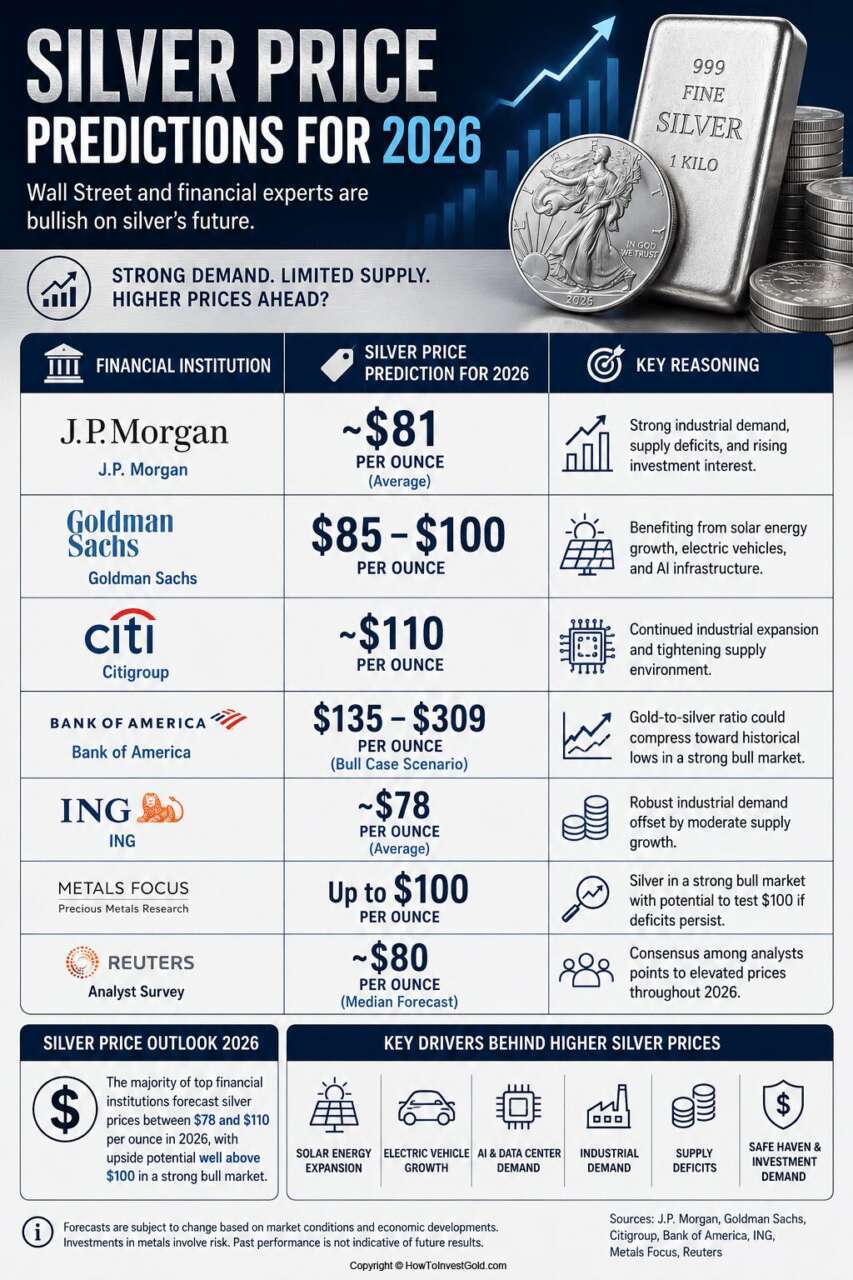
Several of the world’s largest financial institutions have issued bullish forecasts for silver prices. Here are silver price predictions from seven major financial institutions:
1. J.P. Morgan
J.P. Morgan analysts have projected silver could average approximately $81 per ounce during 2026. The bank cites strong industrial demand, ongoing supply deficits, and growing investor interest as primary catalysts.
2. Goldman Sachs
Goldman Sachs remains constructive on silver’s long-term prospects. Various market reports suggest the firm sees silver potentially trading between $85 and $100 per ounce, driven by growing demand from solar energy, electric vehicles, and AI-related infrastructure.
3. Citigroup
Citigroup analysts have projected silver could reach approximately $110 per ounce if industrial demand remains strong and investment flows continue increasing.
4. Bank of America
Among major financial institutions, Bank of America has issued one of the most aggressive forecasts. The bank’s commodity strategists have outlined a bullish scenario in which silver could potentially trade between $135 and $309 per ounce if precious metals enter a major bull market and the gold-to-silver ratio compresses toward historical norms.
5. ING
ING analysts forecast silver averaging around $78 per ounce, supported by robust industrial consumption and constrained mine supply.
6. Metals Focus
The precious metals research firm Metals Focus believes silver could potentially test $100 per ounce if market deficits persist and investment demand accelerates.
7. Reuters
Reuters’ latest survey of precious metals analysts paints a bullish picture for silver over the coming years. According to the survey, the median forecast among leading commodity experts suggests silver prices could average around $80 per ounce in 2026, representing significant upside from historical averages.
Request a FREE Info Kit to learn about a little-known IRS loophole!

Although forecasts vary considerably, the common theme is clear: many leading analysts expect silver prices to move higher over the coming years.
Related:
- How to Buy Silver Bullion Without Costly Mistakes: A Beginner’s Guide
- 10 Powerful Reasons Why You Should Invest in Silver: Industrial Demand for Silver Is Booming!
- Buying Silver Bullion As An Investment: Skyrocket Your Wealth!
Top-Rated Silver IRA Companies
With numerous precious metals IRA companies available today, how do you know which one to select? To simplify your decision-making process, we’ve compiled a curated list of the best precious metals companies in the industry. Each company has been rigorously reviewed and vetted based on several critical factors:
- BBB/BCA Ratings and Complaints: We have analyzed Better Business Bureau and Business Consumer Alliance ratings and complaints to ensure the company’s credibility and reliability
- Customer Reviews: Real customer feedback provides valuable insights into the company’s service quality and customer satisfaction
- Annual Fees: Transparent fee structures can save you from unexpected costs
- Precious Metals Selection: A diverse range of investment options allows for a more tailored portfolio
- Storage Options: Secure and accessible storage is paramount for the safety of your investments
- Promotions: Special offers and promotions can add additional value to your investment
- Buyback Programs: Flexible buy-back programs ensure liquidity and ease of selling your assets
By considering these factors, you can make a well-informed decision that aligns with your financial goals and investment strategy. Whether you’re a retiree looking to safeguard your nest egg, an investor seeking diversification, a financial planner advising clients, or a precious metals enthusiast, this list is designed to help you find the most reliable precious metals IRA company for your needs:
>
| Company | Reviews | Annual Fees | Investment Minimums (IRA) | Preferred Custodian | Free Gold Kit |
 |
 |
$180 | $10,000 | Equity Trust |  |
 |
 |
$180 | $25,000 | Entrust | |
 |
 |
$0 | $25,000 | Equity Trust | |
 |
|
$75-$300 | $10,000 | GoldStar Trust Company | |
 |
 |
$200 | $50,000 | Equity Trust | |
 |
 |
$250 | $20,000 | Equity Trust | |
 |
 |
$250 | $10,000 | Equity Trust | |
 |
 |
$48 | $0 | Various | |
See if you qualify for Goldco’s special promotion of 10% in FREE silver!