A silver bar is not merely a smaller, lower-cost alternative to gold. Silver industrial demand gives this metal a second source of support:
“…it is both a tangible store of value and a material manufacturers need to build the modern economy.”For retirement savers concerned about inflation, currency devaluation, and stock market volatility, that dual role is worth understanding before buying physical silver or opening a Silver IRA.
In this article, we’ll share why industrial demand matters for silver prices and the key drivers behind the boost in silver demand. We’ll also cover what this, together with limited supply, means for investors and future silver prices.
Let’s begin by explaining why silver industrial demand matters.
Why Silver Industrial Demand Matters
Gold’s demand story is primarily monetary. Central banks, investors, jewelry buyers, and consumers recognize it as a long-standing store of wealth that cannot be created with a keystroke.
Silver shares part of that monetary history, but it also has industrial properties that are difficult to replace at scale. It is highly conductive, reflective, and useful in a wide range of electronic and energy applications.
That means silver demand does not rely solely on investor sentiment. When manufacturers expand production of solar panels, electronics, vehicles, medical devices, and electrical equipment, they may need more silver regardless of whether Wall Street is enthusiastic about precious metals that month.
This does not make silver a guaranteed winner. Industrial demand can weaken during a recession, especially if factories slow production and consumers postpone major purchases.
But the industrial side of the market can give silver a different long-term supply-and-demand profile than gold. Investors who own both metals may gain exposure to two related but distinct forms of wealth protection.
 See if you qualify for Goldco’s special promotion of 10% in FREE silver!

The Key Drivers Behind Increased Silver Industrial Demand
Unlike gold, which is primarily purchased for wealth protection and as a store of value, silver derives much of its demand from industrial applications.
Here are key drivers behind the increased industrial demand for silver that could take prices much higher:
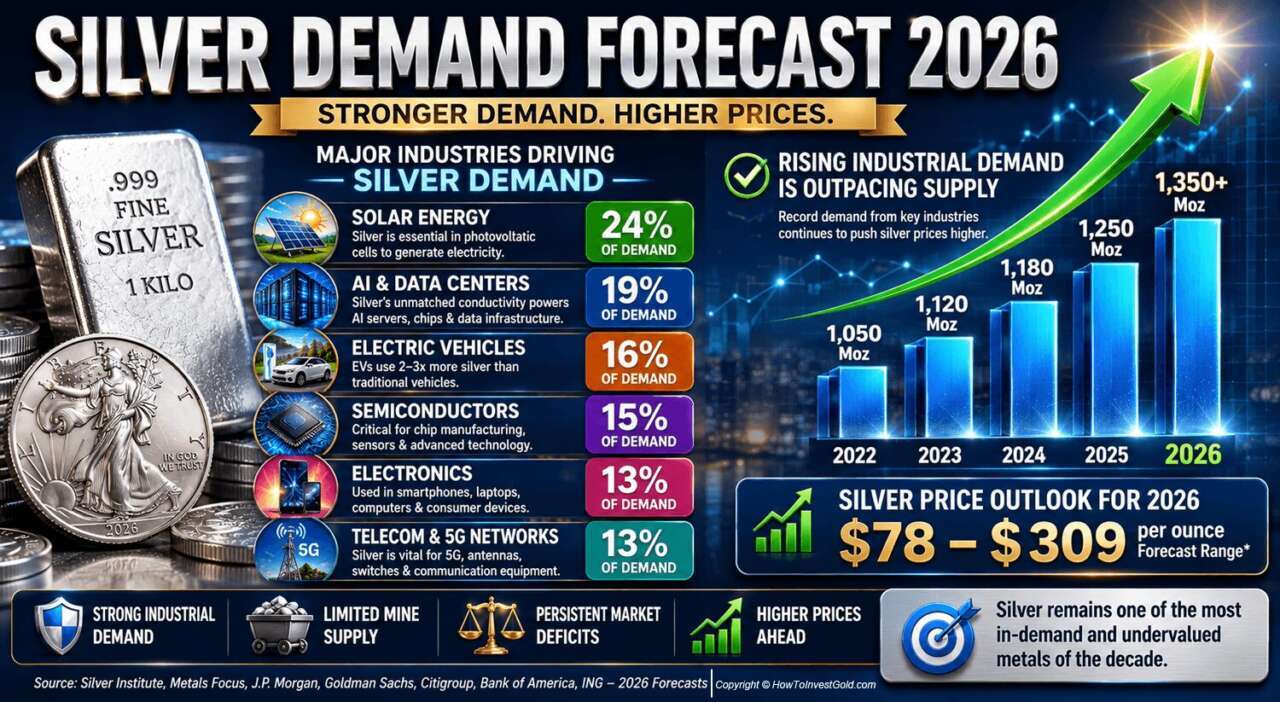
1. Solar Power Is a Major Driver of Silver Demand
Solar photovoltaic manufacturing is one of the clearest examples of rising silver consumption. Solar cells use silver paste to collect and conduct electricity generated from sunlight.
Manufacturers continue working to reduce the amount of silver used in each panel, a process often called thrifting, because silver is a meaningful input cost.
Yet lower silver use per panel does not automatically mean lower total demand. If global solar installation grows faster than manufacturers reduce silver content, overall consumption can still rise.
This is the key distinction many investors miss: efficiency matters, but production volume matters more.
Government energy policy, utility-scale projects, household solar adoption, and the build out of electricity grids all affect this equation.
The pace will vary by country and by year. Still, solar is no longer a niche source of silver use. It is a substantial demand center with a long runway if electrification and renewable-energy investment continue.
2. Electronics, Vehicles, and Electrification Add Even More Support
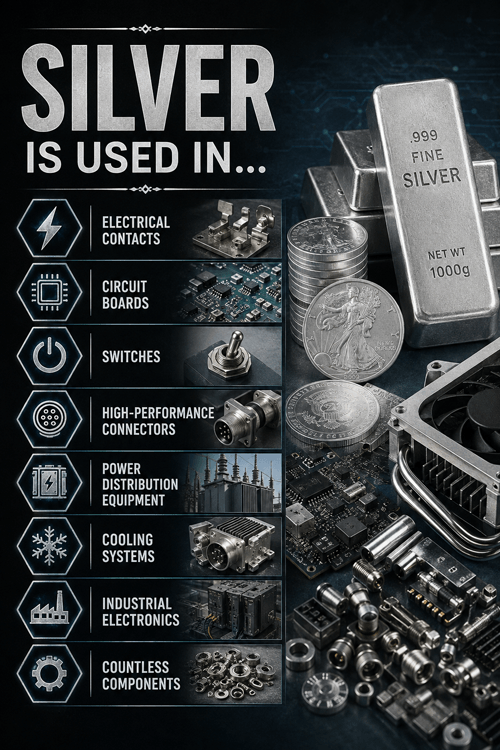 Silver is used in:
- ✅ Circuit boards
- ✅ Switches
- ✅ Contacts
- ✅ Connectors
- ✅ Sensors
- ✅ Coatings
- ✅ Batteries
- ✅ Cooling systems
- ✅ Power distribution equipment
- ✅ And specialized applications where conductivity matters
Modern vehicles also contain more electronics than older models, while electric vehicles and charging infrastructure require extensive electrical systems.
The investment implication is not that every electric vehicle creates a dramatic amount of new silver demand on its own.
Rather, millions of vehicles, chargers, data centers, smart devices, grid upgrades, and industrial controls can create meaningful aggregate demand.
Silver is often used in small quantities per product, but small quantities become significant when production scales globally.
This broad use also makes forecasting complicated. A slowdown in consumer electronics could offset strength in solar for a period.
New technology could reduce silver intensity in one application while creating demand in another. Investors should avoid treating any single headline about solar panels or electric vehicles as a complete silver price forecast.
3. Artificial Intelligence and Data Centers
Artificial intelligence is creating another significant source of silver demand. Building AI infrastructure requires enormous data centers filled with servers, networking equipment, cooling systems, and high-performance electronics.
Silver is widely used throughout this equipment because of its unmatched electrical conductivity and reliability.
As AI adoption accelerates worldwide, investment in computing infrastructure is expected to continue expanding, increasing demand for industrial silver.
Check out this video about how AI is creating massive new demand for gold and silver:
4. Telecommunications and 5G Networks
The worldwide expansion of telecommunications infrastructure also supports rising silver demand. Silver plays an important role in:
- ✅ Antennas
- ✅ RF components
- ✅ Switches
- ✅ Connectors
- ✅ And other high-frequency electronics used in 5G networks and communications equipment
As network upgrades continue around the globe, this sector represents another important source of long-term industrial demand.
Related:
- How to Buy Silver Bullion Without Costly Mistakes: A Beginner’s Guide
- How to Include Physical Silver in an IRA: Ultimate Silver IRA Guide
- Silver Price Prediction 2026: Why Analysts Expect Higher Prices Ahead
- Buying Silver Bullion As An Investment: Skyrocket Your Wealth!
Let’s now move on to the struggling mine supply, which will most likely boost prices as well.
Mine Supply Cannot Always Respond Fast Enough
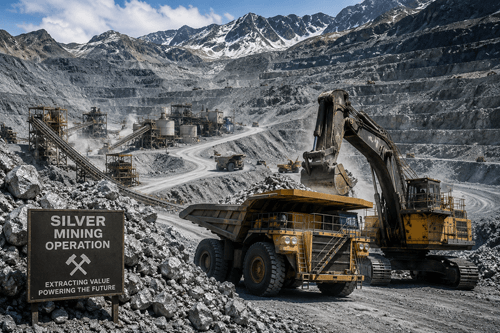 The supply side is equally important. Much of the world’s silver is produced as a byproduct of mining for lead, zinc, copper, or gold.
A mine operator may not sharply increase silver production simply because silver prices rise. Its main business decisions can be driven by the economics of another metal.
This is different from a market where producers can quickly open the spigots when prices move higher.
Developing a new mine can require years of exploration, financing, permitting, construction, and infrastructure. Existing mines also face declining ore grades, labor costs, energy costs, political risk, and environmental requirements.
Recycling supplies some silver back to the market, particularly from industrial scrap and certain consumer goods.
However, recovering tiny amounts of silver from millions of devices is not always economical. The amount recycled depends partly on silver prices and collection systems, so it should not be viewed as an unlimited source of new supply.
When industrial consumption is strong and mine supply is constrained, the market can tighten. Physical inventories, refinery capacity, futures-market activity, and investment flows all influence how that pressure appears in price.
Short-term pricing can still be volatile, but a sustained supply deficit deserves attention from long-term precious metals investors.
See if you qualify for Goldco’s special promotion of 10% in FREE silver!
Industrial Demand Does Not Set the Silver Price Alone
It is tempting to conclude that growing use in solar panels must produce a straight-line rise in silver prices. Markets do not work that neatly. Silver is priced in US dollars, so:
- Interest rates
- The dollar’s strength
- Inflation expectations
- Futures positioning
- And broader financial stress can move the price sharply in either direction
Investment demand is especially important. During periods of banking concerns, geopolitical instability, persistent inflation, or declining confidence in paper currencies, buyers may turn to physical bullion, coins, exchange-traded products, and mining shares.
That can amplify industrial tightness. The reverse can also happen when investors favor cash, high-yield bonds, or a rising dollar.
Silver is generally more volatile than gold. Its smaller market and industrial exposure can produce larger percentage moves in both directions.
For a retiree, that is a reason to size a silver position carefully rather than treating it as a short-term trade or a substitute for a fully diversified retirement plan.
Silver Price Predictions for 2026
But where are silver prices heading? Let’s move on to what seven major financial institutions predict for silver in 2026. You can either watch the video or continue reading the text below:
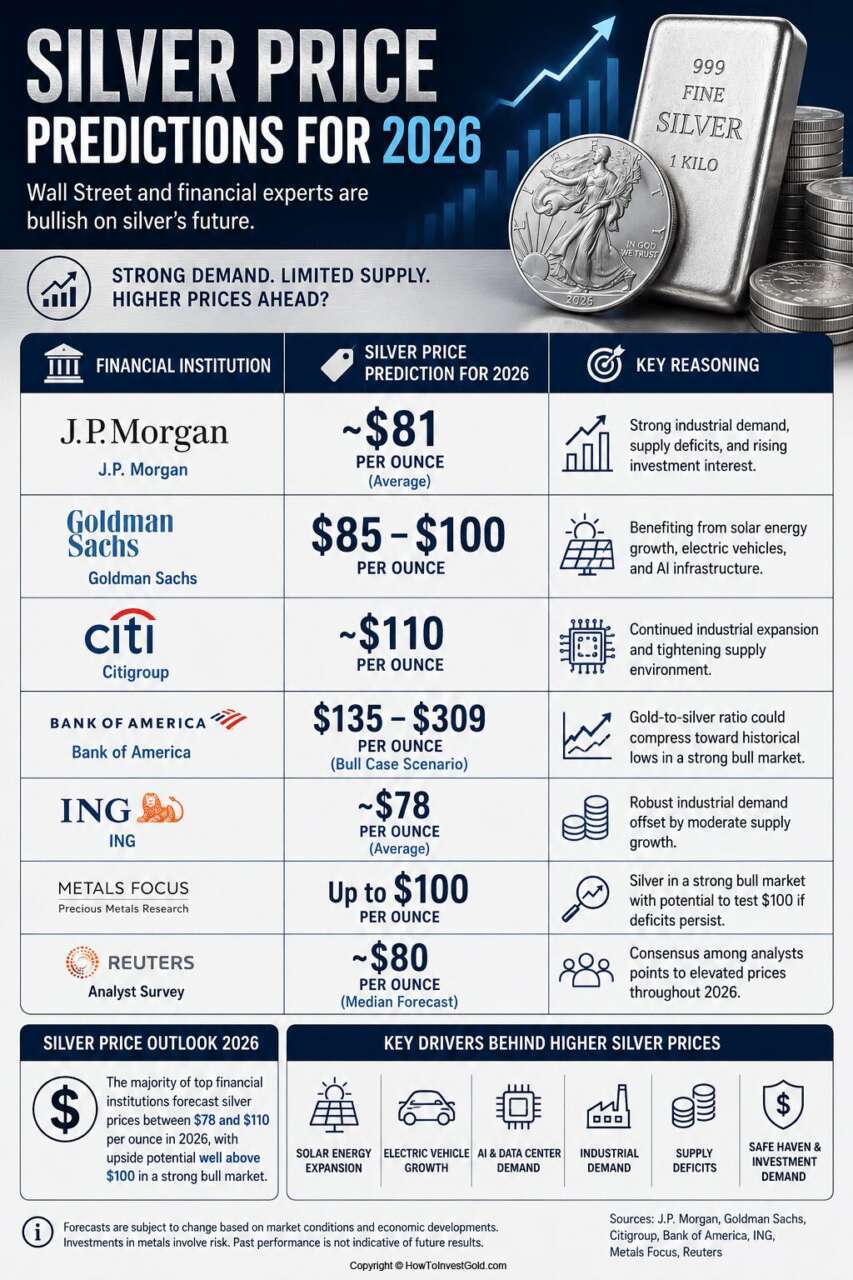
Several of the world’s largest financial institutions have issued bullish forecasts for silver prices. Here are silver price predictions from seven major financial institutions:
1. J.P. Morgan
J.P. Morgan analysts have projected silver could average approximately $81 per ounce during 2026. The bank cites strong industrial demand, ongoing supply deficits, and growing investor interest as primary catalysts.
2. Goldman Sachs
Goldman Sachs remains constructive on silver’s long-term prospects. Various market reports suggest the firm sees silver potentially trading between $85 and $100 per ounce, driven by growing demand from solar energy, electric vehicles, and AI-related infrastructure.
3. Citigroup
Citigroup analysts have projected silver could reach approximately $110 per ounce if industrial demand remains strong and investment flows continue increasing.
4. Bank of America
Among major financial institutions, Bank of America has issued one of the most aggressive forecasts. The bank’s commodity strategists have outlined a bullish scenario in which silver could potentially trade between $135 and $309 per ounce if precious metals enter a major bull market and the gold-to-silver ratio compresses toward historical norms.
5. ING
ING analysts forecast silver averaging around $78 per ounce, supported by robust industrial consumption and constrained mine supply.
6. Metals Focus
The precious metals research firm Metals Focus believes silver could potentially test $100 per ounce if market deficits persist and investment demand accelerates.
7. Reuters
Reuters’ latest survey of precious metals analysts paints a bullish picture for silver over the coming years. According to the survey, the median forecast among leading commodity experts suggests silver prices could average around $80 per ounce in 2026, representing significant upside from historical averages.
Direct Ownership of Silver

For investors buying silver outright, physical bullion can provide direct ownership outside the conventional financial system.
IRA-eligible silver bars and certain coins can also be held in a self-directed Precious Metals IRA through an approved custodian and qualified depository.
The metal must meet IRS fineness standards, and IRA assets cannot be stored at home under ordinary personal control.
Silver’s lower price per ounce can make it accessible for investors building a position gradually.
The trade-off is practical: silver is bulkier than gold for the same dollar value. A significant silver holding requires more storage space and can carry higher shipping, storage, and transaction costs.
Premiums over the spot price can also be higher for smaller-format products. For that reason, many investors use gold as the core precious-metals holding and silver as a complementary allocation.
Gold has greater value density and a stronger central-bank demand story. Silver may offer more upside sensitivity if precious metals enter a strong bull market and industrial demand remains firm, but it also brings more price swings.
The right balance depends on your timeline, risk tolerance, existing retirement assets, and reason for owning metals.
Someone seeking maximum compactness and stability may lean more heavily toward gold. Someone who wants exposure to industrial growth alongside monetary metals may choose to include silver.
Neither approach removes the need for cash reserves, income planning, and diversification across assets.
Related: How to Start a Silver IRA in 3 Simple Steps
Risks Investors Should Consider
While the outlook for silver remains positive, investors should recognize that silver prices can be volatile. Factors that could impact silver prices include:
- Changes in interest rates
- Economic slowdowns
- Strength in the U.S. dollar
- Reduced industrial activity
- And market sentiment shifts
Like any investment, silver should be considered as part of a diversified portfolio rather than a standalone strategy.
How to Evaluate Silver Demand
Instead of reacting to daily price moves, watch whether the broader thesis remains intact. All the factors provide useful context:
- ✅ Solar deployment
- ✅ Manufacturing output
- ✅ Mine production
- ✅ Recycling
- ✅ Reported market deficits
- ✅ Real interest rates
- ✅ And physical investment demand
One data point rarely tells the whole story. It is also wise to distinguish between a long-term allocation and a prediction.
Buying silver because it can help diversify wealth is different from betting that it will double by a particular date.
The first approach is grounded in portfolio resilience. The second can lead investors to buy too much after prices have already moved higher.
Before funding a Silver IRA or purchasing bullion, compare:
- ✅ Dealer pricing
- ✅ Buyback policies
- ✅ Storage arrangements
- ✅ Annual account fees
- ✅ And company reputation
Established providers like Birch Gold Group, GoldenCrest Metals, Goldco, Metals Edge, and Augusta Precious Metals should explain costs clearly and should not pressure you to move your entire retirement account into any one asset class.
A careful rollover or transfer process helps protect the tax-advantaged status of retirement funds.
Silver’s industrial role is one reason it deserves more than a passing glance. As the world builds more electrical infrastructure, solar capacity, and advanced technology, demand for this irreplaceable metal may remain a meaningful force.
For investors focused on preserving purchasing power, a disciplined silver allocation can be a practical way to own a hard asset with both monetary heritage and real-world utility.
Silver Industrial Demand: FAQ
Why does silver have both monetary and industrial demand, and why does that matter for investors?
Silver serves as a store of value like gold but also has industrial properties that are difficult to replace at scale, making it useful in electronics, solar energy, and other technologies.
This dual role means its price can be influenced by investor sentiment and by real demand from manufacturers, providing a different long‑term supply‑and‑demand dynamic than gold.
What are the main drivers behind the increased industrial demand for silver?
Key drivers include solar power expansion, electronics and electrification such as in vehicles and charging infrastructure, artificial intelligence data centers, and telecommunications including 5G networks, all of which use silver for high conductivity and reliability.
Why can silver supply not always respond quickly to rising prices?
Most silver is produced as a byproduct of mining for other metals, so mine operators cannot easily boost silver output when prices rise. Developing a new mine takes years, and existing mines face declining ore grades, higher costs, and regulatory and geopolitical risks.
How should a retiree or investor evaluate holding silver in a retirement portfolio or Silver IRA?
Consider how silver fits your timeline and risk tolerance, compare dealer pricing, buyback policies, storage arrangements, annual fees, and company reputation, and remember that IRA-eligible silver must meet IRS fineness standards and cannot be stored at home.
What external factors can move silver prices beyond its industrial demand?
Prices are influenced by interest rates, the dollar’s strength, inflation expectations, futures positioning, and broader financial stress. Investment demand during banking concerns or geopolitical instability can amplify or dampen industrial tightness and price movements.
See if you qualify for Goldco’s special promotion of 10% in FREE silver!