A Gold IRA can help you hold physical precious metals in a tax-advantaged retirement account, but its costs deserve just as much attention as its potential benefits.
So, are gold IRA fees deductible? For most individual investors, the practical answer is no: Gold IRA setup, custodial, storage, and transaction fees generally do not create a separate personal federal income-tax deduction.That does not mean fees are unimportant. Far from it. Every dollar spent on administration or secure storage is a dollar that is no longer working toward your retirement goals.
Understanding how these fees are paid, and how they interact with IRA rules, can help you protect more of the wealth you have worked to build.
Let’s begin by taking a look at whether Gold IRA fees are deductible on your tax return.
Are Gold IRA Fees Deductible on Your Tax Return?

A Gold IRA is usually structured as a self-directed traditional IRA or Roth IRA. The account may own IRS-approved gold, silver, platinum, or palladium, but it is still an IRA for tax purposes. Its specialized nature does not turn its ongoing costs into a special tax deduction.
In general, fees paid directly from IRA assets are not reported as a taxable withdrawal. Your custodian may deduct annual maintenance charges or depository storage fees from your cash balance inside the account, and that payment is normally treated as an account expense, not a distribution to you.
However, paying a fee from the IRA does not mean you receive a personal deduction. Traditional IRA earnings are generally tax-deferred already, while qualified Roth IRA earnings may be tax-free.
Since the account itself receives favorable tax treatment, you usually cannot also claim its expenses as an itemized deduction on your individual return.
Federal rules surrounding miscellaneous itemized deductions have changed over time, so investors should not rely on old articles suggesting that IRA management costs are routinely deductible when paid personally.
Before claiming any IRA-related expense, confirm the treatment for the tax year in question with a qualified tax professional.
For most Gold IRA owners, the sound planning assumption is simple: fees reduce your account value, not your current taxable income.
The Main Gold IRA Fees to Expect
Gold IRAs require more administration than a standard brokerage IRA holding mutual funds or stocks.
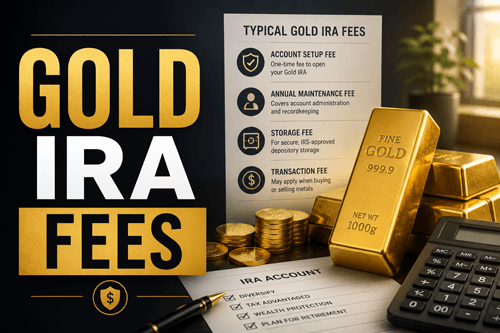
The IRS requires an approved custodian to administer the account, and physical bullion must generally be stored through an approved depository rather than at home. Common charges include the following:
 A one-time account setup or application fee
- Annual custodian or account-administration fees
- Segregated or non-segregated depository storage fees
- Insurance costs associated with vaulted metals
- Wire, transaction, shipping, or liquidation fees
- Dealer spreads between the metals’ spot price and the price you pay
Not every provider charges each fee separately. Some use a flat annual fee, while others base storage costs on the value of the metals in your account.
Some Gold IRA companies like Goldco and Augusta Precious Metals may cover or waive certain first-year expenses for qualifying account sizes.
Those offers can be valuable, but investors should still ask what the costs become after any promotional period ends.
The dealer spread deserves particular attention. It may not appear as a line item on an annual statement, yet it can be one of the largest costs of acquiring metals. This is the difference between the market spot price and the price at which a dealer sells a specific coin or bar.
A reputable provider should clearly explain pricing, eligible bullion options, and the process for selling metals when you need liquidity.
 Request a FREE Gold & Silver Guide

Paying Fees From the IRA vs Paying Out of Pocket

The source of payment matters operationally, even if it does not usually produce a deduction.
When fees are paid from your IRA, the payment reduces the cash or assets available inside the account. This is often convenient because you do not need to write a separate check each year.
Still, it is wise to keep enough cash in the account to cover annual charges. If an IRA holds only physical coins and bars with no cash reserve, the custodian may need to sell assets to pay fees, potentially at a time when you would rather continue holding them.
Paying a Gold IRA fee with funds outside the account can preserve more IRA assets for long-term growth. It may also be appealing if your account contains little cash.
But do not assume that an out-of-pocket payment is deductible or that it should be reported as an IRA contribution. The tax treatment can depend on the exact fee, account arrangement, and current tax law.
For retirees taking required minimum distributions from a traditional Gold IRA, planning is especially important.
Annual fees reduce the account balance, but they do not eliminate your responsibility to calculate and withdraw the proper RMD amount.
If the account is heavily invested in bullion, you may need to plan ahead to raise cash or consider an in-kind distribution when appropriate.
Related:
- How to Start a Gold IRA in 3 Simple Steps
- How to Start a Silver IRA in 3 Simple Steps
- Best Gold IRA Companies for 2026 (Reviewed & Rated)
Why Fee Transparency Matters More Than a Tax Deduction
The tax question is understandable, but it can distract from the larger issue: whether the total cost of your Gold IRA is fair, clear, and suitable for your strategy.
Physical precious metals are not the same as paper assets. Secure storage, insurance, specialized custody, and regulatory administration are real services with real costs.
For investors seeking an asset that cannot be created out of thin air or devalued in an instant, those expenses may be an acceptable trade-off for owning allocated physical bullion within a retirement structure.
The goal is not to find an account with no fees. It is to avoid paying unclear, excessive, or unnecessary fees.
A low advertised storage rate means little if the provider charges inflated product premiums, imposes high liquidation fees, or makes it difficult to understand where your metals are held.
Before opening an account or completing a 401(k), 403(b), TSP, or traditional IRA rollover, ask for the complete fee schedule in writing.
You should understand:
- Initial charges
- Annual recurring fees
- Storage options
- Transaction costs
- Minimum balances
- And any fees that apply when you sell or close the account
Also ask whether fees are flat or based on account value, and whether they can be paid from available IRA cash.
When a Gold IRA May Still Make Financial Sense
 A lack of deductibility does not make a Gold IRA a poor choice. Tax deductions are only one piece of retirement planning.
Many investors allocate a portion of their retirement savings to gold or silver because they want diversification beyond stocks, bonds, and currency-based assets.
Gold has historically been viewed as a store of value during periods of inflation, market stress, currency weakness, and geopolitical uncertainty.
It does not replace a complete retirement plan, and prices can rise or fall. Unlike a dividend-paying stock or interest-bearing bond, physical gold does not generate income.
Its role is generally preservation, diversification, and potential protection against financial-system risk. For that role, costs should be weighed against the size of the allocation and the length of time you expect to hold it.
A small account with high fixed annual charges may be less efficient than a larger account where those same fees represent a smaller percentage of assets.
Conversely, putting too large a share of retirement savings into one asset class can create concentration risk. Your appropriate allocation depends on your time horizon, liquidity needs, income sources, and broader financial plan.
Keep Records, Even When Gold IRA Fees Are Not Tax Deductible
Maintain records of every Gold IRA purchase, sale, fee disclosure, and account statement. Your custodian handles much of the required IRA reporting, but organized records help you evaluate performance and spot unexpected cost increases.
If you take an in-kind distribution of metals, convert a traditional Gold IRA to a Roth IRA, or inherit a precious metals IRA, tax reporting can become more complicated.
Those are situations where a CPA or enrolled agent who understands self-directed retirement accounts can be particularly valuable.
The practical next step is to compare providers based on transparency, service, storage arrangements, and total long-term cost – not a promised tax write-off.
A well-structured Gold IRA should give you confidence that your retirement metals are properly held, clearly priced, and positioned to support the wealth-preservation strategy you want for yourself and your family.
For more information about Gold IRAs, you can visit these related resources:
- Ultimate Guide to Gold IRA Taxes: Rules That Protect Retirement Savings
- Gold IRA Rules: How To Protect Your Retirement With Precious Metals
- Gold IRA FAQ: Everything You Need To Know About Gold IRAs
If you’re searching for the best company, request this FREE Gold IRA Checklist: