A gold IRA versus physical gold decision is really a decision about where you want your protection to live: inside a tax-advantaged retirement account or directly in your hands.
Both can help diversify wealth beyond paper assets that can be printed, diluted, or exposed to market stress. But they serve different purposes, come with different rules, and require different levels of access and responsibility.For many Americans approaching retirement, the strongest approach is not necessarily choosing one over the other. It may be using a Gold IRA to protect long-term retirement savings while keeping a separate allocation of personally owned bullion for immediate control and flexibility.
In this guide, we’ll explain the difference between owning physical gold outright versus through a Gold IRA, and the benefits and drawbacks of both options.
Gold IRA Versus Physical Gold: The Core Difference

A Gold IRA is a self-directed individual retirement account that holds IRS-approved precious metals. You do not take personal possession of the gold while it remains in the account.
Instead, an IRS-approved custodian administers the IRA, and the bullion is held at an approved depository.
Physical gold, sometimes called non-IRA gold, is bullion you buy with after-tax dollars and own directly.
This can include coins and bars delivered to your home, stored in a private vault, or kept in a safe-deposit arrangement. You choose the precious metals dealer, the products, and the storage method.
The distinction matters because a Gold IRA is designed for retirement investing. It can offer tax-deferred growth in a traditional account or potentially tax-free qualified withdrawals in a Roth account.
Personally owned gold offers more direct access, but it does not receive IRA tax treatment.
When a Gold IRA May Be the Better Fit
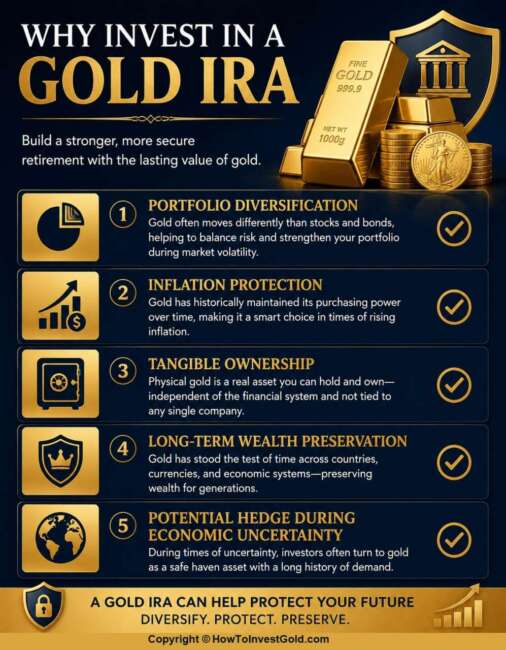
A Gold IRA can make sense when much of your wealth is tied up in retirement plans such as a traditional IRA, 401(k), 403(b), or Thrift Savings Plan.
A rollover or transfer can move eligible retirement funds into a self-directed IRA without creating a taxable event when handled correctly.
This structure allows you to diversify retirement savings without first taking a distribution, paying income taxes, and potentially triggering an early-withdrawal penalty.
For investors concerned about inflation, currency weakness, stock market volatility, or excessive exposure to conventional financial assets, that can be a meaningful advantage.
 Request a FREE Info Kit to learn more about an IRS loophole on gold & silver!

Here are three aspects to consider when a Gold IRA might be the best fit:
1. Gold IRA Tax Treatment Can Preserve More Capital for Retirement
With a traditional Gold IRA, investments generally grow tax-deferred. Taxes are typically due when you take distributions, just as they are with a conventional traditional IRA.
With a Roth Gold IRA, qualified distributions may be tax-free if you meet the applicable rules.
That does not mean a Gold IRA eliminates taxes. It changes when taxes are paid, and the outcome depends on your account type, age, withdrawal timing, and personal tax situation.
Traditional IRA owners also need to plan for required minimum distributions once they reach the applicable RMD age.
A Gold IRA can be especially appealing for investors who want to reposition part of an existing retirement account without liquidating it into taxable cash.
A direct custodian-to-custodian transfer is generally simpler than receiving the funds yourself and trying to complete an indirect rollover within the required time frame.
Related:
- How to Start a Gold IRA in 3 Simple Steps
- 8 Gold IRA Scam Warning Signs Before You Buy
- Physical Gold Taxes: What US Investors Need to Know
2. Professional Storage Reduces the Burden of Personal Custody
 Gold held in an IRA must generally remain under the control of the custodian and in an approved depository.
You can typically choose between segregated storage, where specific metals are set aside in your name, and non-segregated storage, where like-kind metals are stored together.
This arrangement adds annual costs, including custodian, storage, and sometimes insurance fees. In return, it removes the responsibility of securing high-value metals at home and helps keep the account aligned with IRS requirements.
For retirement assets meant to remain untouched for years, that trade-off can be sensible.
3. Gold IRA Metals Are Subject to Eligibility Rules
Not every coin, bar, or collectible belongs in a Gold IRA. Gold generally must meet a minimum fineness standard of .995, although certain widely recognized coins, including American Gold Eagles and Canada Maple Leafs, are permitted exceptions.
The same principle applies to silver, platinum, and palladium, each with its own purity standards.
That means an IRA investor cannot simply move a personal coin collection into a retirement account. The custodian and precious metals provider should help verify that the selected bullion is eligible before the purchase is completed.
When Personally Owned Physical Gold May Be the Better Fit
 Direct ownership is usually the better choice when immediate access and complete personal control matter most.
You buy the bullion with money outside your retirement account, receive it or arrange storage, and can sell or transfer it when you choose. For families who want a tangible reserve outside the banking and brokerage system, this is a powerful feature.
Physical bullion does not depend on an online login, a retirement custodian, or market trading hours. It is a real asset with no counterparty promise attached to it.
Here are two key scenarios when owning physical gold outright might be the better fit:
1. You Control Access, But You Also Control Security
Holding gold at home can provide peace of mind, especially for investors who value direct possession. Yet it also brings practical risks.
A home safe must be properly rated, installed, and discreet. Homeowners insurance may not fully cover precious metals, and publicizing ownership can create avoidable security concerns.
Private vault storage can reduce those concerns, but it introduces an ongoing storage cost similar to a Gold IRA. Before purchasing, decide whether you truly want to manage transportation, verification, insurance, and eventual resale yourself.
2. Physical Gold Is Easier to Use Before Retirement
 A Gold IRA is not designed as an emergency fund. Taking money or metals from the account before age 59 1/2 can result in ordinary income taxes and, in many cases, a 10% early-distribution penalty.
There are exceptions, but they are limited and should not be assumed.
Personally owned gold has no retirement-account withdrawal rules. If you need to sell a few coins to cover an unexpected expense, you can do so. The trade-off is that any gain may be taxable.
For federal tax purposes, gold bullion is generally treated as a collectible, and long-term gains can face a maximum 28% federal rate, depending on your income and circumstances.
That difference makes physical gold more flexible, but not automatically more tax-efficient.
Costs Matter in Both Choices
Investors sometimes assume physical gold has no ongoing costs and a Gold IRA is expensive. The truth is more nuanced.
Both paths involve purchase premiums and dealer spreads. The price you pay above the spot price of gold and the price a dealer offers when you sell can significantly affect returns, especially on smaller purchases.
A Gold IRA typically adds setup, annual administration, and storage fees. Ask:
 Whether pricing is flat or scaled to account value
- Whether the first-year fees are waived
- And whether there are minimum investment requirements
 Whether pricing is flat or scaled to account value
A reputable Gold IRA provider should explain every charge in writing.
With direct gold ownership, costs may include:
- Shipping
- Insurance
- Private storage
- Safe installation
- And authentication when selling.
Smaller fractional coins can offer flexibility, but they often carry higher premiums than larger bars or common bullion coins. The lowest upfront price is not always the best value if resale is difficult or the product is unfamiliar to local buyers.
If you’re searching for the best company, request a FREE Gold IRA Checklist:

Avoid the Biggest Mistakes
The most costly errors usually happen when investors treat gold as a quick trade or ignore the rules around retirement accounts. Do not use retirement funds to buy metals and store them at home as though they were personally owned bullion.
That can create serious tax problems if the IRS treats the transaction as a distribution.
Do not choose a provider solely because of a promotional offer, either. Review its:
- Fee schedule
- Buyback practices
- Available custodians
- Storage options
- And customer reputation
Independent ratings and complaint history from sources such as the BBB, Business Consumer Alliance, Trustpilot, and TrustLink can reveal how a company handles service issues after the sale.
Finally, avoid placing every dollar into one asset. Gold can help defend purchasing power and diversify a portfolio, but it does not produce income, and its price can move sharply over shorter periods.
Your allocation should reflect your retirement timeline, liquidity needs, risk tolerance, and confidence in your broader financial plan.
A Practical Way to Decide
 Start by separating your goals. If you want to protect retirement funds while preserving potential tax advantages, a Gold IRA deserves serious consideration.
If you want a tangible reserve that you can access without IRA rules, physical gold may better match that need.
Many investors use both roles deliberately. They keep a measured amount of bullion outside retirement accounts for direct control, while using a self-directed Gold IRA for long-term, tax-advantaged diversification.
This approach can create a clearer boundary between emergency flexibility and retirement preservation. Before moving funds, take time to understand the rollover process, the metals that qualify, and the total cost of ownership.
Gold works best when it is purchased with a clear purpose: not as a reaction to a frightening headline, but as a disciplined layer of protection for the wealth you have worked years to build.
Related:
- Gold Price Forecast 2026: Build a Resilient Retirement Portfolio
- Silver Price Prediction 2026: Why Analysts Expect Higher Prices Ahead
- Gold Demand and Supply: 4 Key Forces Behind Price Swings
- How to Buy Silver Bullion Without Costly Mistakes: A Beginner’s Guide
Gold IRA vs Physical Gold: FAQ
What is the core difference between a Gold IRA and physical gold?
A Gold IRA is a self-directed individual retirement account that holds IRS-approved precious metals and is administered by a custodian with the bullion held at an approved depository.
Physical gold, or non-IRA gold, is bullion you buy with after-tax dollars and own directly, with control over storage and access.
When might a Gold IRA be the better fit?
A Gold IRA can be a better fit when much of your wealth is tied up in retirement plans such as a traditional IRA, 401(k), 403(b), or TSP, and you want tax-advantaged growth or a rollover/transfer that moves funds without a taxable event if done correctly.
What are the tax implications of a Gold IRA versus personally owned gold?
With a traditional Gold IRA, investments grow tax-deferred, and taxes are due on distributions; with a Roth Gold IRA, qualified distributions may be tax-free if rules are met.
Personally owned gold has no IRA tax treatment and gains may be subject to capital gains taxes, often at up to 28% for collectibles, depending on circumstances.
What costs should I expect with Gold IRAs and with directly owned gold?
Gold IRAs typically incur setup, annual administration, and storage fees, plus custodian and insurance costs. Directly owned gold involves costs like shipping, insurance, private storage, safe installation, and authentication when selling; smaller coins may carry higher premiums than larger bars.
What are common mistakes to avoid when choosing between a Gold IRA and physical gold?
Avoid using retirement funds to buy metals and storing them at home as if they were personally owned bullion; don’t choose a provider based only on promos and don’t put all funds into one asset.
Also review fee schedules, buyback practices, available custodians, storage options, and reputation to prevent costly errors.
If you’re searching for the best company, request a FREE Gold IRA Checklist: