A retirement account can look diversified on paper while still relying almost entirely on the same financial system: stocks, bonds, mutual funds, and cash. That is why many Americans nearing retirement ask, how does a gold IRA work and whether it can help protect purchasing power when inflation, debt concerns, and market volatility rise.
A Gold IRA allows you to hold qualifying physical gold inside a tax-advantaged retirement account. It is not a box of coins stored in your home, and it is not the same as buying shares of a gold mining company or a gold exchange-traded fund.A properly structured Gold IRA holds IRS-approved bullion through a qualified custodian and an approved depository. The account can offer a practical way to diversify retirement savings with an asset that cannot be printed out of thin air or devalued in an instant.
Feel free to use the TOC list to jump straight to any section:
Let’s begin by taking a look at how a Gold IRA works.
How Does a Gold IRA Work?
A Gold IRA is a type of self-directed individual retirement account. “Self-directed” means the account can hold alternative assets that are generally unavailable in a standard brokerage IRA, including certain physical precious metals.
The tax treatment follows the IRA type you choose: traditional, Roth, or, in some cases, SEP IRA for self-employed investors.
The account has several moving parts. You choose a Gold IRA company to help coordinate the process, a custodian to administer the account and report to the IRS, a metals dealer to source the bullion, and a depository to store it.
Some established providers work with a network of custodians and storage facilities, making the process less burdensome for first-time buyers.
You direct the purchase, but the custodian executes the transaction using funds inside the IRA. The gold is then shipped directly to the approved depository.
You do not personally take possession of the metal while it remains in the IRA. Taking possession would generally be treated as a distribution, which could trigger income taxes and, if you are under age 59½, a possible 10% early-withdrawal penalty.
That separation is the central rule. You may own physical gold for retirement, but the IRA must maintain the proper custody and storage structure.
👉 Request a FREE Info Kit on Gold to learn more!

Funding a Gold IRA: Contributions, Transfers, and Rollovers
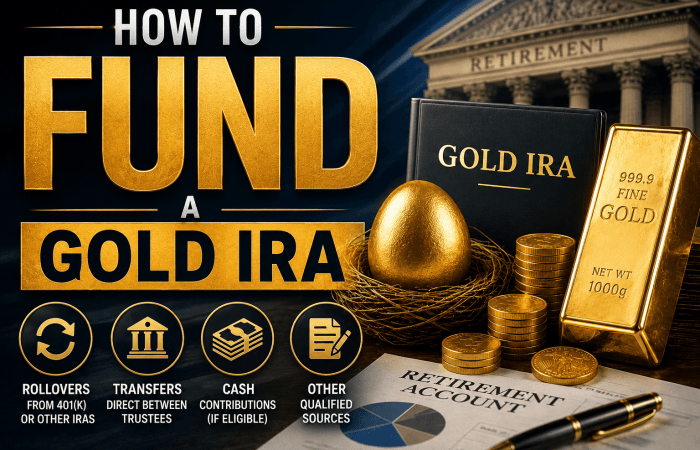
There are three common ways to fund a Gold IRA. The right path depends on where your retirement money currently sits. Here are three ways to fund your Gold IRA:
1. New Contribution
You can make a new annual IRA contribution, subject to IRS contribution limits and eligibility rules. This route can work for investors starting small, although it may take time to build a meaningful precious metals allocation.
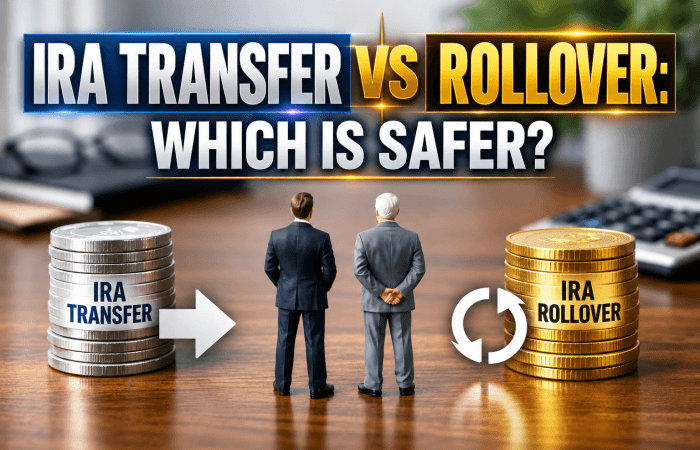
2. A Gold IRA Transfer
A transfer is often used when moving funds from one IRA to another IRA, such as from a traditional brokerage IRA to a traditional self-directed Gold IRA.
In a direct trustee-to-trustee transfer, the funds move between custodians without passing through your hands.
This is usually the cleanest option because it reduces the chance of missing a deadline or creating an unintended taxable event.
3. A Gold IRA Rollover
A rollover is more common when moving money from an employer plan, such as a 401(k), 403(b), TSP, or similar retirement account. If you have left the employer, you can often roll over eligible funds into a Gold IRA.
Some active plans permit an in-service rollover, but this depends entirely on the plan’s rules. Your plan administrator can tell you what is permitted.
Whenever possible, investors generally prefer a direct rollover, in which plan funds move directly to the new custodian.
With an indirect rollover, you receive the money first and must redeposit it into an IRA within 60 days. The employer plan may also withhold 20% for taxes, leaving you to replace that amount from other funds if you want to roll over the full balance.
For most retirement savers, that added complexity is not worth the risk.
What Gold Can You Hold in an IRA?
Not every gold coin or bar qualifies. The IRS has purity standards and other requirements designed to limit IRA holdings to investment-grade bullion rather than collectibles.
 Gold generally must meet a minimum fineness of .995, although certain widely recognized coins are allowed by specific exception. Common examples can include:
- American Gold Eagles
- American Gold Buffalos
- Canadian Gold Maple Leafs
- And qualifying bars from approved refiners
 Silver, platinum, and palladium coins and bars may also be held in a self-directed precious metals IRA if they meet applicable standards.
Collectible coins, rare numismatic pieces, jewelry, and many proof coins may not qualify. This is one area where a knowledgeable provider matters. A dealer should clearly explain whether a product is IRA-eligible before you authorize the purchase.
Be cautious of a sales pitch that focuses only on scarcity stories, commemorative packaging, or claims that a coin will rapidly appreciate because it is rare.
Gold IRA investors are usually seeking disciplined wealth preservation and diversification, not a speculative collectibles market. Ask for transparent pricing, including the difference between the dealer’s selling price and the metal’s market price.
Custody and Storage Rules
 The IRS does not permit you to store IRA-owned gold in a home safe, personal vault, or safe-deposit box under a standard Gold IRA arrangement. The metals must be held by an approved trustee or custodian at an authorized depository.
Depositories are specialized facilities designed for precious metals storage. They typically provide insurance, security controls, inventory reporting, and either segregated or non-segregated storage.
Segregated storage generally means your specific bars or coins are stored separately. Non-segregated, sometimes called commingled, storage means your holdings are stored alongside like-kind metals owned by other investors, while records identify your ownership.
Neither option is automatically better for every investor. Segregated storage may cost more (typically $150 per year) and can appeal to those who want their exact coins or bars returned upon distribution.
Non-segregated storage is commonly used, often at a lower cost (around $100 per year), and generally gives you an equivalent quantity and type of metal when you sell or take a distribution.
Taxes and Required Distributions
With a traditional Gold IRA, eligible contributions may be deductible depending on your income and workplace retirement plan coverage. Growth is generally tax-deferred. You normally pay ordinary income tax when you take distributions.
With a Roth Gold IRA, contributions are made with after-tax dollars. Qualified distributions can be tax-free if you meet the relevant age and account-holding requirements.
Roth IRAs do not have lifetime required minimum distributions for the original owner, while traditional IRAs generally do beginning at the IRS-required age.
Required minimum distributions can require extra planning in a Gold IRA because bullion is not as instantly liquid as cash in a brokerage account.
You may sell enough metal within the account to raise cash for the distribution, or you may take an in-kind distribution of coins or bars. The value of metal distributed is generally taxable as ordinary income in a traditional IRA.
A Gold IRA custodian and tax professional can help you understand the mechanics, but neither gold nor an IRA structure eliminates tax obligations. Rules can change, and personal circumstances matter.
For more information, you can check out our ultimate gold IRA tax rules guide.
👉 Request a FREE Info Kit on Gold to learn more!
Costs to Understand Before You Buy
Gold IRAs usually carry more costs than a conventional IRA holding paper assets. That does not make them unsuitable, but it does mean you should understand the full picture before moving retirement funds.
Typical charges may include:
- An account setup fee
- Annual custodian fee
- Storage and insurance fee
- And dealer markup on the metals
In total, many investors can expect annual Gold IRA costs to range between approximately $180 and $300, depending on the selected services and storage arrangements.
Some companies waive or reimburse certain first-year costs for qualifying account sizes, but evaluate the complete offer rather than making a decision based on a promotion alone.
Ask every provider for a written fee schedule. Find out whether fees are flat or based on account value, whether storage is segregated or non-segregated, and how the company handles buybacks. A strong buyback process can matter when you need liquidity or must satisfy required distributions.
It is also wise to research the company beyond its advertising. Review customer complaint patterns, service history, pricing transparency, and third-party reputation sources such as the Better Business Bureau, Business Consumer Alliance, TrustLink, Trustpilot, and Ripoff Report.
No company is perfect, but unanswered complaints, unclear fees, and high-pressure sales tactics deserve serious attention.
Is a Gold IRA Right for Your Retirement Savings Plan?

Gold has historically been valued as a store of value during periods of currency weakness, inflation pressure, geopolitical uncertainty, and financial stress.
It can diversify a portfolio built around assets that may move together during a market downturn. However, gold also has risks: its price can fluctuate, it does not pay dividends or interest, and physical ownership brings storage and transaction costs.
For that reason, a Gold IRA is usually considered one piece of a broader retirement strategy, not a replacement for every other investment. The appropriate allocation depends on your time horizon, income needs, tax situation, existing holdings, and comfort with price movement.
Investors who expect to need regular withdrawals soon should pay particular attention to liquidity planning.
Before you move retirement funds, take the time to compare custodians, bullion options, storage terms, and provider reputations. A Gold IRA works best when it is built deliberately: with eligible metals, proper custody, clear fees, and a role that supports the retirement security and family legacy you are working to protect.
👉 Before you go, request a FREE Info Kit on Gold to learn more!
FAQ: How Does a Gold IRA Work
How does a Gold IRA work?
A Gold IRA is a self-directed retirement account that can hold qualifying physical precious metals, administered by a custodian and stored in an approved depository. You select a Gold IRA company to coordinate the process, a custodian to manage the account, a metals dealer to source the bullion, and a depository to hold it. You direct the purchase, but the custodian executes the transaction and ships the gold to the approved depository; you do not take possession of the metal while it remains in the IRA.
What gold can you hold in an IRA?
Not every gold coin or bar qualifies. The IRS requires a minimum fineness of .995 for most bullion, with exceptions for certain widely recognized coins. Common eligible options include American Gold Eagles, American Gold Buffalos, Canadian Gold Maple Leafs, and qualifying bars from approved refiners; silver, platinum, and palladium can also qualify if they meet applicable standards. Collectible coins and certain jewelry or proof coins generally do not qualify.
How is a Gold IRA funded?
There are three common funding methods: a new contribution within IRS limits and eligibility rules; a Gold IRA transfer, typically a direct trustee-to-trustee transfer between custodians; and a Gold IRA rollover, often from an employer plan like a 401(k). Direct rollovers are usually preferred to avoid missed deadlines or tax consequences, while indirect rollovers may require redeposit within 60 days and can involve 20% withholding for taxes.
What are the custody and storage rules for a Gold IRA?
The IRS does not permit storing IRA-owned gold at home or in a personal safe, and the metals must be held by an approved custodian at an authorized depository. Depositories offer segregated (held separately) or non-segregated (commingled) storage. Segregated storage costs more but ensures your exact coins or bars are returned; non-segregated storage is typically cheaper and still allows you to sell or distribute the same metal type.
What costs should I understand before buying a Gold IRA?
Typical costs include an account setup fee, annual custodian fee, storage and insurance fees, and a dealer markup on the metals. Total annual Gold IRA costs commonly range from about $180 to $300, depending on services and storage terms. It is important to obtain a written fee schedule and understand whether fees are flat or based on account value, and how buybacks are handled.