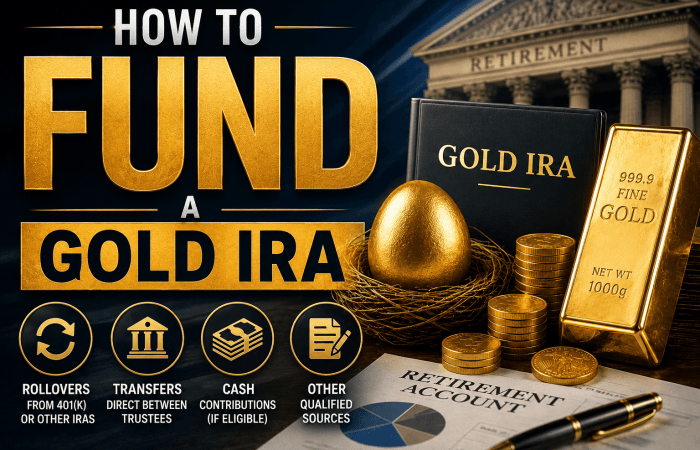
Moving retirement savings should not feel like a gamble, especially when you are looking to protect a lifetime of work from inflation, market swings, and a weakening dollar.
The difference between an IRA transfer versus rollover may sound technical, but choosing the right method can determine whether your funds move cleanly into a self-directed Gold IRA or create avoidable tax paperwork, withholding, or penalties.For many retirement savers, a direct transfer is the cleaner path. A rollover can still be the right choice when money is held in a former employer’s 401(k), TSP, 403(b), or similar workplace plan.
The key is knowing which transaction applies to your account before funds are ever distributed.
In this article, we’ll explain IRA transfer versus rollover and which option is safer when moving retirement savings. We’ll also cover how a Gold IRA move typically works.
Let’s begin by taking a look at IRA transfer versus rollover and their core differences.
IRA Transfer Versus Rollover: The Core Difference

An IRA transfer moves money directly between financial institutions. For example, you may move assets from a traditional IRA at a bank or brokerage to a traditional self-directed IRA with a custodian that allows IRS-approved gold, silver, or other alternative assets.
The account holder does not take possession of the money. One custodian sends it directly to the other.
A rollover generally moves money from an employer-sponsored retirement plan into an IRA. A common example is rolling a former employer’s 401(k) into a traditional Gold IRA after leaving that job.
Rollovers can also occur between IRAs, but that is where timing rules become especially relevant.
The terms are often used loosely by financial firms, and some companies may call almost any retirement-account move a “rollover.” What matters is how the transaction is processed.
A direct institution-to-institution movement is usually safer and simpler than having retirement funds sent to you personally.
Why a Direct IRA Transfer Is Usually Preferable
With a trustee-to-trustee transfer, the funds never become a distribution to you. That means there is generally no 60-day deadline, no mandatory federal withholding, and no limit on how many direct IRA transfers you can complete in a year.
This matters for investors repositioning retirement savings into physical precious metals. A properly structured transfer allows the new self-directed IRA custodian to receive the funds, then purchase eligible bullion for the account.
Your gold or silver remains inside a tax-advantaged retirement structure and is held by an approved depository, rather than at home or in a personal safe.
A transfer is often appropriate when you already own a traditional IRA, Roth IRA, SEP IRA, or SIMPLE IRA and want to change custodians or investment options.
It is also useful when your current IRA is heavily concentrated in paper assets, and you want to allocate a measured portion to assets that cannot be printed out of thin air or devalued in an instant.
When a Rollover Makes Sense
A rollover is typically necessary when the funds are in a qualified workplace plan. If you have retired, changed employers, or have an old 401(k) left behind with a previous company, you may be able to roll those savings into a self-directed IRA.
The best version is a direct rollover. In this arrangement, your former plan administrator sends the money directly to the new IRA custodian, often by check made payable to the custodian for your benefit.
You do not cash the check or deposit it into your personal bank account.
A direct rollover is not subject to the same practical hazards as an indirect rollover. It is the standard approach for people who want to move a former 401(k), 403(b), 457(b), or Thrift Savings Plan account into a Gold IRA while preserving tax-deferred treatment.
 If you’re searching for the best company, request a FREE Gold IRA Checklist:

The Risk of an Indirect Rollover
An indirect rollover occurs when the retirement plan or IRA distributes the money to you first. You then have 60 calendar days to deposit the full eligible amount into another retirement account.
Miss that deadline, and the IRS may treat the distribution as taxable income. If you are under age 59 1/2, an additional 10% early-distribution penalty may apply unless an exception is available.
There is another issue with employer-plan distributions: mandatory withholding. If a 401(k) plan sends an eligible rollover distribution to you, it generally must withhold 20% for federal income taxes.
To complete a full rollover, you would need to replace that withheld amount from other personal funds before the 60-day period expires.
Otherwise, the withheld portion may be treated as a taxable distribution, even though it was sent to the IRS.
That is an unnecessary cash-flow problem for most households. If your goal is long-term wealth preservation, avoid creating a short-term tax trap. Ask the plan administrator for a direct rollover to the receiving IRA custodian.
There is also an IRA-specific limit to understand. Generally, you can make only one 60-day IRA-to-IRA rollover in a 12-month period, regardless of how many traditional, Roth, SEP, or SIMPLE IRAs you own.
Direct trustee-to-trustee transfers are not subject to this once-per-12-month rollover rule. Direct rollovers from employer plans are also generally outside that limitation.
Related:
- 401(k) to Gold IRA Rollover Without Penalty: Rules and Steps
- TSP to Gold IRA Transfer Rules: Traditional vs Roth and Direct Rollovers
- 8 Gold IRA Scam Warning Signs Before You Buy
Traditional, Roth, and Tax Treatment
Account type matters just as much as transaction type. A traditional 401(k) rolled into a traditional IRA normally remains tax-deferred when handled correctly. Likewise, a traditional IRA transfer into another traditional IRA should not create a current tax bill.
A Roth IRA transfer should generally move into another Roth IRA. Roth 401(k) funds may be rolled into a Roth IRA, while pre-tax workplace-plan funds typically go to a traditional IRA.
Mixing account types without understanding the tax consequences can create confusion later.
Moving pre-tax money from a traditional IRA or 401(k) to a Roth IRA is not a standard tax-free rollover. It is generally a Roth conversion, meaning the converted amount is taxable income in the year of conversion.
A conversion may make sense for some investors, but it deserves careful planning because it can push income into a higher tax bracket.
The same principle applies to precious-metals accounts. A Gold IRA does not change the fundamental tax rules of an IRA. It is simply a self-directed IRA designed to hold permitted alternative assets.
Whether your account is traditional or Roth determines the tax framework, while the custodian, dealer, and depository handle the operational side.
Related: Gold IRA Tax Rules: The Ultimate Gold IRA Tax Guide
How a Gold IRA Move Usually Works
 A reputable Gold IRA company can coordinate paperwork, but it should not pressure you to rush or imply that every retirement account is eligible. Your existing plan rules and personal tax situation still control the transaction.
The process usually follows a straightforward sequence:
✔️ Step 1. Open a self-directed IRA with a Gold IRA company or qualified custodian that supports precious metals
✔️ Step 2. Identify whether your existing funds require an IRA transfer or an employer-plan rollover
✔️ Step 3. Complete the transfer or direct-rollover request with the current custodian or plan administrator
✔️ Step 4. Once funds arrive, select IRA-eligible bullion and arrange storage through an approved depository
The metals must meet IRS standards, and collectibles are generally not permitted. Many investors choose widely recognized gold and silver bullion products because they are easier to price, sell, and verify.
Your IRA, not you personally, must own the metals, and personal possession can jeopardize the account’s tax-advantaged status.
Unlock the power of gold & silver investing by requesting a FREE Gold IRA Guide:

Related:
- How to Start a Gold IRA in 3 Simple Steps
- Gold Demand and Supply: 4 Key Forces Behind Price Swings
- Silver Supply and Demand Forecast Into 2026—What to Know
Important Questions to Ask Before You Move Funds
If the money is in a current employer plan, first ask whether the plan permits an in-service rollover. Some plans allow employees over a certain age to move a portion of their balance while still working; others do not.
Do not assume access simply because you are eligible to contribute to an IRA.
Next, ask whether the transaction will be processed directly between institutions. Confirm the payee instructions for any check and make sure it is not payable to you personally. Keep copies of every form, account statement, and confirmation letter.
You should also understand costs before committing. A self-directed precious-metals IRA can involve:
- ☑️ Custodian fees
- ☑️ Depository storage fees
- ☑️ Transaction costs
- ☑️ And dealer spreads
These costs do not automatically make the strategy unsuitable, but they should be weighed against the diversification and wealth-protection role you expect gold or silver to play.
Finally, think about allocation rather than emotion. Gold and silver can provide a store of value outside the conventional financial system, but they are not a substitute for a complete retirement plan.
The appropriate allocation depends on your time horizon, existing holdings, income needs, risk tolerance, and concerns about inflation or market instability.
Related: Gold IRA Fees: What You Actually Pay and How to Compare
Choose the Cleanest Path for Your Retirement Assets
 For an existing IRA, a direct trustee-to-trustee transfer is usually the least complicated option. For funds in a former employer’s plan, a direct rollover to a self-directed IRA is generally the cleanest route.
In both cases, keeping the money out of your personal hands reduces the chance that deadlines, withholding, and reporting mistakes interfere with your retirement strategy.
Before authorizing any movement, verify the account type, confirm the transaction method, and ask how the custodian will document it.
A careful transfer or rollover can help you put part of your retirement savings into tangible assets with greater confidence, while keeping your focus where it belongs: preserving purchasing power and building a more resilient legacy for the people who depend on you.
IRS Transfer Versus Rollover: FAQ
What is the difference between an IRA transfer and an IRA rollover?
An IRA transfer moves money directly between financial institutions, so you do not take possession of the funds, and there is no 60‑day deadline or federal withholding.
An IRA rollover generally moves money from an employer‑sponsored retirement plan into an IRA, and can involve the plan or a distribution to you that you must deposit into another retirement account within 60 days.
Why is a direct IRA transfer usually preferable?
A direct transfer keeps the funds in a tax‑advantaged retirement structure without creating a distribution to you, reducing the risk of deadlines, withholding, or reporting mistakes, and it typically allows for multiple transfers in a year without penalties.
When might a rollover be appropriate?
A rollover is often appropriate when funds are in a former employer’s plan, such as a 401(k) or similar account, and you want to move them into a traditional Gold IRA while preserving tax‑deferred treatment, especially when dealing with workplace plans rather than IRAs.
What are the tax considerations when moving to a Gold IRA?
The tax treatment depends on the account type. Traditional money moved into a traditional IRA remains tax‑deferred, and a Roth IRA transfer should move into a Roth IRA. Moving pre‑tax money to a Roth typically involves a Roth conversion and can affect your tax bracket, so careful planning is advised.
What questions should I ask before moving funds?
Ask whether the plan permits an in‑service rollover, whether the transaction will be processed directly between institutions, and confirm payee instructions so checks are not payable to you personally. Also understand the costs involved, such as custodian and storage fees, transaction costs, and dealer spreads.
If you’re searching for the best company, request a FREE Gold IRA Checklist: