A market drop can make a retirement statement feel far less secure than it did six months earlier. That is why the question of a gold IRA versus 401k is not simply about choosing an account. It is about deciding how much of your retirement wealth should remain tied to paper assets, employer plan menus, and the broader financial system.
For many Americans, the best answer is not to abandon a 401(k). It is to understand what it does well, where its limits are, and whether a self-directed Gold IRA can add a layer of diversification built around physical assets with a long history as a store of value.Gold IRA Versus 401(k): The Core Difference Explained
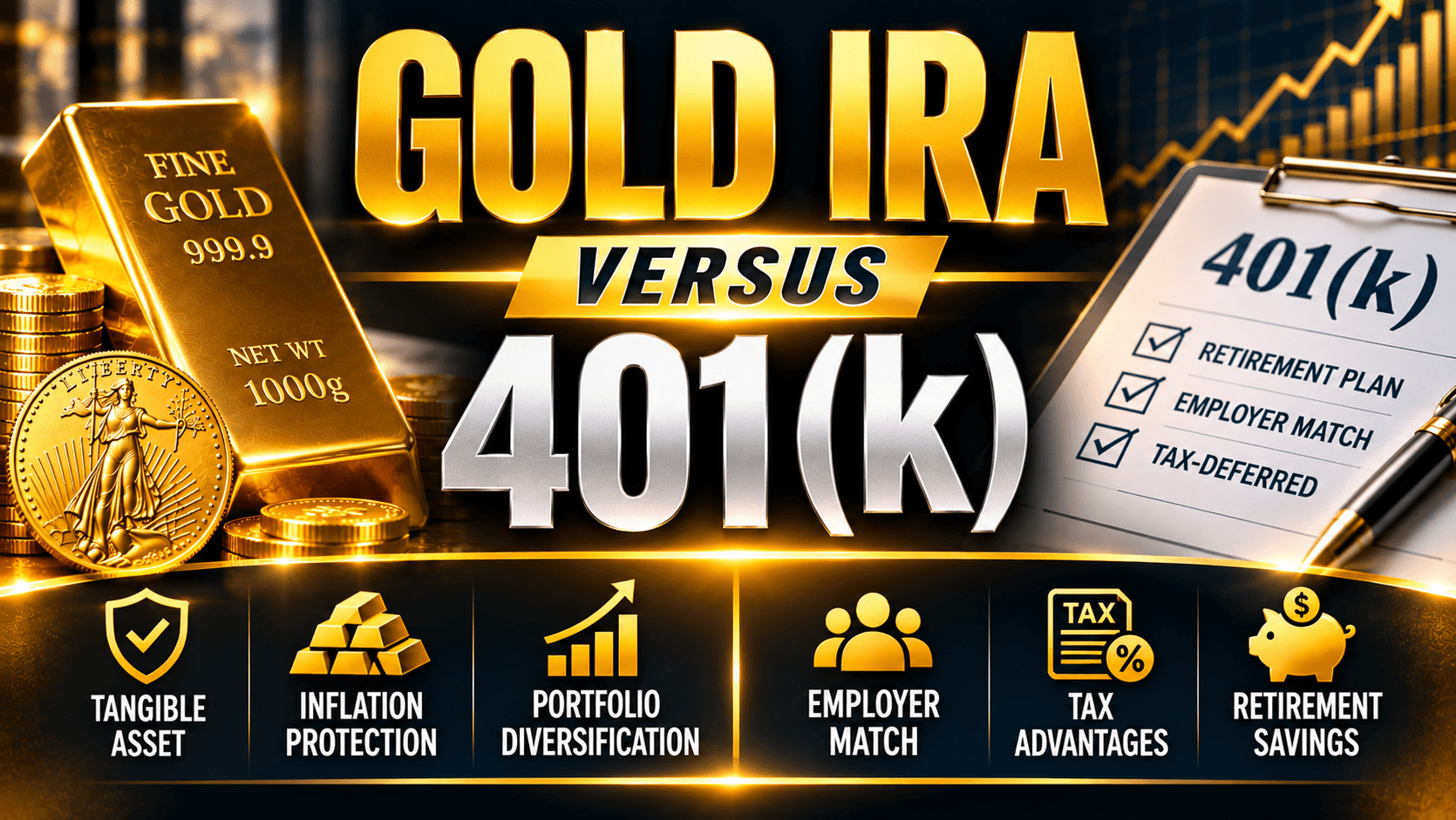
A 401(k) is an employer-sponsored retirement plan. It usually offers a limited menu of mutual funds, target-date funds, company stock, and sometimes stable-value or bond funds.
Your employer selects the plan provider and investment lineup, although you choose from the available options.
A Gold IRA, on the other hand, is a self-directed individual retirement account designed to hold IRS-approved physical precious metals.
Rather than owning a gold mining stock or a gold exchange-traded fund, the account can own qualifying gold bullion, and potentially silver, platinum, or palladium.
A specialized custodian administers the account, while an approved depository stores the metals.
That distinction matters. A 401(k) is generally built for convenient payroll saving and market-based investing. A Gold IRA is built for investors who want direct exposure to physical bullion inside a tax-advantaged retirement account.
Gold cannot be printed out of thin air, and its value is not dependent on the earnings report of a single company or the promise of a fund manager.
Neither account is automatically better in every situation. The right choice depends on your employer benefits, timeline, risk tolerance, existing holdings, and need for protection from inflation, currency weakness, and market volatility.
 Claim your FREE Gold & Silver Info Guide to learn how to protect your retirement savings with a Gold IRA!

Where a 401(k) Has a Real Advantage
 The strongest reason to keep contributing to a 401(k) is an employer match. If your employer matches a portion of your contributions, that is part of your compensation. Walking away from it may mean leaving immediate value on the table.
401(k) contributions are also simple. Money can come directly from each paycheck, which helps investors build discipline without having to make repeated investment decisions.
Traditional 401(k) contributions may reduce current taxable income, while Roth 401(k) contributions are made with after-tax dollars and may offer tax-free qualified withdrawals later.
Many workplace plans also have relatively low institutional fund expenses. A large plan may provide access to diversified stock and bond funds at costs that would be difficult to obtain as an individual investor.
Still, convenience can come with limitations. Most 401(k) participants are heavily exposed to stocks, bonds, and cash-based investments.
Even a diversified fund lineup can remain connected to the same economic system, interest-rate cycle, and market sentiment.
When stocks and bonds decline together, retirement savers may discover that diversification inside a conventional plan did not provide as much separation as they expected.
What a Gold IRA Can Add to Retirement Savings

A Gold IRA gives eligible investors the ability to hold physical precious metals within an IRA structure.
This can provide diversification that behaves differently from conventional securities, especially during periods of monetary uncertainty, persistent inflation, banking concerns, or geopolitical stress.
Gold is not guaranteed to rise when stocks fall. Its price can move sharply, it does not pay dividends, and short-term performance can disappoint investors who expect a quick hedge against every headline.
But physical gold has historically served a different role than growth assets. It is often held to preserve purchasing power and create a more resilient retirement mix, not to replace every stock or bond in a portfolio.
A Gold IRA may be especially worth researching if you have a substantial amount in a former employer’s 401(k), a traditional IRA, or another eligible retirement account and want more direct control over your investment choices.
It can also appeal to investors who are concerned that long-term debt expansion, currency devaluation, and inflation may erode the real value of cash and fixed-income holdings.
The metals must meet IRS standards. Collectible coins, rare coins, and personal bullion purchases do not automatically qualify.
In general, the account must hold approved bullion through a custodian and store it at an approved depository. Taking personal possession of IRA metals can create a taxable distribution and possible penalties, so proper administration is not optional.
Related:
- How to Start a Gold IRA in 3 Simple Steps
- How to Start a Silver IRA in 3 Simple Steps
- Best Gold IRA Companies for 2026 (Reviewed & Rated)
Taxes: The Account Type Matters More Than the Asset

A common misunderstanding is that gold receives special tax treatment simply because it is held in a Gold IRA. The tax treatment usually depends on whether the IRA is traditional or Roth, not on the fact that it holds precious metals.
A traditional Gold IRA generally follows the familiar traditional IRA framework: eligible contributions may be deductible depending on:
 Income and workplace-plan coverage
- Investment growth is tax-deferred
- And qualified withdrawals are taxed as ordinary income
 Income and workplace-plan coverage
A Roth Gold IRA is funded with after-tax dollars, and qualified withdrawals can generally be tax-free.
The same broad logic applies to traditional and Roth 401(k) accounts. That means a rollover from a traditional 401(k) to a traditional Gold IRA generally preserves tax-deferred status when completed correctly.
Moving pre-tax funds into a Roth account, however, can create a taxable conversion.
Tax rules are detailed, and required minimum distributions may apply to traditional accounts. Before making a major change, speak with a qualified tax professional who understands retirement distributions and rollovers.
Fees and Liquidity Deserve a Look
A 401(k) usually has administrative fees and fund expenses, even if they are not always obvious on a quarterly statement. A Gold IRA has a different fee structure.
Investors may pay account setup fees, annual custodian fees, depository storage fees, insurance-related costs, and dealer spreads when buying or selling metals.
These costs do not make a Gold IRA unsuitable. They simply need to be understood before opening an account.
Ask for a complete written fee schedule, including whether pricing changes with account value and whether storage is segregated or non-segregated.
Liquidity is another trade-off. Selling a mutual fund within a 401(k) is usually straightforward, subject to the plan’s procedures.
Selling metals in a Gold IRA requires contacting the custodian and dealer, receiving a quoted price, and settling the transaction. Physical gold is still a liquid global asset, but it is not as instantaneous as clicking a fund-trade button.
Investors should also avoid funding a Gold IRA with money they may need soon.
Retirement accounts can impose taxes and penalties on early withdrawals, and precious metals are generally better suited to long-term wealth preservation than short-term cash needs.
Can You Move a 401(k) Into a Gold IRA?
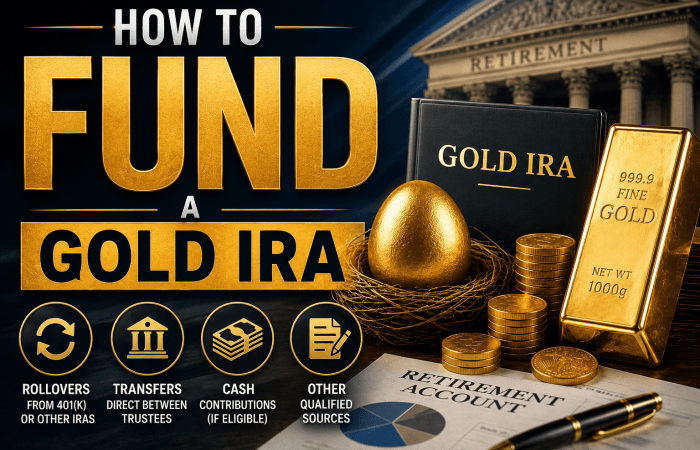
 Often, yes. The cleanest situation is a 401(k) from a previous employer. Former employees can commonly roll eligible funds into a self-directed Gold IRA without current taxation when the process is handled as a direct rollover.
With a direct rollover, funds move from the old plan provider to the new IRA custodian without being paid to you first.
This helps reduce the risk of missed deadlines and mandatory withholding that can occur when retirement funds are distributed directly to the account owner.
An active employer’s 401(k) is different. Many plans do not allow a rollover while you are still employed, though some allow an in-service distribution after a certain age or under particular plan rules.
Your plan administrator can confirm what is available. Do not assume you must quit your job to explore your options, but do not assume your plan permits a move either.
A reputable Gold IRA company can explain the paperwork and coordinate with the custodian, but it should not pressure you to liquidate every conventional retirement asset.
Be cautious of high-pressure sales tactics, vague fee disclosures, or promises that gold can only go up.
How to Decide Between a Gold IRA and a 401(k)
Start with the role each account would play. If you are still working and receive a meaningful employer match, contributing enough to receive the full match is often a sensible foundation.
After that, review whether your overall retirement savings are overly concentrated in stocks, bonds, and dollar-based assets.
If you have an old 401(k), a Gold IRA rollover may offer more control and a practical way to diversify a portion of those funds into physical bullion.
The appropriate allocation varies widely. A person with a pension, substantial cash reserves, and a long investment horizon may make a different decision than someone nearing retirement who is concerned about a major market drawdown.
It also helps to compare providers carefully. Look beyond promotions and ask about:
- Custodian relationships
- Depository options
- Buyback policies
- Complete fees
- Educational support
- And third-party reputation signals
A decision involving retirement savings deserves documentation, patience, and clear answers. Your retirement plan does not have to make an all-or-nothing choice between growth and protection.
A 401(k) can help you capture employer benefits and pursue market growth, while a properly structured Gold IRA can hold a portion of wealth in a tangible asset outside the daily swings of paper markets.
The goal is not to predict every crisis. It is to build a retirement strategy you can live with when uncertainty arrives.
Top-Rated Gold IRA Companies for 401(k) Rollovers
There are many options for gold IRA companies on the market, so which company should you choose?
To make your decision a bit easier, we’ve put together a list of the best precious metals and gold IRA companies in the industry, which we have carefully reviewed and vetted based on BBB/BCA ratings and complaints, customer reviews, annual fees, precious metals selection, storage options, promotions, and buy-back programs.
In other words, we have looked for patterns in complaints, especially around delayed communication, unexpected fees, or sales pressure for you. You can feel safe taking help from any of these companies to set up a gold IRA or for regular precious metals purchases:
>
| Company | Reviews | Annual Fees | Investment Minimums (IRA) | Preferred Custodian | Free Gold Kit |
 |
 |
$180 | $10,000 | Equity Trust |  |
 |
 |
$180 | $25,000 | Entrust | |
 |
 |
$180 | $25,000 | Equity Trust | |
 |
|
$75-$300 | $10,000 | GoldStar Trust Company | |
 |
 |
$200 | $50,000 | Equity Trust | |
 |
 |
$250 | $20,000 | Equity Trust | |
 |
 |
$250 | $10,000 | Equity Trust | |
 |
 |
$48 | $0 | Various | |
For more information about Gold IRAs, you can visit these related resources:
- Gold IRA Rules: How To Protect Your Retirement With Precious Metals
- Gold IRA Tax Rules: The Ultimate Gold IRA Tax Guide
- Gold IRA FAQ: Everything You Need To Know About Gold IRAs
- Gold IRA Pros And Cons
👉 If you’re searching for the best company, request this FREE Gold IRA Checklist: