A fee that looks small on paper can take a meaningful bite out of a modest account over several years.
The good news is that Gold IRA costs are usually understandable once you separate them into the right categories.
Your task is to identify every one-time and recurring charge, estimate the dealer’s price markup, and compare the total against the value and protection you expect physical gold to provide.
In this article, we’ll show you how to calculate Gold IRA fees before you invest using a simple fee calculation formula. We’ll also cover how to compare fee quotes and evaluate Gold IRA promotions.
Let’s begin by taking a look at the simple Gold IRA fee calculation formula.
The Gold IRA Fee Calculation Formula
Start with a simple first-year calculation:
First-year Gold IRA cost = account setup fee + annual custodian fee + annual storage fee + transaction fees + bullion markup or spread + any shipping or wire charges
For later years, the formula is usually simpler:
Annual ongoing cost = custodian fee + storage fee + any transaction, sale, or account-service charges
The Gold IRA company markup, often called the spread, deserves special attention. It may not appear as a line-item fee, but it is still a real cost.
It is the difference between what you pay for gold and what the Gold IRA company would generally pay to buy it back at that time.
If a dealer sells an IRA-approved gold coin for $2,650 while the comparable metal value is $2,500, the $150 difference is part of your acquisition cost.
That does not automatically mean the dealer is overcharging. Coins carry minting, distribution, inventory, and business costs. Still, you should understand the difference before committing retirement money.
Related:
- How to Start a Gold IRA in 3 Simple Steps
- 8 Gold IRA Scam Warning Signs Before You Buy
- Are Gold IRA Fees Deductible for Tax Purposes?
The 5 Costs Most Gold IRA Retirement Investors Face

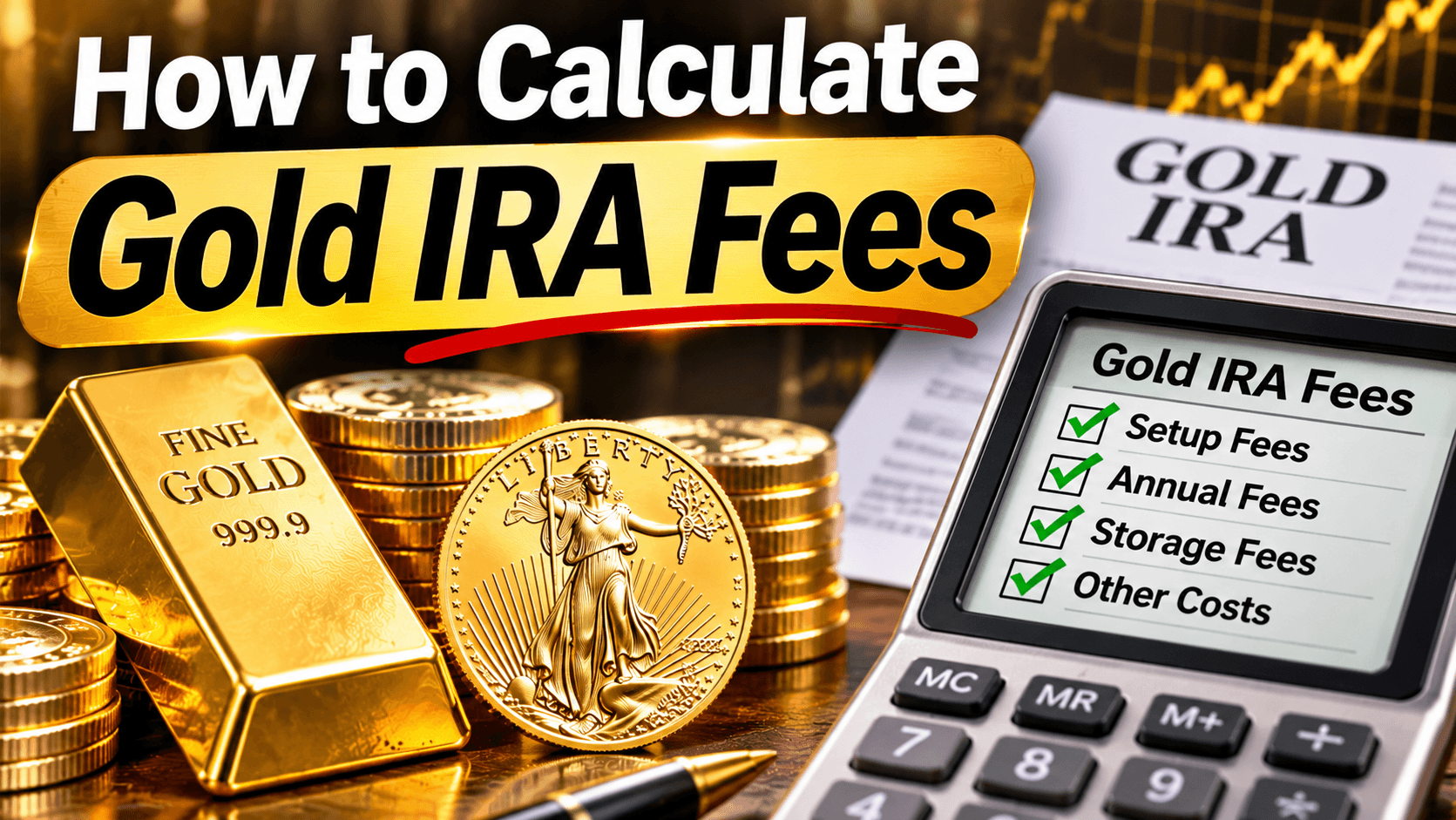
Gold IRA pricing varies by provider, account balance, metals selected, and storage arrangement. Yet most investors will encounter the same core expenses, including:
1. One-Time Setup or Establishment Fee
A self-directed IRA requires a specialized custodian to administer the account, report to the IRS, and hold the assets under the IRA structure.
Most Gold IRA companies or custodians charge an initial setup fee, often in the range of $30 to $150. Others, like Goldco and Augusta Precious Metals waive it during promotions or for accounts above a stated funding threshold.
A waived fee can be helpful, but do not make your decision on that number alone. A $50 setup fee matters far less than a high recurring storage cost or a wide spread on a $100,000 metals purchase.
2. Annual Custodian or Administration Fee
This is the charge for maintaining the self-directed IRA, processing required records, and handling annual tax reporting.
Many custodians use a flat annual fee, while others charge according to account value.
Flat fees can be more predictable, particularly as a Gold IRA grows. A percentage-based fee may look inexpensive at first but can rise with the value of your metals.
Ask whether the quoted fee includes account statements, tax forms, transfers, and required minimum distribution support, or whether those services cost extra.
3. Depository Storage Fee
IRS-approved precious metals held in a Gold IRA must generally remain with a qualified depository.
Keeping IRA gold at home can jeopardize the account’s tax-advantaged status and create serious tax consequences.
Storage is often priced annually and may be flat-rate or value-based. You may also choose between commingled and segregated storage.
Commingled storage means your metals are held alongside other investors’ like-kind metals. Segregated storage means your specific coins or bars are separately identified and stored.
Segregated storage often costs more, so the right choice depends on how much you value that added level of separation. The cost is typically $100 per year for non-segregated storage and $150 per year for segregated storage.
4. Transaction and Service Fees
These can include fees for buying metals, selling metals, sending wires, closing the account, or taking an in-kind distribution. Some providers absorb certain transaction costs, while others pass them through.
Do not assume “no annual fee” means no cost. A provider may make up for a waived administrative fee through transaction charges or a higher bullion spread.
Request a written fee schedule and ask specifically about termination fees, sale fees, and distribution charges.
5. Dealer Markup or Bid-Ask Spread
This is the cost that demands the most careful comparison. Unlike a custodian fee, it may not be listed in a standard schedule.
You should ask for the exact price per coin or bar, the current spot price used in the quote, and the dealer’s typical buyback process.
Use this calculation:
Markup percentage = (purchase price – underlying metal value) / underlying metal value × 100
For example, suppose gold is trading at $2,500 per ounce and you pay $2,650 for a one-ounce IRA-approved coin. The calculation is ($2,650 – $2,500) / $2,500 × 100. That equals 6%.
Premiums differ by product. Government-minted coins may cost more than common bullion bars, while limited-edition or collectible products can carry significantly higher premiums.
For retirement investors focused on bullion exposure, higher-cost collectible products deserve additional scrutiny because they may require a larger increase in gold’s price before you break even. Note that collectible coins aren’t IRA-approved.
 If you’re searching for the best company, request this FREE Gold IRA Checklist:

A Practical Gold IRA Cost Example
Assume you roll over $75,000 from an old 401(k) into a Gold IRA. The provider quotes a $50 setup fee, a $150 annual custodian fee, and $100 annual non-segregated storage. You buy gold with a 5% average markup and pay a $30 wire fee.
Your first-year cost would look like this:
| Cost | Example amount | |—|—:| | Setup fee | $50 | | Custodian fee | $150 | | Storage fee | $100 | | Wire fee | $30 | | 5% bullion markup on $75,000 | $3,750 | | Estimated first-year total | $4,080 |
In this illustration, the visible annual fees total only $250, but the purchase markup is $3,750. That is why comparing providers solely by their advertised annual fee can be misleading.
If the metals are held for 10 years and annual custodian and storage costs stay at $250, recurring fees would total about $2,500 before any price changes or additional transactions.
The upfront markup is still the largest single expense, but long holding periods make ongoing costs increasingly relevant.
How to Compare Fee Quotes Fairly
 Ask each company to quote the same scenario. If one Gold IRA company is pricing a $25,000 Gold IRA with American Gold Eagles in segregated storage and another is pricing a $100,000 account with bars in commingled storage, the figures are not comparable.
Give each provider the same account value, the same metal type, and the same storage preference. Then request an all-in estimate for year one and a separate estimate for each later year.
If you are rolling over funds, ask whether the company charges fees for coordinating the rollover, though a direct trustee-to-trustee transfer or direct rollover is generally the cleanest way to move retirement assets.
A useful comparison question is: “How much of my deposit will be represented by metals at today’s market price after all purchase costs?”
That question gets beyond promotional language and focuses on the amount of gold actually working to preserve your purchasing power.
Fee Waivers and Promotions: Useful, But Not Decisive
Some Gold IRA companies offer free storage for one, three, or more years, reimburse setup costs, or provide bonus silver.
These offers can reduce initial expenses, especially for larger accounts. They should not, however, replace a full evaluation of pricing, service, custodian quality, depository arrangements, and company reputation.
A free-storage promotion is worth less if the bullion quote is materially higher than alternatives. Likewise, bonus metals are not truly free if they are funded through a wider dealer spread. Evaluate the entire transaction, not the headline offer.
It is also wise to review a company’s reputation across independent consumer and business sources, including:
 The Better Business Bureau
- Business Consumer Alliance
- Trustpilot
- Google
- And TrustLink
Fees should be clear, but so should the provider’s process for answering questions, completing rollovers, and buying metals back when you need liquidity.
See if you qualify for Goldco’s special promotion of 10% in FREE silver!

Consider Account Size Before Judging the Actual Fees
Gold IRA fees are often fixed or partly fixed, which means they affect smaller accounts more heavily. A combined $350 annual custodian and storage cost equals 3.5% of a $10,000 account, but only 0.35% of a $100,000 account.
That does not mean smaller investors should avoid gold. It means they should be especially deliberate.
For some people, owning physical gold outside an IRA may be more cost-effective for a smaller allocation, though it does not receive IRA tax treatment. For others, the tax-deferred growth potential and retirement-account structure justify the ongoing costs.
Your decision should reflect your time horizon, tax situation, desired allocation, and reason for owning precious metals.
Gold is not a replacement for every asset class, but it can serve as a store of value that cannot be printed out of thin air or devalued in an instant. It’s a proven inflation hedge and can also offer protection from AI bank hacks.
Before signing paperwork, get the fees in writing, calculate the spread, and compare the all-in first-year cost with the long-term annual cost. A Gold IRA should strengthen your retirement security, not leave you guessing where your money went.
Learn more about how to protect your money against AI hacks with tangible assets such as gold and silver in this video:
Related:
- Gold IRA Rules: How To Protect Your Retirement With Precious Metals
- Gold IRA Tax Rules: The Ultimate Gold IRA Tax Guide
- Gold IRA FAQ: Everything You Need To Know About Gold IRAs
- Gold IRA Pros And Cons