Your Gold IRA can hold physical bullion, but it cannot sit in a home safe, a bank safe-deposit box, or under the control of a dealer. It must be held by an IRS-approved third-party facility.
That makes learning how to choose IRA depository services more than a paperwork exercise. It is a decision about who protects a portion of your retirement wealth when markets, currencies, and confidence are under pressure.In this guide, we’ll walk you through how to choose an IRA depository for gold and silver and important questions to ask to make an informed decision.
Let’s get started!
How to Choose an IRA Depository for Gold and Silver: 7 Key Steps

A reputable depository provides professional vaulting, inventory controls, insurance, and documented custody of the gold or silver owned by your IRA.
The right facility should give you confidence without adding unnecessary costs or creating uncertainty about where your metals are held. Here’s how to choose an IRA depository for gold and silver step-by-step:
1. Start With the Roles: Custodian, Precious Metals IRA Dealer, and Depository
First-time Gold IRA investors often hear these terms used together, but they have different jobs. Your IRA custodian administers the account, reports to the IRS, and processes transactions.
Your precious metals dealer helps you select and buy IRA-eligible bullion. The depository is the secure storage facility that receives and safeguards the metals.
In many cases, the Gold IRA company you work with has established relationships with one or more custodians and depositories.
You may be offered a choice of storage locations, or the choice may be limited by the custodian’s approved network. That is not automatically a concern, provided the arrangement is clearly disclosed and the facility meets strong security and insurance standards.
The key point is that a dealer is not the same as a depository. A polished sales presentation does not replace due diligence on the actual vault where your retirement metals will be stored.
2. Confirm the Depository Can Hold IRA Assets
 An IRA depository must meet IRS requirements for the storage of precious metals held inside an IRA.
The metals need to remain in the possession of a qualified trustee or custodian, not the account holder. So-called home-storage IRA arrangements can create serious tax exposure and are not a shortcut worth risking your retirement account over.
Ask your custodian to confirm that the proposed depository is approved for its IRA clients and that it routinely handles retirement-account bullion.
An established facility should have documented receiving procedures, clear account records, and the ability to coordinate directly with the custodian.
Also confirm that the products being stored are IRA-eligible. Most investment-grade gold, silver, platinum, and palladium must meet minimum purity standards, although certain widely recognized coins receive exceptions.
A qualified dealer and custodian should help prevent an ineligible purchase before it reaches the vault.
3. Evaluate Security Beyond a Marketing Claim
Every storage company says its vault is secure. Look for the operating controls behind that claim.
You do not need a tour of every security measure, and reputable facilities will not publish sensitive details, but they should be able to explain their general safeguards in plain language.
Strong depositories commonly use:
- ☑️ Restricted-access vaults
- ☑️ Around-the-clock monitoring
- ☑️ Alarm systems
- ☑️ Controlled receiving procedures
- ☑️ And dual-control practices for handling inventory
They should also maintain detailed records that tie metals received to the proper IRA account. Location can matter, but it should not be the only deciding factor. Some investors prefer a depository closer to home because it feels more tangible.
Others favor geographic diversification and choose a vault in another region. Since you generally cannot visit and handle IRA metals without triggering a distribution, operational quality matters more than convenience.
Ask whether the facility undergoes regular independent audits or inventory verification. A meaningful audit process helps confirm that reported holdings match the metal in storage.
It is one of the clearest signals that a depository takes accountability seriously.
Related:
- Top 4 Most Secure Gold Depositories for Precious Metals IRA Investors
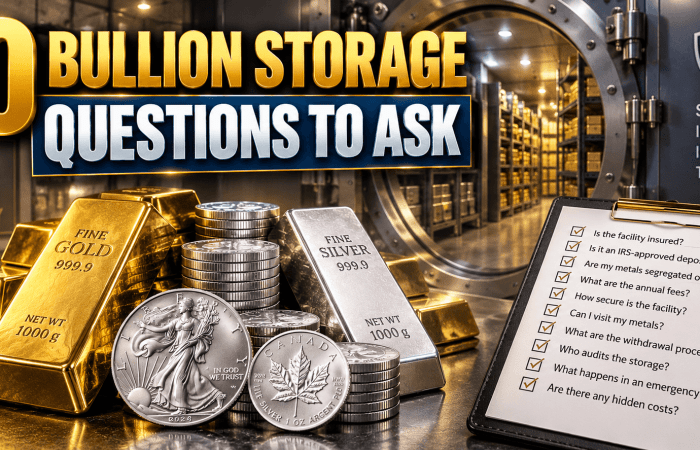
- Protect Your Metals: Top 10 Bullion Storage Questions to Ask
- How to Buy Silver Bullion Without Costly Mistakes: A Beginner’s Guide
4. Understand Segregated and Commingled Storage
 Storage type is one of the most practical choices you will make. With segregated storage, your specific bars or coins are held separately from other customers’ metals.
With commingled or non-segregated storage, your holdings are tracked by type, weight, and purity alongside identical products belonging to other account owners.
Segregated storage can provide an added sense of control, particularly for investors holding collectible-style coins or specific serial-numbered bars. It usually costs more.
Commingled storage is often less expensive and can be perfectly appropriate when you own standard bullion products and value efficiency over receiving the exact same items upon distribution.
Neither option is universally better. What matters is understanding the arrangement before funding your account.
Ask whether your metals are allocated to your IRA, how the facility records ownership, and what you would receive if you later take an in-kind distribution. Clear answers now can prevent surprises years from now.
 Request a FREE Gold & Silver Guide
Related: Segregated vs Non-Segregated Gold IRA Storage: What’s the Difference?
5. Review Insurance Carefully
Insurance should be a core part of your decision, not a footnote. A depository should maintain comprehensive coverage against risks such as theft, damage, or loss while metals are in its care.
Ask whether coverage is based on the full market value of stored holdings and whether it applies while metals are in transit to and from the facility.
You do not need to become an insurance specialist, but you should know who provides the coverage, what broad risks it addresses, and whether there are limits that could affect your account.
Your custodian or Gold IRA provider should be able to help you obtain this information.
Do not assume a custodian’s insurance and a depository’s insurance are identical. The custody chain can involve several parties, particularly when bullion is shipped from a dealer to storage.
Knowing where responsibility changes hands is a sensible part of protecting retirement assets.
6. Compare the Full Fee Schedule
Depository fees are often bundled with custodian fees, so request a complete written schedule before moving forward. Look beyond an advertised first-year promotion.
Retirement accounts are long-term holdings, and recurring costs deserve as much attention as introductory pricing.
Fees may include:
- ☑️ Account setup
- ☑️ Annual administration
- ☑️ Storage
- ☑️ Insurance
- ☑️ Transaction processing
- ☑️ Shipping
- ☑️ And distribution charges
Segregated storage generally carries a higher annual fee than commingled storage, typically $150 per year, instead of $100 per year.
Some providers charge a flat rate, while others base storage costs on the value of the metals.
A flat annual fee can be attractive as your account grows, but it may not be the lowest-cost option for a smaller account. Value-based pricing can be reasonable for modest balances yet become more expensive if gold or silver prices rise significantly.
Compare the projected annual cost for your actual investment amount, not just a generic example.
7. Consider Access, Distributions, and Liquidity
Physical bullion in an IRA is designed for disciplined, tax-advantaged ownership, not frequent trading. Still, you should understand how a future sale or distribution works:
- Ask how the depository releases metals when your custodian receives instructions
- How long does processing normally take?
- And what shipping options apply if you take an in-kind distribution after reaching an eligible age
You may eventually choose to sell metals for cash within the IRA, rebalance into other assets, or receive the gold or silver itself as a taxable distribution.
A reliable depository should have orderly procedures for each path. Your dealer’s buyback policy matters here as well, because storage and liquidation are related but separate services.
Avoid providers that make basic questions about distributions seem difficult or vague. Retirement investors deserve to understand the exit process before they enter an account.
8. Check Reputation and Transparency

A depository may operate behind the scenes, but its reputation still deserves review. Start with:
- ☑️ How long it has been in business
- ☑️ Whether it specializes in precious metals custody
- ☑️ And whether its relationships with established IRA custodians are clearly identified
Then examine the broader provider ecosystem. The Gold IRA company should be upfront about the depository it uses, the storage options available, and every material fee.
Research customer feedback and independent reputation sources such as:
- ☑️ The Better Business Bureau
- ☑️ Business Consumer Alliance
- ☑️ TrustLink
- ☑️ Trustpilot
- ☑️ And Ripoff Report with perspective
A complaint alone does not prove misconduct, but patterns involving delayed delivery, unclear fees, or poor communication should not be ignored.
Be especially cautious about pressure to choose a particular storage option without explanation. A trustworthy company can explain why it works with a facility while still respecting your right to ask questions and compare alternatives.
Request a FREE Gold & Silver Guide
Questions to Ask Before You Fund Your Account
Before approving a rollover, transfer, or new contribution, get direct answers to these questions:
- ☑️ Which depository will hold my metals, and is it approved by my IRA custodian?
- ☑️ Is storage segregated or commingled, and how is my ownership recorded?
- ☑️ What insurance applies to my holdings and to shipments?
- ☑️ Are independent audits or inventory reconciliations performed regularly?
- ☑️ What are my total first-year and ongoing costs, including distribution fees?
- ☑️ What happens if I sell metals or take an in-kind distribution from my IRA?
A legitimate provider should answer without rushing you. Keep copies of the fee schedule, storage agreement, purchase invoice, and account statements. These records create a clear paper trail and make it easier to monitor your retirement assets over time.
The best depository is not necessarily the closest one or the one with the lowest quoted fee. It is the facility that works properly with your custodian, protects your bullion through proven controls, carries appropriate insurance, and gives you clear documentation of what you own.
When your goal is preserving purchasing power and building a stronger family legacy, that level of clarity is worth demanding.
Related:
- How to Start a Gold IRA in 3 Simple Steps
- How to Start a Silver IRA in 3 Simple Steps
- Best Gold IRA Companies for 2026 (Reviewed & Rated)
- Gold IRA Depository Checklist: 10 Questions to Ask About the Vault
How to Choose an IRA Depository for Gold: FAQ
What are the roles of custodian, dealer, and depository in a Gold IRA?
The custodian administers the account, reports to the IRS, and processes transactions. The precious metals dealer helps you select and buy IRA-eligible bullion, and the depository is the secure storage facility that receives and safeguards the metals.
How can I confirm the depository can hold IRA assets?
Ask your custodian to confirm that the proposed depository is approved for its IRA clients and that it routinely handles retirement-account bullion; ensure there are documented receiving procedures and clear account records, and that the facility can coordinate directly with the custodian.
What security measures should I look for beyond marketing claims?
Look for restricted-access vaults, around-the-clock monitoring, alarm systems, controlled receiving procedures, and dual-control practices for handling inventory, along with detailed records that tie metals to the correct IRA account and evidence of regular independent audits or inventory verifications.
What is the difference between segregated and commingled storage, and why does it matter?
Segregated storage holds your specific bars or coins separately from others, while commingled storage tracks your holdings by type, weight, and purity alongside similar products from other owners.
Segregated offers more control and may cost more; what matters is understanding how ownership is recorded and what you would receive on in-kind distribution.
What should I know about fees and insurance when choosing a depository?
Review the full fee schedule, including setup, annual administration, storage, insurance, shipping, and distribution charges, not just promotional first-year pricing; confirm who provides the insurance, what risks are covered, any limits, and how custody and depository insurance differ, since the custody chain can involve several parties.