A market decline can cut the value of a paper-heavy retirement account quickly. Inflation can erode the buying power of the cash left behind.
A Roth Gold IRA gives eligible investors a way to hold physical precious metals inside a retirement account funded with after-tax dollars, positioning future qualified withdrawals for tax-free treatment.This is not a way to turn retirement savings into a speculation account. Done correctly, it is a self-directed Roth IRA strategy for investors who want a measured allocation to an asset that cannot be created by a central bank, printed out of thin air, or devalued in an instant.
The details matter, though. IRS rules govern the account, the metals, the custodian, and the location of the bullion.
In this article, we’ll explore whether a Roth Gold IRA is right for you to help you protect and secure your retirement savings.
Let’s begin by taking a look at how a Roth Gold IRA works.
How a Roth Gold IRA Works
 A Roth Gold IRA is a self-directed Roth IRA that holds IRS-approved physical gold and, in many cases, other qualifying precious metals such as silver, platinum, and palladium.
“Self-directed” does not mean you can store coins in a desk drawer or make up your own rules. It means the account is administered by a custodian that permits alternative assets rather than only conventional mutual funds, stocks, and bonds.
You contribute or move eligible funds into the account, choose IRA-eligible bullion through a precious metals company, and have the metals shipped directly to an approved depository.
The custodian handles the account reporting and transaction paperwork. And the depository provides insured, secure storage while the metal remains inside the IRA.
The Roth structure is what makes this different from a traditional Gold IRA.
Roth IRA contributions are generally made with money that has already been taxed.
If you meet the rules for a qualified distribution, withdrawals of contributions and earnings can be tax-free. For many people who expect tax rates to be higher later in retirement, that is a meaningful planning advantage.
The Potential Advantages of Holding Gold in a Roth IRA

Gold does not pay dividends or interest, and its price can rise or fall sharply over shorter periods. Its role is different from that of an income-producing stock or bond fund.
Physical bullion can serve as a diversification tool and a potential store of value when investors are concerned about currency weakness, persistent inflation, banking stress, geopolitical risk, or declining confidence in financial markets.
In a taxable account, selling appreciated gold may create a tax bill. In a Roth Gold IRA, qualified distributions are tax-free, so future appreciation in the account may not be reduced by federal income tax at withdrawal.
That does not guarantee a gain, but it can make the account structure attractive for long-term investors with a strong conviction in precious metals.
Roth IRAs also have no required minimum distributions during the original owner’s lifetime. That gives you more control over when to sell bullion, take cash distributions, or leave assets in the account for heirs.
A traditional IRA, by comparison, generally requires distributions beginning at a certain age, which can force planning decisions when metal prices are not where you want them to be.
There is a trade-off. Because Roth contributions are made after tax, you do not receive the upfront tax deduction that may be available with a traditional IRA contribution.
Whether paying tax now for potentially tax-free qualified withdrawals later makes sense depends on your current tax bracket, expected future income, age, and overall retirement plan.
 Claim your FREE Gold & Silver Info Guide to learn how to protect your retirement savings with a Roth or Traditional Gold IRA!

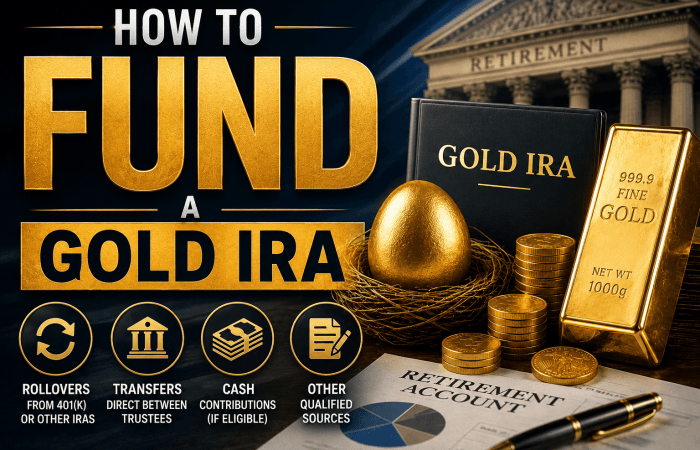
Ways to Fund a Roth Gold IRA
The right funding method depends on the account you already own. Direct annual contributions are straightforward for investors who are eligible under Roth IRA income rules and have available contribution room.
Annual limits and income phaseouts can change, so confirm the current IRS figures before acting. Here are two ways to fund your Roth Gold IRA:
✅ 1. Transferring an Existing Roth IRA
A transfer from one Roth IRA custodian to another is often the cleanest route. Funds move directly between custodians, preserving the Roth tax status.
Once the self-directed account is funded, it can purchase eligible bullion. A properly handled trustee-to-trustee transfer does not involve you taking possession of the money.
✅ 2. Converting a Traditional IRA or Retirement Plan
You may also convert pre-tax traditional IRA assets to a Roth Gold IRA. This can be useful if you want a portion of future precious-metals growth to receive Roth treatment.
However, the converted amount is generally included in taxable income for the year of conversion. That tax cost deserves careful review before you proceed.
A 401(k), 403(b), or Thrift Savings Plan may be eligible for rollover after you leave an employer, retire, or meet the plan’s in-service distribution rules.
Do not assume an active workplace plan allows a rollover. Ask the plan administrator first, and use a direct rollover whenever possible to avoid withholding complications and avoidable tax mistakes.
A rollover and a transfer are often used interchangeably in advertising, but they are not always the same in practice. A direct custodian-to-custodian movement is generally simpler than receiving funds personally and trying to redeposit them within the allowed time frame.
A knowledgeable custodian can explain the paperwork, but a tax professional should address your individual tax treatment.
Roth Gold IRA Rules You Cannot Ignore

Physical metals inside an IRA must meet specific standards. Gold bars and rounds generally need a minimum fineness of 99.5%, although certain widely recognized government-minted coins, including American Gold Eagles, are permitted exceptions.
Collectibles, rare coins, jewelry, and most numismatic products are not appropriate IRA holdings.
The metal also must be held by an IRS-approved custodian and stored at a qualified depository. Home-storage IRA arrangements are heavily marketed, but they can create serious compliance risk.
Personal possession may be treated as a distribution, potentially triggering taxes and penalties. Retirement bullion should remain in professional, insured storage until a proper distribution occurs.
For tax-free Roth IRA earnings withdrawals, the account generally must satisfy a five-year holding requirement and the distribution must occur after age 59 1/2, death, disability, or another qualifying circumstance.
Contributions can usually be withdrawn under more flexible rules, but using retirement assets as an emergency fund can undermine the purpose of the account. So, remember to confirm distribution treatment before taking metals or cashing out.
Claim your FREE Gold & Silver Info Guide to learn how to protect your retirement savings with a Roth or Traditional Gold IRA!
What Type of Precious Metals Belong in a Roth Gold IRA Account?

For investors focused on wealth preservation, gold is usually the foundation. Common choices include government-minted bullion coins and investment-grade bars from approved refiners.
 Silver can add a lower-cost entry point and exposure to industrial demand, though it typically requires more storage space for the same dollar value.
Platinum and palladium can offer additional diversification but may carry greater industrial-cycle volatility.
The best choice is rarely the most heavily promoted collectible coin. Focus on IRA eligibility, transparent pricing, liquidity, and the dealer’s buyback process.
A lower-premium bullion product may be easier to value and sell than a high-markup specialty item. Ask for the full out-the-door price, not just a spot-price comparison.
With the products in mind, let’s take a look at how to choose a Gold IRA provider with care to avoid costly mistakes.
Choosing a Gold IRA Provider With Care Is Crucial
A Gold IRA involves several parties: the custodian, the metals dealer, and the depository. Some companies coordinate the process, which can make it easier for first-time buyers, but you should still understand each party’s role and costs.
Before opening an account, evaluate at least these four areas:
- ✅ The company’s track record, complaint history, and ratings across independent reputation sources such as the BBB, Business Consumer Alliance, TrustLink, Trustpilot, and Ripoff Report
- ✅ Setup, custodial, storage, and annual maintenance fees, including whether charges are flat or based on account value
- ✅ The specific bullion products offered, their premiums over spot price, and the company’s written buyback practices
- ✅ And the available storage options, insurance coverage, service responsiveness, and whether you can choose segregated or non-segregated storage
Be cautious with promises of guaranteed returns, pressure to move an entire retirement account, or claims that gold never declines.
Precious metals can protect diversification, but concentration creates its own risk. Many retirement investors prefer to establish an allocation that complements their stocks, bonds, cash reserves, and income needs rather than replacing them all at once.
Top-Rated Gold IRA Companies for Roth & Traditional IRAs
There are many options for Gold IRA companies on the market, so which company should you choose?
To make your decision a bit easier, we’ve put together a list of the best precious metals and Gold IRA companies in the industry, which we have carefully reviewed and vetted based on BBB/BCA ratings and complaints, customer reviews, annual fees, precious metals selection, storage options, promotions, and buy-back programs.
In other words, we have looked for patterns in complaints, especially around delayed communication, unexpected fees, or sales pressure for you.
You can feel safe taking help from any of these companies to set up a Gold IRA or for regular precious metals purchases:
>
| Company | Reviews | Annual Fees | Investment Minimums (IRA) | Preferred Custodian | Free Gold Kit |
 |
 |
$180 | $10,000 | Equity Trust |  |
 |
 |
$180 | $25,000 | Entrust | |
 |
 |
$180 | $25,000 | Equity Trust | |
 |
|
$75-$300 | $10,000 | GoldStar Trust Company | |
 |
 |
$200 | $50,000 | Equity Trust | |
 |
 |
$250 | $20,000 | Equity Trust | |
 |
 |
$250 | $10,000 | Equity Trust | |
 |
 |
$48 | $0 | Various | |
For more details, watch a Goldco IRA rollover review from a customer perspective:
Related:
- 8 Gold IRA Scam Warning Signs Before You Buy
- 401(k) to Gold IRA Rollover Without Penalty: Rules and Steps
- TSP to Gold IRA Transfer Rules: Traditional vs Roth and Direct Rollovers
Is This Strategy a Good Fit?
A Roth Gold IRA may fit someone with a long time horizon, earned income or eligible rollover assets, and a desire to protect part of their retirement wealth from risks tied to the dollar and conventional markets.
It can be especially compelling for investors who believe their future tax burden may be higher and who want the flexibility of tax-free qualified withdrawals.
It may be less suitable for someone who needs current income, has little emergency savings, expects to use the funds soon, or would be uncomfortable with gold-price volatility and account fees.
Gold should support a retirement plan, not substitute for one. Consider your tax situation, liquidity needs, estate goals, and total portfolio exposure before making a move.
A carefully chosen Roth Gold IRA can give a portion of your retirement savings a home outside the paper-asset system while preserving the tax advantages that make Roth accounts valuable.
Take the time to compare providers, verify every fee, and build an allocation you can hold with confidence through the next cycle of inflation, volatility, and uncertainty.
For more information about Gold IRAs, you can visit these related resources:
- Gold IRA Rules: How To Protect Your Retirement With Precious Metals
- Gold IRA Tax Rules: The Ultimate Gold IRA Tax Guide
- Gold IRA FAQ: Everything You Need To Know About Gold IRAs
- Gold IRA Pros And Cons
Claim your FREE Gold & Silver Info Guide to learn how to protect your retirement savings with a Roth or Traditional Gold IRA!
Roth Gold IRA: FAQ
What is a Roth Gold IRA and how does it differ from a traditional Gold IRA?
A Roth Gold IRA is a self-directed Roth IRA that holds IRS‑approved physical gold and other qualifying precious metals, funded with after‑tax dollars, with the potential for tax‑free qualified withdrawals.
It differs from a traditional gold IRA because contributions are after‑tax, and withdrawals under qualified circumstances can be tax‑free, whereas traditional IRAs typically involve pre‑tax contributions and taxed withdrawals.
How does funding a Roth Gold IRA work and what are the options?
Funding a Roth Gold IRA can be done by transferring an existing Roth IRA to the self‑directed account or by converting a traditional IRA or retirement plan to a Roth Gold IRA.
Direct annual contributions are possible if you meet Roth IRA income limits and have contribution room. A custodian handles the transfer or conversion, and then you acquire IRS‑approved bullion for the account.
What are the tax advantages of Roth Gold IRA withdrawals?
In a Roth Gold IRA, qualified distributions are tax‑free, meaning withdrawals of contributions and earnings can avoid federal income tax if the distribution meets the five‑year holding rule and the age or qualifying event requirements. This can be advantageous for investors who expect higher tax rates in retirement.
What rules govern selecting metals and custodians for a Roth Gold IRA?
Physical metals must meet standards, typically a minimum fineness of 99.5% for gold bars and rounds, with certain government‑minted coins allowed. The metal must be held by an IRS‑approved custodian and stored in a qualified depository.
Home storage arrangements are not recommended due to compliance risk, and the custodian and depository must handle reporting, storage, and insurance inside the IRA.
Is a Roth Gold IRA suitable for every investor and what cautions should be considered?
A Roth Gold IRA may suit investors with a long time horizon, earned income or eligible rollover assets, and a desire to protect retirement wealth from dollar‑ and market‑related risks.
It can be less suitable for those needing current income, with little emergency savings, or uncomfortable with gold price volatility and account fees. It should complement but not replace a broader retirement plan, and one should carefully compare providers, fees, and storage options.