The phrase “revalue gold to wipe debt” sounds like a simple reset button: assign America’s gold a much higher official price, use the resulting gain to shrink federal obligations, and restore confidence in the dollar.
For retirees watching debt climb while purchasing power erodes, the idea deserves a serious look. Gold is one of the few monetary assets that cannot be printed out of thin air or devalued in an instant.But a gold revaluation is not the same as creating spendable money, eliminating Treasury bonds, or making the nation’s fiscal problems disappear. It could materially change the government’s balance sheet and signal a major shift in the monetary system.
Whether it actually reduces debt depends entirely on the policy structure around it.
In this article, we’ll cover whether revaluing gold could help wipe out the U.S. debt and whether the $38,000 per ounce gold case is likely to happen.
What Does It Mean to Revalue Gold to Wipe Debt?

The U.S. Treasury holds roughly 261.5 million troy ounces of gold, primarily at Fort Knox, West Point, Denver, and the Federal Reserve Bank of New York.
Yet the government’s official book value for gold remains set at $42.22 per ounce, a figure established decades ago. That accounting value is far below the metal’s market price, currently at $4,600 per ounce.
Revaluing gold would mean raising the official dollar value assigned to the Treasury’s holdings. At a market-based price, the Treasury’s gold would be worth far more on paper than its current statutory valuation.
At a dramatically higher official price, the gain could become very large. That distinction matters. A higher valuation creates an accounting gain.
It does not automatically put trillions of dollars in cash into the Treasury’s checking account, nor does it cancel the principal and interest owed to holders of U.S. government debt. To affect the debt directly, policymakers would need to decide how the revaluation gain is recognized, financed, and used.
The $38,000 Per Ounce Gold Price Case: Is It Likely?
Depending on whether analysts compare official gold reserves to the U.S. monetary base, M2 money supply, or broader measures of global liquidity, some calculations suggest gold would need to trade somewhere between $10,000 and more than $50,000 per ounce.
One commonly cited estimate lands around $38,000 per ounce. This isn’t a traditional price forecast based on mining supply or jewelry demand.
It’s a theoretical revaluation price that could restore significant monetary value to the world’s gold reserves if governments ever decided to partially back currencies with gold again.
For more information behind the $38,000 per ounce gold price scenario, check out this video:
 Request a FREE Info Kit to learn more about an IRS loophole on gold & silver!

Why Gold Revaluation Keeps Returning to the Debate
America’s federal debt is measured in the tens of trillions of dollars, while annual interest costs have become a growing pressure on the federal budget.
Investors understandably ask whether a national gold reserve could provide a credible asset base behind the currency and reduce reliance on ever-expanding borrowing.
The appeal is not merely mathematical. Gold has served as a store of value through currency failures, wars, sovereign defaults, and inflationary cycles.
Central banks around the world have been adding gold to reserves in recent years, reflecting concern about currency concentration, geopolitical risk, and the long-term purchasing power of fiat money.
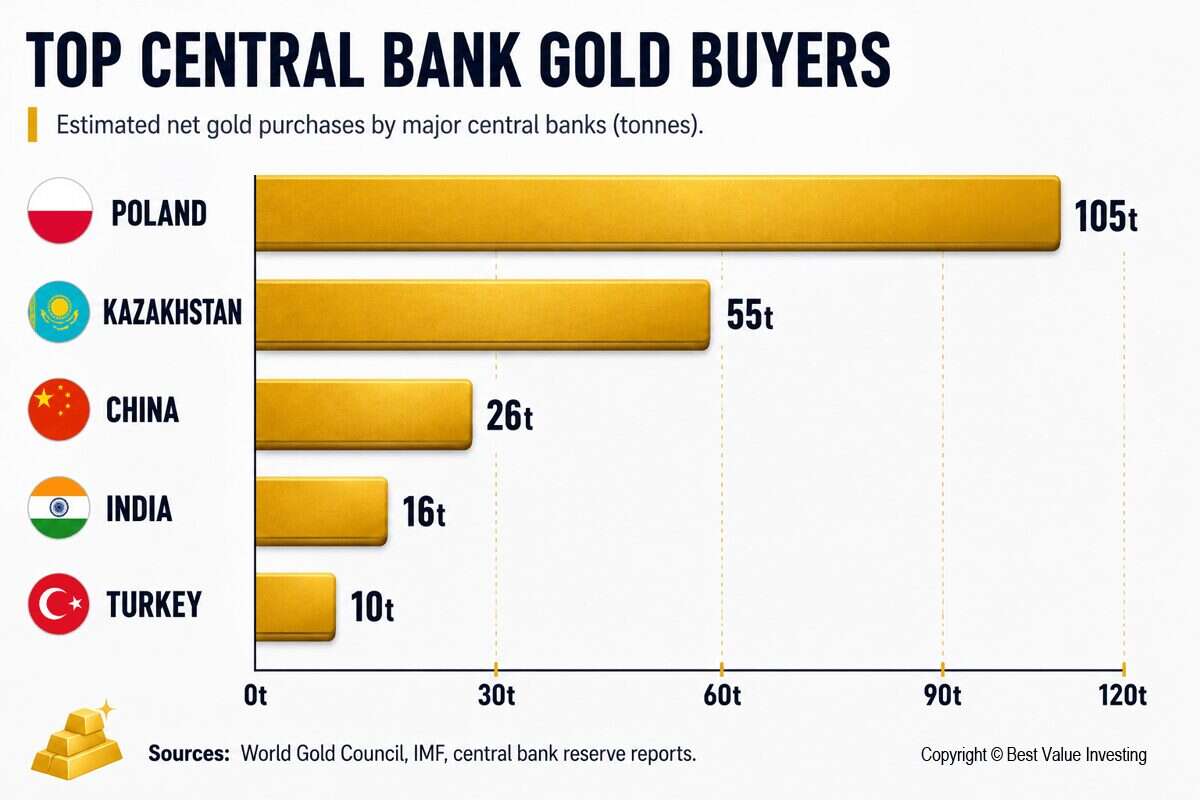
A formal revaluation could also acknowledge a reality many savers already see: gold’s market value has risen while the official U.S. gold price has remained frozen in a different monetary era.
For advocates, updating that figure is a way to strengthen the national balance sheet without raising taxes or issuing more debt.
Related:
- Gold Price Forecast 2026: Build a Resilient Retirement Portfolio
- Silver Price Prediction 2026: Why Analysts Expect Higher Prices Ahead
- Gold Demand and Supply: 4 Key Forces Behind Price Swings
- How to Buy Silver Bullion Without Costly Mistakes: A Beginner’s Guide
The Numbers Show Both the Promise and the Limit
At a gold price of $3,000 per ounce, 261.5 million ounces would be worth roughly $785 billion. That is a meaningful national asset, but it is small relative to total federal debt.
Even if gold were officially valued at $10,000 per ounce, the reserve would be worth about $2.6 trillion. That could improve the government’s financial position, but it would not wipe out all obligations.
To match a debt burden in the tens of trillions using the existing gold reserve alone, the implied gold price would have to be extraordinarily high.
This is why claims that a revaluation can effortlessly solve the entire debt problem should be treated cautiously. There is another complication: debt is not a single bill due all at once. It includes Treasury securities held by households, pension funds, banks, foreign governments, mutual funds, and the Federal Reserve.
A plan to use revalued gold against debt would need to explain precisely which liabilities are being reduced and how creditors are paid or exchanged.
An Accounting Gain Is Not a Fiscal Reform
The Treasury could, in theory, revalue its gold and receive a larger value for gold certificates held by the Federal Reserve.
That could alter the Treasury’s cash position and potentially reduce the need for some new borrowing. However, unless spending, deficits, and interest costs are brought under control, the underlying debt problem continues.
Think of a homeowner whose property value rises sharply. Their balance sheet improves, but their monthly bills do not vanish. They must sell, borrow against the property, or generate income from it to turn that increased value into cash.
The federal government faces a larger and more complex version of the same issue.
Could Revaluation Mean a New Gold-Backed Dollar?

A more consequential proposal would involve using gold to support the dollar at a new official price.
Rather than promising that every dollar could be redeemed for gold, the government might establish partial backing or use gold as a reserve anchor to support confidence in the currency.
This approach could make the dollar system more disciplined if it limited excessive money creation and deficit financing. It could also make gold more central to the financial system, rewarding countries and individuals that accumulated physical reserves before the change.
The trade-off is significant. A gold-linked monetary framework can restrict policymakers’ flexibility during recessions, banking stress, or emergencies.
If the official price is set too low, the system may invite pressure on reserves. If set too high and accompanied by broad money creation, it could validate the inflation the policy was supposed to contain.
A successful transition would require clarity, credible rules, and a plan for the existing debt load. Without those safeguards, a revaluation could be interpreted as a disguised dollar devaluation.
That may lift the nominal price of gold while reducing the purchasing power of cash savings and fixed-income payments.
Related: A New Financial System Is Emerging: NESARA GESARA (QFS)—Two Key Assets To Skyrocket Your Wealth!
What a Gold Revaluation Could Mean for Retirees
For Americans holding physical gold, silver, or a properly structured Precious Metals IRA, a major gold revaluation could increase the dollar value of their holdings.
That is one reason investors view bullion as monetary insurance rather than simply a short-term trade. Gold has no counterparty risk when held outright, and its supply cannot be expanded by a policy meeting.
Still, a higher gold price does not guarantee a higher standard of living. If revaluation occurs alongside inflation, rising taxes, capital controls, or disruption in bond and currency markets, households may face higher prices for necessities.
Retirees living on fixed pensions or large cash balances could be particularly exposed to a weaker dollar. This is where diversification matters.
A retirement strategy built entirely around stocks, bonds, cash, or any one asset class can be vulnerable when the rules of the monetary system change.
Allocating a measured portion of retirement savings to physical precious metals may help balance those risks, especially for investors concerned about inflation and sovereign debt.
Request a FREE Info Kit to learn more about an IRS loophole on gold & silver!
Gold Is Protection, Not a Prediction
 No investor should build a retirement plan on the assumption that Washington will announce a specific official gold price. Policymakers may never pursue a formal revaluation, and the market price of gold can move sharply in both directions.
The stronger case for owning gold is more practical. It can serve as a long-term store of value, a diversifier during market stress, and an asset outside the banking system.
Silver can offer related diversification, though it is generally more volatile and carries greater industrial-demand exposure.
Investors considering a Gold IRA should also focus on execution. IRS rules limit which coins and bars qualify, require an approved custodian, and generally prohibit personal home storage for IRA-owned bullion.
Fees, storage arrangements, buyback policies, and a provider’s reputation all deserve careful review before moving funds from a 401(k), traditional IRA, TSP, or other retirement account.
The More Realistic Outcome
The most plausible role for a gold revaluation is not a magical debt eraser. It is a possible component of a broader monetary and fiscal reset.
It could strengthen the government’s asset position, support confidence in the dollar, and reduce some financing pressure. But it cannot substitute for:
- Disciplined budgets
- Manageable interest costs
- Productive economic growth
- And credible monetary policy
For individual investors, the lesson is straightforward: do not wait for a dramatic national announcement before protecting purchasing power. Build a retirement plan that can withstand more than one outcome.
Keep adequate liquidity for near-term needs, understand the risks in your bond and cash holdings, and consider whether a sensible allocation to tangible assets belongs alongside your traditional investments.
Gold may never be officially revalued to erase U.S. debt. Yet the fact that the conversation persists is a reminder that paper promises and real money are not the same thing.
For families protecting retirement savings and a lasting legacy, owning a measured amount of physical precious metals can be a disciplined way to prepare for uncertainty without betting everything on one headline.
Related:
- How to Start a Gold IRA in 3 Simple Steps
- 8 Gold IRA Scam Warning Signs Before You Buy
- Physical Gold Taxes: What US Investors Need to Know
Revaluing Gold: FAQ
What does it mean to revalue gold to wipe debt and can it actually erase debt?
Revaluing gold would raise the official dollar value assigned to the Treasury’s gold holdings, creating an accounting gain. However, it does not automatically put cash in the Treasury or cancel debt; whether debt is reduced depends on how policymakers recognize, finance, and use the gain.
How much would gold have to be revalued to affect the debt, and is $38,000 per ounce realistic?
Some estimates place the necessary price between $10,000 and over $50,000 per ounce, with $38,000 per ounce commonly cited. This figure is theoretical and not a traditional price forecast; it reflects the value needed to significantly bolster the balance sheet, not to wipe out all obligations.
Could a gold revaluation lead to a gold-backed dollar, and what are the trade-offs?
A gold-backed dollar would use gold to support the currency, either partially or as a reserve anchor. Benefits could include disciplined money creation and stronger confidence, but drawbacks include reduced policy flexibility during recessions or emergencies and the risk that too-low or too-high pricing destabilizes reserves or inflation.
What would be the impact of gold revaluation on retirees and savers?
Retirees and savers could see higher dollar-valued gold holdings, but a higher gold price does not guarantee a higher standard of living. If revaluation accompanies inflation or higher taxes, households could face higher prices for essentials, making diversification and prudent asset allocation important.
What is the most realistic outcome of a gold revaluation according to the article?
The most plausible outcome is a component of a broader monetary and fiscal reset, strengthening the government’s asset position and confidence in the dollar without erasing the underlying debt, while requiring disciplined budgets, manageable interest costs, growth, and credible policy.
Request a FREE Info Kit to learn more about an IRS loophole on gold & silver!