A 401(k) to gold IRA rollover can give retirement savers a way to move part of their nest egg beyond paper assets and into physical precious metals. For investors concerned about inflation, debt, market volatility, and the buying power of the dollar, that added diversification can be meaningful.
But this is not a matter of withdrawing retirement money, buying coins, and putting them in a safe. The account structure, rollover method, metals, custodian, and storage arrangement all need to follow IRS rules.
A properly handled rollover can preserve the tax-deferred status of a traditional 401(k) while allowing the account to hold IRA-approved gold. A mistake, however, can create unnecessary taxes, withholding complications, or penalties.The goal is not to abandon stocks and bonds overnight. It is to make a deliberate decision about whether a portion of your retirement savings should be held in an asset that cannot be printed out of thin air or devalued in an instant.
Feel free to use the TOC list below if you want to jump straight to any section:
Let’s begin by taking a look at what a 401(k) to Gold IRA rollover actually does.
What a 401(k) to Gold IRA Rollover Actually Does
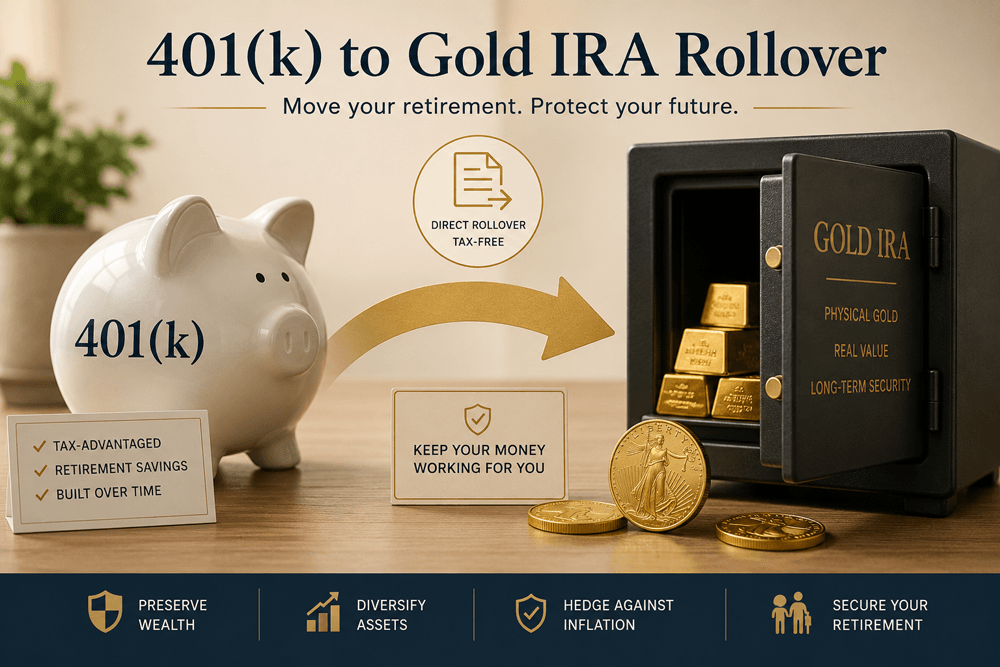
A Gold IRA is a self-directed individual retirement account that holds qualifying physical precious metals rather than only conventional mutual funds, stocks, and bonds.
The account remains an IRA, which means its tax treatment is determined by whether it is traditional or Roth. What changes is the range of assets the account can own.
Typically, with a traditional 401(k), the usual path is to open a traditional self-directed Gold IRA and move eligible funds into it.
When completed as a direct rollover, the money does not become a taxable distribution merely because it changed accounts.
Your new IRA custodian receives the funds, and the custodian purchases the approved bullion you select through the appropriate process.
More importantly, the gold is not shipped to your home. IRS rules require IRA metals to be held by an approved custodian and stored at an eligible depository.
That separation can feel less convenient than personal possession, but it is central to keeping the account tax-advantaged.
When You Can Move 401(k) Funds
Whether your 401(k) is eligible depends largely on your employment status and the rules of your plan.
If the 401(k) is from a former employer, a rollover is generally available. This is why many people review their retirement options after changing jobs, retiring, or being laid off.
Leaving an old 401(k) behind can be simple, but it may also limit your investment choices and leave you with less control over the account.
If you still work for the company sponsoring the plan, the answer depends on whether the plan permits an in-service withdrawal or in-service rollover.
Some plans allow it once participants reach a certain age, often 59 1/2, while others do not allow it at all. Your plan administrator can confirm the specific rules. Do not assume that being eligible to take a loan means you are eligible for a rollover.
Government Thrift Savings Plan participants, 403(b) account holders, and investors with certain other employer-sponsored plans may also have rollover options.
The account type and current-employment status still matter, so verify the details before opening an account or initiating paperwork.
👉 If you’re searching for the best company, request this FREE Gold IRA Checklist:

Direct Rollover vs Indirect Rollover
There are direct and indirect Gold IRA rollovers. Here’s a quick overview of the difference between the two options:
1. Direct Rollover
The safest route is usually a direct rollover, sometimes called a trustee-to-trustee rollover. Your existing 401(k) provider sends the funds directly to the new self-directed IRA custodian, or issues a check payable to the custodian for your benefit. You never take possession of the money.
2. Indirect Rollover
An indirect rollover works differently. The 401(k) plan distributes the funds to you, and you must deposit the full amount into an IRA within 60 days.
Employer plans generally withhold 20% for federal taxes on an eligible rollover distribution. That means you may have to replace the withheld amount from other savings to roll over the full balance and avoid having the shortfall treated as a distribution.
For example, if a plan sends you a $100,000 distribution, you may receive only $80,000 after withholding. To complete a tax-free rollover of the entire $100,000, you would need to deposit $100,000 into the IRA within the deadline.
The withheld $20,000 is generally reclaimed when you file your tax return if the rollover is completed properly, but it can create an avoidable cash-flow problem.
A missed 60-day deadline can turn the distribution into taxable income. If you are under age 59 1/2, an additional 10% early-distribution penalty may apply unless an exception applies.
Direct rollovers remove much of this risk. The once-per-12-month rule that can affect indirect IRA-to-IRA rollovers does not apply to direct transfers or plan-to-IRA rollovers, but there is still little reason to create unnecessary complexity.
How to Complete a Gold IRA Rollover
The process is straightforward when each party understands its role. Here’s a breakdown of the four simple steps for a Gold IRA rollover:
✔️ Step 1. Choose a Custodian
First, choose a self-directed IRA custodian that administers precious metals accounts.
Custodians handle reporting, account administration, and the movement of retirement funds. They do not typically give personalized investment advice.
✔️ Step 2. Open a Traditional Gold IRA or Roth Gold IRA
Next, choose a Gold IRA company and have them help you open a new traditional Gold IRA or Roth Gold IRA.
For a pretax 401(k), moving into a traditional IRA is usually the cleanest tax match. Rolling pretax funds into a Roth Gold IRA is possible in some cases, but it is a Roth conversion and can create taxable income for the year.
That is a decision worth reviewing with a qualified tax professional. After the account is open, request a direct rollover from your former plan administrator.
Your Gold IRA provider may help explain the paperwork and coordinate with the custodian, but you should confirm the distribution instructions yourself. Keep copies of forms, confirmations, and account statements.
✔️ Step 3. Purchase Eligible Precious Metals
Once the funds settle in the IRA, direct the custodian to purchase eligible metals. Your Gold IRA provider will help you and ship your metals to an IRS-approved depository such as the Delaware Depository or Brink’s under the IRA’s name and reported as assets of the account.
✔️ Step 4. Choose Storage
You can generally choose between segregated storage, where your specific bars or coins are separately identified, and commingled storage, where like-kind metals are stored together.
Segregated storage may cost about $50 per year more, so compare the arrangement rather than assuming one option fits every investor. Typically, non-segregated storage costs $100 per year and segregated storage costs $150 per year.
Watch a Goldco IRA rollover review from a customer perspective:
Which Precious Metals Products Qualify for a Gold IRA?
Not every gold coin or bar is eligible. In general, gold must meet a minimum fineness of .995, although certain widely recognized coins are exceptions under the rules.
 American Gold Eagles are a familiar example. Other commonly eligible choices may include Canadian Maple Leafs, American Buffalo coins, and qualifying bars from approved refiners.
Collectible coins, rare numismatic pieces, jewelry, and most personal holdings do not belong in a Gold IRA. A product can be attractive to a collector and still be unsuitable for a retirement account.
This is one reason investors should get confirmation that a specific product is IRA-approved before authorizing a purchase.
Gold is often the starting point, but a self-directed precious metals IRA may also hold qualifying silver, platinum, and palladium.
 Silver can offer a different mix of monetary appeal and industrial demand, while platinum and palladium can behave differently because of their industrial uses.
However, more metals do not automatically mean better diversification. The right mix depends on your time horizon, risk tolerance, and broader holdings.
👉 For more information, request a FREE Gold IRA Guide:
Costs and Trade-Offs to Review Before You Roll Over
Physical metals have costs that an index fund does not. A Gold IRA may include a one-time setup fee, annual custodian fee, storage fee, transaction costs, and dealer spreads. It typically comes up to about $180 to $300 per year.
Additionally, the spread is the difference between the price you pay to buy metals and the price a dealer may offer when you sell. Ask for a clear explanation of every fee and how pricing is calculated.
Provider quality matters just as much. Review a company’s history, customer-service approach, buyback process, minimum investment requirements, and written fee schedule.
Independent reputation sources such as the Better Business Bureau, Business Consumer Alliance, Trustpilot, TrustLink, and Ripoff Report can add useful context, though no single review platform tells the entire story.
Look for patterns in complaints, especially around delayed communication, unexpected fees, or sales pressure.
Be cautious with promotions that sound too good to be true. Free silver offers or fee waivers can be legitimate marketing incentives, but they should not distract from the underlying price of the metals, the storage terms, and the long-term cost of maintaining the account.
A retirement decision should hold up after the promotion ends.
How Much of a 401(k) Is Recommended to Go Into Gold?
 There is no universal percentage. A retiree who depends heavily on portfolio withdrawals may make a different choice than an investor with decades before retirement.
Someone with substantial stock exposure, concerns about currency depreciation, and a desire for tangible assets may value a larger allocation than someone whose portfolio already has meaningful exposure to real assets.
Gold does not produce dividends or interest, and its price can move sharply over shorter periods. Its case is usually about diversification, purchasing-power protection, and a potential counterweight during periods when confidence in financial assets weakens.
It should be considered alongside cash needs, pension income, Social Security, other retirement assets, and your ability to tolerate price fluctuations.
Before moving funds, ask whether the decision is driven by a durable wealth-preservation plan or a reaction to a frightening headline.
A disciplined allocation can support retirement confidence. An all-or-nothing move can create a new concentration risk.
A 401k to gold IRA rollover is most useful when it gives you greater clarity and control over what your retirement savings owns.
Take the time to verify plan eligibility, insist on a direct rollover, understand every cost, and choose metals that meet IRS standards.
The strongest retirement plan is one built to protect your family’s future through more than one kind of market environment.
Before we leave this topic, let’s take a look at some legit Gold IRA providers to help you facilitate a 401(k) to Gold IRA rollover.
Top-Rated Gold IRA Companies for 401(k) Rollovers
There are many options for gold IRA companies on the market, so which company should you choose?
To make your decision a bit easier, we’ve put together a list of the best precious metals and gold IRA companies in the industry, which we have carefully reviewed and vetted based on BBB/BCA ratings and complaints, customer reviews, annual fees, precious metals selection, storage options, promotions, and buy-back programs.
In other words, we have looked for patterns in complaints, especially around delayed communication, unexpected fees, or sales pressure for you.
You can feel safe taking help from any of these companies to set up a gold IRA or for regular precious metals purchases:
>
| Company | Reviews | Annual Fees | Investment Minimums (IRA) | Preferred Custodian | Free Gold Kit |
 |
 |
$180 | $10,000 | Equity Trust |  |
 |
 |
$180 | $25,000 | Entrust | |
 |
 |
$180 | $25,000 | Equity Trust | |
 |
|
$75-$300 | $10,000 | GoldStar Trust Company | |
 |
 |
$200 | $50,000 | Equity Trust | |
 |
 |
$250 | $20,000 | Equity Trust | |
 |
 |
$250 | $10,000 | Equity Trust | |
 |
 |
$48 | $0 | Various | |
For more information about Gold IRAs, you can visit these related resources:
- Gold IRA Rules: How To Protect Your Retirement With Precious Metals
- Gold IRA Tax Rules: The Ultimate Gold IRA Tax Guide
- Gold IRA FAQ: Everything You Need To Know About Gold IRAs
- Gold IRA Pros And Cons
👉 If you’re searching for the best company, request this FREE Gold IRA Checklist: