A retirement account can look diversified on a quarterly statement while still being tied to the same system: stocks, bonds, banks, and the U.S. dollar. Funding a gold IRA gives qualifying investors a way to add physical precious metals to a tax-advantaged retirement strategy, potentially strengthening long-term protection against inflation, currency weakness, and market turbulence.
The funding method matters. A properly handled transfer or rollover can move eligible retirement savings without creating a current tax bill, while a poorly handled transaction can lead to withholding, penalties, or an unintended taxable distribution.The goal is not simply to buy gold. It is to move retirement funds under the right rules, use an approved custodian, and purchase eligible metals that are stored correctly.
In this guide, we’ll show you how to fund a Gold IRA in three main ways. We’ll also cover essential rules and regulations to help you avoid possible tax penalties.
Let’s begin by explaining what funding a Gold IRA actually means.
What Does Funding a Gold IRA Mean?
 A Gold IRA is a self-directed individual retirement account that holds IRS-approved physical precious metals rather than only conventional paper assets.
It can be structured as a Traditional IRA, where taxes are generally deferred until distributions, or as a Roth IRA, where qualified retirement withdrawals may be tax-free if the account meets applicable rules.
Funding the account means getting cash into the IRA so the custodian can purchase approved gold, silver, platinum, or palladium on the account’s behalf.
Investors generally do this with an IRA transfer, an employer-plan rollover, or a new annual contribution. Each route has different paperwork, timing, and tax considerations.
Physical metals in an IRA cannot be kept at home, in a personal safe, or in a bank box controlled by the account holder. The metals must be held by an approved custodian and stored at an eligible depository.
That structure may feel less hands-on than owning coins outright, but it preserves the IRA’s tax treatment.
Three Main Ways to Fund a Gold IRA
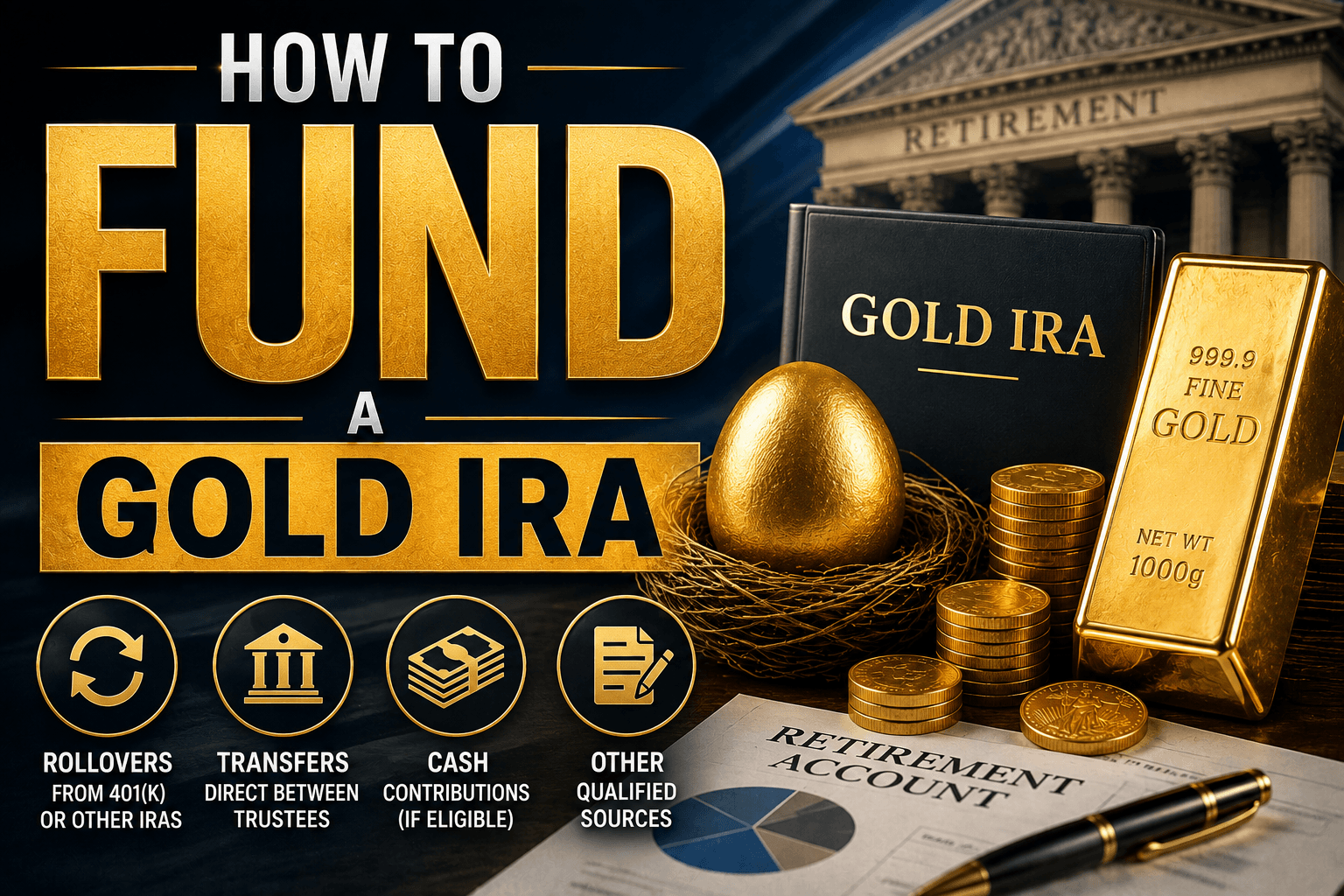
With that brief introduction in mind, here are three main ways to fund a Gold IRA:
1. Transfer Funds From an Existing IRA
An IRA-to-IRA transfer is often the cleanest path for investors who already have a Traditional IRA, Roth IRA, SEP IRA, or SIMPLE IRA.
In a transfer, the existing IRA custodian sends funds directly to the new self-directed Gold IRA custodian. You do not take possession of the money.
Because the funds move directly between custodians, a transfer generally avoids the 60-day rollover deadline and the mandatory withholding issues associated with distributions paid to you.
It is often the preferred approach when the existing IRA is no longer serving your diversification goals. Traditional IRA funds are commonly transferred into a Traditional Gold IRA, and Roth IRA funds into a Roth Gold IRA.
Moving money between account types can have tax consequences, so investors considering a Roth conversion should discuss the decision with a qualified tax professional before submitting paperwork.
Related: Gold IRA Tax Rules: The Ultimate Gold IRA Tax Guide
2. Roll Over a Former Employer’s Retirement Plan
A rollover is commonly used to move money from a 401(k), 403(b), 457(b), Thrift Savings Plan, or similar employer-sponsored retirement account into a self-directed Gold IRA.
For many Americans nearing retirement, this is the largest potential source of funding because workplace plans may hold years of accumulated contributions and employer matches.
If the account is from a former employer, a rollover is usually available. If it is tied to your current job, access depends on the plan’s rules.
Some plans allow an in-service distribution once an employee reaches a certain age, while others do not permit a rollover until separation from service, retirement, or another qualifying event.
Ask for a direct rollover whenever possible. The plan administrator sends the funds directly to the receiving IRA custodian, or issues a check payable to that custodian for your benefit.
A direct rollover helps prevent the plan from withholding funds and reduces the risk of missing deadlines.
An indirect rollover is different. The funds are paid to you first, and you must redeposit the full eligible amount into an IRA within 60 days.
Employer plans generally withhold 20% for federal taxes on an eligible rollover distribution paid to the participant.
To roll over the entire balance, you would need to replace the withheld amount from other funds before the deadline. That is an unnecessary complication for most investors.
3. Make a New Annual IRA Contribution
You may also fund a Gold IRA with a new cash contribution, subject to annual IRS contribution limits, income rules, and eligibility requirements.
This approach can make sense for an investor who wants to begin modestly without moving an existing retirement account.
A contribution is not a rollover. It counts toward your annual IRA limit, while a properly completed transfer or rollover generally does not.
Deductibility for Traditional IRA contributions and eligibility to contribute directly to a Roth IRA can depend on income and workplace retirement-plan coverage.
Check current IRS limits and consult a tax adviser when your household situation is more complex.
 If you’re searching for the best company, request a FREE Gold IRA Checklist:

Related:
- How to Start a Gold IRA in 3 Simple Steps
- 8 Gold IRA Scam Warning Signs Before You Buy
- Physical Gold Taxes: What US Investors Need to Know
Funding a Gold IRA Without Creating a Tax Problem
 The safest approach is usually to keep retirement funds from passing through your personal bank account.
Direct custodian-to-custodian transfers and direct plan rollovers create a clear paper trail and reduce the chance of accidentally treating the movement as a distribution.
There is also a rollover frequency rule that can affect certain IRA transactions. The once-per-12-month limitation generally applies to indirect IRA rollovers, not direct trustee-to-trustee transfers.
This is another reason a direct transfer is frequently the more practical choice. The rule can be technical when several IRA accounts are involved, so do not assume that a transaction is exempt simply because it involves a different IRA.
If you are under age 59 1/2 and fail to complete an indirect rollover on time, the amount may be taxable and could also trigger an additional early-distribution penalty.
Exceptions can apply, but they should not be a funding strategy. Careful paperwork is far less expensive than fixing a preventable mistake.
What Your Gold IRA Can Buy
 Once the money arrives, the self-directed IRA can purchase bullion that meets IRS eligibility standards.
Gold generally must meet a minimum fineness requirement of .995, although certain widely recognized coins are permitted under specific exceptions. Silver, platinum, and palladium have their own purity standards.
 That does not mean every gold coin, collectible, proof set, or rare item belongs in an IRA. Collectibles are generally restricted, and products sold for scarcity or sentimental appeal may carry high premiums that are difficult to recover.
A disciplined retirement allocation usually focuses on liquid, IRA-eligible bullion with transparent pricing and established resale markets.
Your provider may present bars and coins from recognized mints, but you should still ask direct questions:
- ✅ What is the total price above the metal’s spot price?
- ✅ Which products are IRA eligible?
- ✅ How would the metals be sold if you later need to take a distribution?
Clear answers are a sign that the company understands both the investment and the retirement-account rules.
Costs to Understand Before You Start Moving Your Funds
Gold can serve as a store of value outside the paper financial system, but it is not a no-cost asset. Gold IRAs typically involve:
- ☑️ A one-time setup fee
- ☑️ Annual custodian administration fees
- ☑️ Depository storage fees
- ☑️ And the dealer spread built into the purchase price
Fees vary based on account size, storage type, and provider policies. Commingled storage places your metals alongside those of other clients while maintaining account records of your ownership.
 Segregated storage assigns specific bars or coins to your account and may cost more. Neither option is automatically better. The appropriate choice depends on your preferences, your holdings, and the fee difference.
Additionally, there are companies like Goldco that offer free silver and waived fees for qualifying purchases.
A promotion may be worthwhile, but it should never replace a comparison of total costs, product premiums, storage arrangements, service quality, and the provider’s reputation with sources such as the BBB, Business Consumer Alliance, TrustLink, and Trustpilot.
👉 If you’re ready to take action, request a FREE Gold IRA Guide:
Related:
- Gold Price Forecast 2026: Build a Resilient Retirement Portfolio
- Silver Price Prediction 2026: Why Analysts Expect Higher Prices Ahead
- Gold Demand and Supply: 4 Key Forces Behind Price Swings
- How to Buy Silver Bullion Without Costly Mistakes: A Beginner’s Guide
A Practical Step-by-Step Process for Funding a Gold IRA
The process is straightforward when the parties communicate clearly. Here is what to expect:
- ✔️ Open a self-directed Gold IRA with a qualified Gold IRA company or custodian and complete the account application
- ✔️ Choose the funding path: direct IRA transfer, direct employer-plan rollover, or new contribution
- ✔️ Submit the required transfer or rollover forms and confirm how funds should be made payable
- ✔️ Once cash arrives in the IRA, select IRS-approved bullion and review the complete transaction price before authorizing the purchase
- ✔️ Confirm that the metals are shipped to an approved depository and retain your account statements, purchase records, and tax documents
If you’re working with a reputable Gold IRA company, they will hold your hand throughout this whole setup process.
Processing times vary. An IRA transfer may be completed relatively quickly, while an employer plan can take longer because the plan administrator must review distribution paperwork. It typically takes about 10 days from start to finish.
Do not liquidate investments or assume a deadline until you understand the steps required by the current custodian, the new custodian, and your employer plan.
Decide How Much Belongs in Gold

A Gold IRA is a diversification decision, not an all-or-nothing bet on a single asset. Gold does not pay dividends or interest, and its price can move sharply over shorter periods.
Its appeal is different: physical bullion has a long history as a monetary asset and may help offset risks tied to:
- ☑️ Inflation
- ☑️ Debt concerns
- ☑️ Currency devaluation
- ☑️ Geopolitical instability
- ☑️ And financial-market stress
The right allocation depends on your age, income needs, time horizon, existing assets, and tolerance for price movement. Investors who expect to need retirement distributions soon may need enough liquid assets outside precious metals to cover near-term spending.
Those with concentrated exposure to stocks, bonds, and cash may see a measured metals allocation as a way to add a layer of resilience.
Before signing funding paperwork, slow down long enough to compare providers, understand every fee, and verify that the transaction will be handled as a direct transfer or rollover when appropriate.
Retirement savings deserve more than a rushed decision. A carefully funded Gold IRA can become one practical part of a broader plan to preserve purchasing power and protect the wealth you worked to build.
Let’s move on to take a look at 8 top-rated Gold IRA companies to fund your IRA.
Top-Rated Gold IRA Companies to Fund Your IRA
To make your research process a bit easier, we have reviewed and vetted the Gold IRA companies, including:
- Birch Gold Group
- GoldenCrest Metals
- Goldco
- Metals Edge
- Augusta Precious Metals
- Noble Gold Investments
- American Hartford Gold
- And BullionVault
The banners below provide you with a quick overview of the key strengths of each company. You can also click on the banners to request a FREE Info Kit or Guide:








Each may appeal to a different type of investor based on minimums, education, product availability, promotions, service model, and the custodians and depositories they work with.
How to Fund a Gold IRA: FAQ
What does funding a Gold IRA mean?
Funding a Gold IRA means getting cash into the self‑directed IRA so the custodian can purchase IRS‑approved physical metals for the account, such as gold, silver, platinum, or palladium.
What are the three main ways to fund a Gold IRA?
The three main ways are: transferring funds from an existing IRA, rolling over a former employer’s retirement plan, or making a new annual cash contribution to the Gold IRA.
Why is a direct custodian-to-custodian transfer often preferred over a rollover?
A direct transfer moves funds directly between custodians, avoiding withholding, the 60‑day rollover deadline, and potential tax issues, making it a simpler and safer option for many investors.
What costs should you understand before funding a Gold IRA?
Expect setup fees, annual custodian administration fees, depository storage fees, and the dealer spread built into the purchase price; costs vary by account size, storage type, and provider policies.
How should you determine how much gold to hold in a retirement portfolio?
Gold should be a diversification decision, not a complete bet on one asset. The right allocation depends on your age, income needs, time horizon, existing assets, and tolerance for price movement, ensuring enough liquidity for near‑term spending if needed.
For more information about gold IRAs, you can visit these related resources:
- Gold IRA Rules: How To Protect Your Retirement With Precious Metals
- Gold IRA Tax Rules: The Ultimate Gold IRA Tax Guide
- Gold IRA FAQ: Everything You Need To Know About Gold IRAs
- Gold IRA Pros And Cons
Or, request a FREE Info Kit to learn more about an IRS loophole on gold & silver!